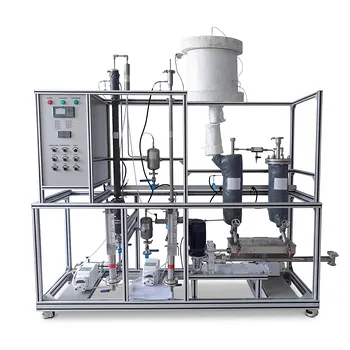
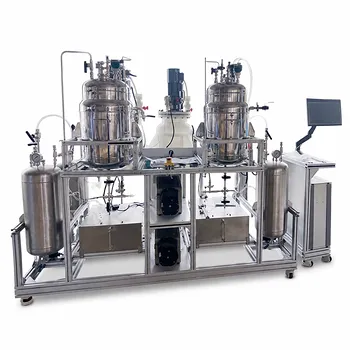
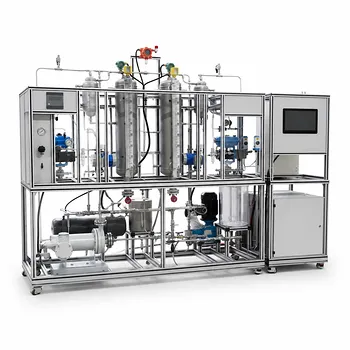
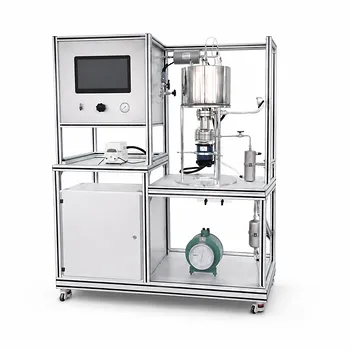
Dark fermentation is the biological route to hydrogen—where anaerobic bacteria break down organic feedstocks in the absence of light, releasing hydrogen gas. To study this process at pilot scale, the plant must first and foremost eliminate oxygen and light, as both can shut down the microbial pathways that produce hydrogen. Beyond this environmental foundation, the facility needs tight, automated control over temperature, pH, and agitation to keep the specific bacterial culture within its narrow productive window, and it must safely collect, quantify, and analyze the generated hydrogen using gas‑tight systems and analytical instruments. These are not optional add‑ons; they are the three pillars that turn a generic fermenter into a reliable dark‑fermentation research platform.
The true challenge of a dark‑fermentation pilot plant is not just growing microbes—it is holding every environmental variable steady while precisely capturing a flammable, low‑density gas. Success demands an integrated design where gas‑tight architecture, parameter control, and analytical safety are engineered together from the start.
Engineering the Missing Environment: Anaerobic and Dark Conditions
Dark fermentation relies on obligate anaerobes whose hydrogen‑producing enzymes (hydrogenases) are irreversibly poisoned by molecular oxygen. Light, meanwhile, invites phototrophic microorganisms that compete for substrates or shift the metabolic balance away from hydrogen production. A suitable pilot plant must therefore provide both oxygen‑free and light‑free conditions as a single, non‑negotiable baseline.
The Gas‑Tight Imperative
The bioreactor vessel and all ancillaries—ports, seals, valves, and sampling lines—must be designed for near‑zero oxygen ingress. This typically means double‑O‑ring flanges, welded connections where possible, and a permanent positive pressure of an inert gas such as nitrogen or carbon dioxide. An integrated gas‑mixing manifold allows researchers to purge the headspace and the liquid medium before inoculation, then maintain a consistent blanket of inert gas throughout the fermentation.
Why Darkness Matters
Opaque vessel walls or a dedicated light‑proof enclosure are required to eliminate phototrophic activity. This is especially important when working with real waste feedstocks that may carry a mixed microbial consortium. Even brief exposure to light can trigger algal growth or activate photo‑heterotrophs, confounding the hydrogen yield data. Simple stainless‑steel construction often suffices, but any sight‑glasses should be fully shrouded.
The Metabolic Levers: Tight Control of Temperature, pH, and Agitation
Dark‑fermentative bacteria operate within narrow niches. The pilot plant must transform the bioreactor into a precisely controlled environment where temperature, pH, and mixing can be set, held, and adjusted on demand. This level of control is what turns an observation exercise into a systematic investigation.
Temperature Jackets and Automated Heat Management
Microbial growth kinetics follow an Arrhenius‑type relationship up to an optimal temperature, beyond which cell death accelerates. Whether studying mesophilic (Clostridium butyricum) or thermophilic (Thermoanaerobacterium spp.) strains, the reactor must have a fully automated temperature jacket or internal heating/cooling coils linked to a PID controller. The system should be able to run isothermal experiments for weeks and, ideally, execute thermal ramp protocols to pinpoint the strain’s optimal growth rate.
pH Dosing: Fighting the Acid Build‑Up
Hydrogen production in dark fermentation always comes with a side‑stream of organic acids—acetate, butyrate, lactate. This continuous acidification can crash the culture’s pH within hours. A dedicated pH‑dosing module with peristaltic pumps and a sterilizable pH probe is therefore essential. It must be able to add alkali (e.g., NaOH or KOH) under automatic feedback to maintain a setpoint, commonly between pH 5.0 and 6.5 depending on the inoculum. The ability to record the volume of base consumed also gives a real‑time proxy for acid production rates.
Agitation That Respects the Biology
Mixing is required to suspend the organic solids, ensure uniform temperature, and release the evolved hydrogen from the liquid phase. However, many dark‑fermentative anaerobes are sensitive to shear. A pilot plant should therefore feature variable‑speed, low‑shear impellers (such as pitched‑blade or marine‑propeller designs) and allow researchers to study the trade‑off between mass transfer and cell viability. The motor and shaft seal must be gas‑tight, typically achieved with a magnetic drive to eliminate rotating seals that can leak oxygen.
The Hydrogen Fate: Safe Collection, Measurement, and Analysis
Hydrogen is a light, highly flammable gas with low solubility. Every aspect of its handling in a pilot plant must address both safety and analytical accuracy. The aim is not just to see bubbles, but to quantify production rates and gas composition in real time.
Gas‑Tight Collection and Headspace Management
The reactor’s headspace must connect to a gas‑tight collection line that prevents air back‑diffusion and equalizes pressure. This often employs a water‑displacement column filled with an acidified brine solution to avoid CO₂ dissolution, or a gas bag in a vacuum‑shielded vessel. More advanced systems use thermal mass‑flow meters to continuously log the total biogas flow before it enters a sampling loop.
From Gas Chromatography to On‑Line Sensors
For accurate quantification of hydrogen, a gas chromatograph (GC) with a thermal conductivity detector is the gold standard and should be plumbed directly to the reactor’s sample line. For higher time resolution, on‑line sensors such as thermal conductivity‑based hydrogen analyzers or micro‑GC units can be integrated. The design must include a sample conditioning system to remove moisture and particulates that could foul the detectors.
Safety Architecture for a Flammable Gas
Hydrogen’s wide flammability range (4–75% in air) demands redundant safety measures. The pilot‑plant enclosure requires forced ventilation, hydrogen‑specific gas detectors, and intrinsically safe electronics. All exhaust lines should vent to an outdoor safe location, and the system should trigger automatic shutdown and nitrogen purging if the hydrogen concentration nears the lower explosive limit.
Understanding the Trade‑offs: Realism vs. Control
Building a pilot plant with every possible feature can lead to an over‑engineered, inflexible, and costly system that obscures the very biology you want to understand. A thoughtful design acknowledges these tensions.
Cost and complexity scale rapidly with analytics. A research‑grade GC with continuous sampling is powerful, but it also introduces more points of failure and calibration overhead. A simpler manual gas‑sampling port may be perfectly adequate for low‑throughput, high‑precision studies.
Flexibility often competes with strict anaerobicity. Quick‑release clamps and reconfigurable tubing make the plant adaptable for other microbial processes, but every additional seal is a potential oxygen leak. If the plant will be used for both aerobic and anaerobic work, invest in a dual‑mode gas manifold and a rigorous leak‑test protocol, rather than compromising on seal quality.
Volatile fatty acid removal adds realism but shifts the focus. The accumulation of organic acids inhibits hydrogen production. Some pilot plants integrate in‑line extraction (e.g., membrane contactors) to boost yields, mimicking an industrial continuous process. While valuable for scale‑up studies, this adds hydraulic complexity and can mask the fundamental metabolic limits of the chosen strain. For early‑stage research, prioritize sterile sampling ports for off‑line HPLC analysis over full‑scale downstream processing.
Making the Right Choice for Your Research Goal
The configuration of your dark‑fermentation pilot plant should match the specific questions you are asking and the stage of your investigation.
-
If your primary focus is pure‑culture metabolic studies: Prioritize a gas‑tight, magnetically stirred vessel with a light‑proof jacket, a high‑accuracy pH dosing system, and a temperature bath that maintains ±0.1 °C. Use a gas bag for collection and periodic GC injection for precise yield determination.
-
If your primary focus is real‑world feedstock evaluation: Choose a reactor with robust, low‑shear mechanical agitation that can handle high solids loading without clogging. Integrate an on‑line gas flow meter and a continuous hydrogen sensor to monitor dynamic shifts in production rates as complex substrates are consumed.
-
If your primary focus is scale‑up or continuous hydrogen production: Include a gas‑tight, automated liquid inlet and outlet for continuous stirred‑tank reactor (CSTR) operation. Design the off‑gas system with a condenser and demister to protect sensors, and ensure the control architecture can cascade pH control with dilution rate.
In every case, the plant must function as a single, coherent system where environmental control, gas containment, and safety are inseparable. Start with these essentials, and every additional sensor or module you add will answer a precise question—rather than generate noise.
Summary Table:
| System Component | Key Design Feature | Critical Function |
|---|---|---|
| Anaerobic & Dark Environment | Double-O-ring seals, N2/CO2 purging, light-proof enclosures | Eliminates oxygen poisoning and prevents phototrophic microbial growth. |
| Parameter Control | PID temperature jackets, automated pH dosing, low-shear magnetic drives | Optimizes growth kinetics, mitigates acid build-up, and protects shear-sensitive microbes. |
| H2 Safety & Analytics | Gas-tight lines, inline GC/thermal sensors, forced ventilation | Enables accurate real-time gas quantification while mitigating explosion risks. |
Scale Up Your Bio-Hydrogen Research with LABPARK
At LABPARK, we design and manufacture high-performance Educational and Vocational Unit Operations Pilot Plants for chemical engineering, bioprocess & biotech, and environmental & water treatment applications.
We help universities, research institutes, and enterprises transition from benchtop concepts to robust pilot scale. Our custom-engineered systems ensure absolute anaerobic integrity, precise parameter automation, and strict explosion-proof safety architectures tailored to dark fermentation and green energy research.
Ready to elevate your process engineering capabilities? Contact LABPARK today to request a custom design proposal!
Related Products
- Bio-fermentation Ethanol Production Practical Training Unit Operations Pilot Plant
- Steam Methane Reforming Hydrogen Production and Purification Educational Pilot Plant
- Electrolytic Hydrogen Production Educational Unit Operations Pilot Plant
- 100L Continuous Loop Hydrogenation Educational Unit Operations Pilot Plant
- Water Electrolysis Hydrogen Production and Storage Educational Pilot Plant
People Also Ask
- Why Use PTFE & Hastelloy in Chemical Pilot Plants? Prevent Corrosion & Ensure Safety
- Why Compare Predicted and Experimental Excess Enthalpy? Key to Accurate Pilot Plant Scale-up
- Why is the chemical plant startup schedule crucial? De-risk scale-up with pilot plants.
- When to transition from PID to adaptive control in pilot plants? Key process indicators.
- Why must batch and fed-batch fermentation pilot plants be designed to accommodate changing rheological conditions?