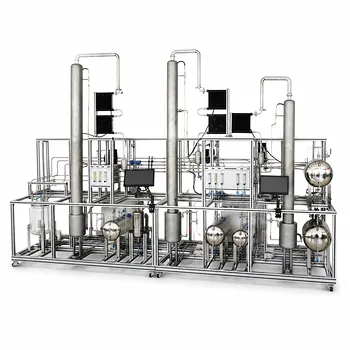
The non-negotiable core of designing an educational pilot plant for hazardous acids is a defense-in-depth strategy. This means the system must not only withstand the inherently corrosive and explosive nature of substances like chloric and perchloric acid, but it must also provide multiple, independent layers of protection to guarantee student safety while clearly demonstrating real-world industrial principles. The primary focus rests on absolute material compatibility with highly reactive oxidizers, the integration of precise thermal management for exothermic reactions, and comprehensive containment and scrubbing of toxic or corrosive off-gases like chlorine and hydrogen chloride.
Teaching commercial acid handling in an academic setting is only possible when the pilot plant is an immaculate model of industrial safety. The deep need is not just to show how a reaction works, but to instill a visceral, operational understanding of how extreme hazard is professionally managed, making material selection, thermal control, and effluent scrubbing the three pillars of design.
The Foundation of Defense: Material Selection and Containment
The very first design decision dictates everything else: the materials of construction must be chemically inert to the process fluids. A single wrong choice can lead to catastrophic failure, especially when teaching with energetic oxidizers.
The Critical Importance of Inert Wetted Materials
The primary reference correctly identifies that components for reactive oxidizers and corrosive gases must be made from materials like PTFE or borosilicate glass. This is not a suggestion; it is a mandate. Concentrated acids and strong oxidizers will aggressively attack standard metals and many polymers, potentially triggering violent decomposition or vessel rupture.
Why Perchloric Acid Defines the Design Boundary
Perchloric acid presents a unique, compounded danger. It is not only a strong acid but becomes an extraordinarily powerful oxidizer when hot and concentrated. Anhydrous perchloric acid can react explosively with organic materials.
Therefore, the pilot plant for perchloric acid chemistry must be constructed almost exclusively from borosilicate glass and PTFE. It must operate in a dedicated, specially designed fume hood with a water-wash system to prevent the accumulation of shock-sensitive perchlorate salts in the ductwork. This specific requirement exemplifies how a single chemical dictates the entire safety architecture.
Managing the Invisible Threats: Reactivity and Toxicity
Beyond material durability, the design must actively manage the energetic and toxic nature of the reactions. This is where students learn that chemical engineering is as much about controlling hazards as it is about optimizing yield.
Taming Runaway Exothermic Reactions
Acid reactions, dilutions, and neutralizations are frequently highly exothermic. The primary reference’s call for precise temperature controls and pressure relief systems is the cornerstone of safe operation. The design must include immediate, automated responses to temperature deviations.
- Active Cooling: Jacketed reactors with precise temperature control loops are essential to absorb generated heat.
- Passive Safety: A rupture disc or pressure relief valve, sized for a worst-case scenario, must be an integral part of any closed pressure-bearing system. This directly aligns with the principles of industrial standards like NFPA 68 for deflagration venting.
- Automated Interlocks: The system must automatically shut down reagent feeds or activate emergency cooling if temperature or pressure thresholds are exceeded. This is a key pedagogical point for industrial best practice.
Building a Layers-of-Protection System from the Ground Up
The supplementary reference on flammable solvents describes a layered safety philosophy that applies perfectly here, even for non-flammable but highly toxic acids. The design should integrate these features natively:
- Primary Containment: Use welded or high-integrity PTFE-sealed connections instead of flanged joints to eliminate fugitive emissions at the source.
- Localized Capture: Every potential leak point—pump seals, valve stems, sample ports—must be within an active localized ventilation hood.
- Active Monitoring: Fixed gas detection sensors for chlorine and hydrogen, connected to a central alarm and automatic shutdown system, are non-negotiable.
- Open-Frame Structure: The main pilot plant structure should be an open frame, preventing any toxic or heavier-than-air vapor from accumulating in a confined workplace.
Completing the Industrial Loop: Effluent Handling and By-Product Management
A pilot plant is incomplete if it merely contains the reaction. To teach commercial production, the design must fully manage all outputs, treating them with the same rigor found in a full-scale facility.
The Absolute Requirement for Off-Gas Scrubbing
The handling of toxic off-gases like chlorine or hydrogen chloride is a core aspect of industrial acid production. The primary reference correctly notes the integration of gas scrubbing units. A caustic scrubber is the standard solution for neutralizing these acidic gases, enabling students to study mass balance and environmental compliance as part of the reaction process.
Handling Two-Phase Flow and Emergency Venting
Any discharge system within the pilot plant must embody real-world engineering practices. If the process stream can contain liquids, the design must include a knockout drum before the vent or scrubber. This separates entrained liquid droplets, protecting the scrubber and ensuring the vented gas is in the correct physical state for safe dispersion or treatment.
The final emergency vent line itself must be routed to a safe, dedicated location—ideally integrated into the scrubber system or an isolated outdoor stack—to prevent any possible release into the teaching lab.
Understanding the Common Pitfalls
The most severe accidents in pilot plants often stem not from a process reaction, but from overlooked secondary hazards or design complacency. Trust is built by openly discussing these failure points.
- The Perchlorate Salt Accumulation Trap: Students must be taught that rinsing with water after every perchloric acid experiment is not just good practice—it prevents the formation of potentially explosive crystalline salts in joints and crevices. The pilot plant must be designed for complete drainability and ease of flushing.
- Material Compatibility in Ancillary Components: The focus on wetted parts is critical, but designers often forget secondary items. A gasket, an O-ring in a sight glass, or a component inside a valve that is rated for “general” chemical use may fail violently when exposed to a strong oxidizer or chlorinated solvent. Every component in the containment envelope must be verified against the specific chemistry.
- Inadequate Ventilation for Spills: A localized hood captures planned process leaks. The room’s general ventilation must be sufficient to handle a major accidental release from a ruptured hose or broken glass vessel without endangering the entire lab.
Designing for the Educational Mission
The ultimate success of the pilot plant is measured not just in its safety record, but in the depth of learning it enables. The design must balance safety with pedagogical visibility.
- If your primary focus is demonstrating fundamental reaction kinetics: Choose a design dominated by borosilicate glass. This maximizes visibility, allowing students to directly observe phase changes, color evolution, and gas-liquid mass transfer, which are invaluable for building intuition.
- If your primary focus is on industrial process control and automation: Prioritize opaque, maintenance-friendly PTFE-lined components integrated with a modern distributed control system (DCS). This shifts the learning objective from direct visual observation to interpreting data, operating automated safety interlocks, and managing a process via a screen—a direct reflection of modern plant operations.
- If your primary focus is on integrated plant economics and environmental compliance: Design the most complete system, incorporating the full product separation train, recycling loops, and an instrumented caustic scrubber. This allows students to calculate yield losses, track consumable scrubber media costs, and perform a rigorous techno-economic analysis.
A brilliantly designed educational pilot plant for hazardous chemicals does more than just run a reaction; it is a physics-based textbook. Its very architecture—from the material of a valve to the logic of a shutdown interlock—teaches the foundational principles of safer industrial chemistry.
Summary Table:
| Design Aspect | Key Considerations | Recommended Solutions |
|---|---|---|
| Materials | Corrosion & chemical inertness | PTFE, Borosilicate glass |
| Thermal Control | Runaway exotherms, pressure spikes | Active cooling, rupture discs, automated interlocks |
| Containment | Leaks and toxic vapors | Localized ventilation, gas detectors, open-frame design |
| Effluents | Toxic off-gases (Cl2, HCl) | Caustic scrubbers, liquid knockout drums |
Bring Industrial Safety to Your Chemical Engineering Lab
Ensure the highest safety standards in your classroom and research facility. LABPARK provides state-of-the-art Educational and Vocational Unit Operations Pilot Plants in chemical engineering, bioprocess & biotech, and environmental & water treatment. Designed specifically for universities, research institutes, and enterprises, our pilot plants deliver robust safety features and unparalleled pedagogical value.
Ready to design a safe, industry-grade learning environment? Contact LABPARK today to discuss your custom pilot plant needs.
Related Products
- Methane Cracking Educational Unit Operations Pilot Plant
- Multi-Functional Special Distillation Educational Pilot Plant
- Fixed-Bed Chemical Reaction and Gas Dust Tar Removal Unit Operations Pilot Plant
- Multi-Reactor Educational Pilot Plant for Reaction Engineering Unit Operations
- Carbon Dioxide Hydrogen Methanol Synthesis Educational Unit Operations Pilot Plant
People Also Ask
- How do ethane vs naphtha cracking influence teaching pilot plant analytical configurations? Key Design Guide
- How can flow-NMR be integrated with pilot plant reactors to monitor kinetics? A Complete Guide
- How do cracking temperature and residence time affect olefin yield? Pilot Plant Guide
- How are utility consumption rates integrated into chemical pilot plant economic evaluations?
- How should OSBL investments be estimated? Key Steps to Avoid Budget Overruns in Pilot Plant Projects