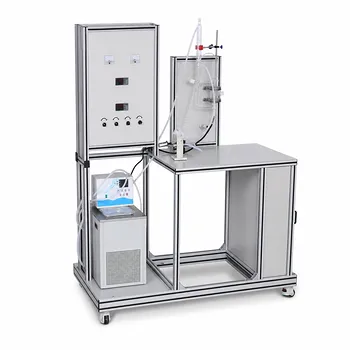
The critical parameters hinge on a two-column configuration where the first column strips HCl at a specific feed point for high recovery, and the second column uses high pressure and numerous stages to purify vinyl chloride.
The first column must introduce the reactant feed at its center to prevent hydrodynamic instability, targeting an 88% mole fraction recovery of HCl. The second, high-pressure column then requires approximately 20 stages and an operating pressure of around 10 atm to achieve 92-93% pure vinyl chloride. These specific setpoints allow researchers to map the direct relationship between pressure, stage count, and the purity of volatile, hazardous organic compounds.
The separation of hydrogen chloride and vinyl chloride in a pilot plant is not just a distillation problem—it is a pressure management and material science challenge. The defining insight is that a high-pressure second column (around 10 atm) is not just a variable but a strategic necessity to condense vinyl chloride efficiently with standard cooling water, while a meticulously placed feed in the first column prevents the flooding that would make that downstream purity impossible.
Architecting the First Column for HCl Recovery
Before vinyl chloride can be purified, the corrosive hydrogen chloride must be stripped efficiently. The design of this first column is less about achieving ultra-high purity and more about preparing the feed for the downstream separation while maintaining stable hydraulics.
The Criticality of the Center Feed Location
Introducing the reactant stream at the center of the first column is a critical operational parameter to avoid flooding and leakage. A feed point that is too low or too high disrupts the vapor-liquid equilibrium profile, creating localized hydraulic loads that exceed the column’s capacity. This central location provides sufficient rectifying and stripping sections below and above the feed to stabilize the separation immediately.
Targeting an 88% HCl Recovery Rate
The primary reference sets a specific performance benchmark: an 88% mole fraction recovery of HCl. Accepting this recovery rate is a deliberate design choice because pushing for near-total removal in a single column often requires an impractically high reflux ratio or column height. The remaining HCl in the bottoms stream is an accepted impurity that will be handled by the second column’s configuration, balancing overall system efficiency with equipment size and energy use.
Engineering the High-Pressure Vinyl Chloride Column
The separation of vinyl chloride from the residual mixture is where pressure becomes the defining operational parameter. The reference to 20 stages at 10 atm is not arbitrary; it is a solution to the challenge of condensing a low-boiling-point monomer.
Why 10 atm Pressure Is a Strategic Necessity
Vinyl chloride has a boiling point of approximately -13°C at atmospheric pressure. To condense it using standard, cost-effective cooling water (rather than expensive cryogenic refrigeration), the system pressure must be elevated. Operating the second column at 10 atm raises the saturation temperature of vinyl chloride significantly, allowing a conventional condenser to create a liquid reflux stream. Without this elevated pressure, efficient rectification and high-purity recovery in a pilot plant environment are practically impossible.
The Role of the 20-Stage Configuration
Achieving a vinyl chloride purity of 92% to 93% requires a specific level of separation work. The 20-stage configuration, in a pilot-scale setting, provides the necessary time and surface area for the vapor and liquid phases to reach equilibrium repeatedly. Each stage acts as a small purification step, and 20 stages at this pressure represent the tested configuration that delivers the target efficiency. A lower stage count would fail to achieve the required purity, while a much higher count would increase capital cost and pressure drop without proportionally beneficial gains.
Understanding Column Efficiency and HETP
The 20-stage specification connects directly to a column’s physical height through the Height Equivalent to a Theoretical Plate (HETP) . A smaller HETP indicates a higher separation efficiency per unit of packed bed height. In this pilot plant, selecting a packing material with a low, well-characterized HETP is critical to ensuring that the theoretical 20 stages can be physically realized in a compact, practical tower height without excessive pressure drop that could cause hydrocarbon loss.
Mastering Key Operational Levers and Principles
Beyond the physical configuration, dynamic control over the system’s internal flows governs whether the column meets its design targets. The most powerful of these is the reflux ratio.
The Purity vs. Throughput Trade-off of the Reflux Ratio
Adjusting the reflux ratio is the operator’s primary tool for fine-tuning performance. A higher reflux ratio returns more condensed liquid to the top of the column, improving separation purity by increasing liquid-vapor contact. However, this comes at a direct cost: it reduces product yield per unit time and increases energy consumption in the reboiler. A ratio that is too low compromises separation efficiency, causing contaminants to exit with the product. The art of operation is finding the minimal ratio that consistently achieves the 92-93% vinyl chloride specification.
Monitoring Hydrodynamic Stability
The high-pressure environment of the second column makes it susceptible to performance-limiting physical phenomena. Entrainment, where liquid droplets are carried up the column by high-velocity vapor, can drastically reduce stage efficiency. Conversely, weeping, where liquid drains through tray perforations, starves the downcomers and disrupts stage mixing. A pilot plant must be instrumented with differential pressure sensors to detect the onset of these conditions that deviate from stable, design-intent hydraulics.
Understanding the Trade-offs and Safety Imperatives
A pilot plant separating HCl and vinyl chloride exists at the intersection of thermal separation science and extreme chemical hazard management. The design parameters are shaped as much by safety as by chemistry.
The Uncompromising Need for Stainless Steel
Material selection is a non-negotiable parameter. Hydrogen chloride in the presence of moisture forms highly corrosive hydrochloric acid, while vinyl chloride is a reactive monomer. For the column shell, trays, packing, and reboiler, industrial-grade stainless steel (Grade 304 or 316) is the standard. This ensures mechanical strength under the 10 atm pressure, prevents chemical degradation and leakage, and provides the thermal stability needed for a long, safe operational life, all while giving researchers experience with industry-standard equipment.
The Hazard Profile: Combustibility and Toxicity
Vinyl chloride is a highly flammable, carcinogenic gas. The entire pilot plant’s design integrity—the flanged connections, valve packings, and pressure-relief systems—must be specified to prevent any release into the laboratory. The operational protocol must avoid any skin contact or inhalation, requiring closed-loop sampling and continuous area monitoring. The structural integrity of the tall pressure vessel must also be calculated not just for internal pressure, but for stability against wind or seismic loading, which often dictates a thicker column wall than the 10 atm pressure alone would require.
Making the Right Choice for Your Pilot Plant Goal
Defining your primary objective will determine which parameters deserve your most intense focus. Use the following guide to prioritize your design and operation efforts:
- If your primary focus is maximum purity of vinyl chloride: Prioritize operating the second column at the full 10 atm pressure and fine-tune the reflux ratio upward. You will sacrifice throughput and increase energy use, but this is the precise path to achieving or exceeding the 93% purity benchmark.
- If your primary focus is instrumented learning and hydrodynamic study: Select high-quality structured packing with a well-documented HETP and equip the column with multiple differential pressure transmitters. Focus your experiments on mapping the flooding and weeping points as functions of the vapor load, not just on reaching the target purity.
- If your primary focus is operational safety and system longevity: Do not compromise on specifying 316 stainless steel for all HCl-contact parts and ensure the condenser design at 10 atm leaves a substantial safety margin for the maximum allowable working pressure (MAWP).
- If your primary focus is scaling up a process concept: Document the precise relationship you discover between the reflux ratio and the HETP under the 10 atm condition. This empirical mass-transfer data is the most valuable information for translating your pilot results into a full-scale industrial column design.
This separation is not merely a unit operation; it is a controlled sequence where high pressure solves a condensation crisis, and precise staging transforms a hazardous mixture into two high-value, recoverable streams.
Summary Table:
| Parameter / Feature | Column 1 (HCl Stripping) | Column 2 (Vinyl Chloride Purification) |
|---|---|---|
| Feed Location | Center (prevents flooding) | Downstream from Column 1 bottoms |
| Operating Pressure | Atmospheric / Low | ~10 atm (allows water condensation) |
| Stage Count / HETP | Hydraulic stability optimized | 20 stages (purity optimized) |
| Target Performance | 88% HCl mole fraction recovery | 92% - 93% Vinyl Chloride purity |
| Material Selection | Stainless Steel (304 or 316) | Stainless Steel (304 or 316) |
Bring Industrial-Scale Distillation Insights to Your Lab
Ready to scale your chemical engineering research or vocational training? LABPARK provides state-of-the-art Educational and Vocational Unit Operations Pilot Plants in chemical engineering, bioprocess & biotech, and environmental & water treatment. Designed for universities, research institutes, and enterprises, our safe and highly instrumented systems help you master complex separation processes.
Contact LABPARK today to customize your pilot plant solutions!
Related Products
- Continuous Sieve-Plate Distillation Pilot Plant for Unit Operations Laboratory Education
- Multi-Modal Distillation Unit Operations Training Pilot Plant
- Dual-Mode Rectification Pilot Plant for Practical Training Unit Operations
- Multi-Functional Special Distillation Educational Pilot Plant
- Green Anhydrous Ethanol Purification Extractive Distillation Unit Operations Training Pilot Plant
People Also Ask
- How do distillation pilot plants validate VLE data? Achieve reliable solvent separation scale-up.
- Why is experimental validation on a distillation unit operations pilot plant essential? Reduce azeotropic scale-up risk
- Why is condensate subcooling critical in pilot plants? Expert Design & Control Guide
- What are the primary reflux ratio control strategies? Master Distillation Unit Operations
- How to select the right activity coefficient model (Wilson, NRTL, UNIQUAC) for distillation pilot plants?