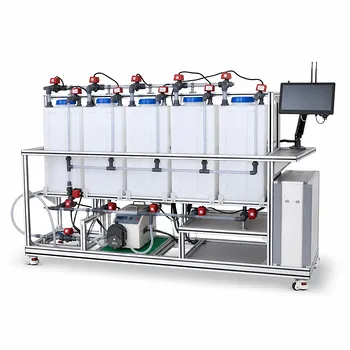
To study industrial electroplating and metal refining in a pilot plant, you cannot afford to treat process control as an afterthought—the quality of the metal deposit is a direct fingerprint of how well you manage five foundational variables. A pilot plant built for these unit operations must integrate real-time control and monitoring of electrolyte temperature, current density, acidity (pH), electrolyte concentration, and the overall rate of deposition. When any one of these drifts outside its optimal window, the result is not subtle: adhesion fails, the coating becomes powdery or crumbly, and the scientific data you capture becomes meaningless.
The core engineering challenge is that a pilot plant must turn laboratory-scale electrochemistry into a controllable, industrial-relevant process. The five variables—temperature, current density, pH, concentration, and deposition rate—form an interconnected system. Neglecting any one parameter will trigger a cascade of poor morphology, from flaking to nodular growth, that obscures the underlying unit operation you set out to study.
The Five Pillars of Electroplating Control
Each variable exerts a distinct influence on the electrochemical mechanism that deposits metal ions onto a cathode. Integrating them into a pilot plant is not simply about bolting on sensors; it’s about designing control loops that respect both electrochemistry and process dynamics.
Electrolyte Temperature
Temperature governs the mobility of ions and the kinetics of charge transfer at the electrode surface. In copper refining or silver electroplating, a consistent bath temperature reduces solution resistance and promotes a fine-grained, adherent deposit. If temperature drops too low, deposition becomes sluggish and the deposit tends to be dark and spongy. If it rises excessively, crystal growth accelerates uncontrollably, often producing a coarse, weakly bonded layer.
In practice, a pilot plant must include immersion heaters or shell-and-tube heat exchangers with feedback from a thermocouple or RTD. The control loop should throttle the heating utility—typically steam or hot water—following the rule that temperature is best controlled by adjusting the flow of the utility stream, not by manipulating the process liquid directly. This avoids thermal shock to the electrolyte and maintains stable bath conditions.
Current Density
Current density ($A/m^2$) is the primary driver of deposition rate and morphology. It directly dictates how quickly metal ions are reduced at the cathode. A pilot plant must be able to hold a precise setpoint because even small deviations shift the cathode potential and can trigger side reactions like hydrogen evolution, which pit the deposit and waste electrical energy.
Integrating this control requires a DC power supply with current-regulation capability and an inline shunt or Hall-effect sensor for continuous feedback. For educational and research pilots, a potentiostat with galvanostatic mode is ideal, as it also allows students to explore polarization curves. Always include an interlock that ramps current down if voltage exceeds a safe threshold, protecting both the electrodes and the data integrity.
Acidity (pH)
The pH of the electrolyte is the gatekeeper of metal ion solubility. In copper electrorefining, for example, the bath is acidified with sulfuric acid to prevent the formation of copper hydroxide or oxide precipitates that would codeposit as sludge. Even when the bulk solution appears clear, a local pH rise near the cathode can nucleate non-adherent particles that ruin a substrate.
To integrate pH control, the pilot plant needs an inline pH probe immersed directly in the recirculating electrolyte or in a fast-flow bypass loop. A dosing pump adds acid (or base, if needed) on demand, but the injection point must be placed far enough upstream of the probe to ensure complete mixing. Because pH dynamics in high-conductivity electrolytes are fast, a simple on-off dosing scheme often works, but a proportional-integral (PI) controller using a small metering pump yields tighter control without overshoot.
Electrolyte Concentration
The concentration of metal ions—copper sulfate in copper refining, silver nitrate in silver plating—dictates the availability of the species you want to deposit. As the process runs, the concentration depletes at the cathode and must be replenished. If concentration falls too low, the limiting current density drops, forcing the reaction into a mass-transport-controlled regime that produces powdery, dendritic deposits.
Monitoring and control can be achieved in several ways. Research-grade pilots may use ion-selective electrodes or UV-Vis spectrophotometers for real-time measurement. In many industrial-relevant pilots, however, concentration is controlled indirectly by maintaining a steady feed of fresh electrolyte and a corresponding bleed of spent solution, based on a stoichiometric mass balance. The overall material balance of the plant is typically set by a flow regulator on the main feed stream, ensuring that the rate of metal-ion addition matches the deposition rate.
Rate of Deposition
Deposition rate is a function of current density, but it deserves its own control focus because it ties directly to process time and economic throughput. In a pilot plant, this variable is often monitored via the change in cathode mass over time or, more practically, by integrating the total charge passed (Faraday’s law). However, simply pushing more current to increase rate risks a transition from laminar to turbulent growth, yielding a non-adherent, flaky deposit.
The pilot plant must integrate a timer-based or charge-based cutoff that stops the plating cycle after a defined ampere-hour target is reached. This prevents over-deposition and ensures that every test run operates under a comparable total coulombic load, which is essential for reproducible research. Coupling this with a load cell or thickness monitor provides immediate feedback on the relationship between current input and physical outcome.
Translating Variables into a Pilot Plant Control System
Ensuring these five parameters are monitored is not enough; the control architecture must follow fundamental chemical engineering principles so that the plant behaves predictably and safely.
Selecting the Right Sensors and Actuators
A well-designed electroplating pilot plant relies on online analytical instruments rather than periodic grab samples. Beyond standard thermocouples and pH probes, consider mass flow meters for electrolyte circulation, digital multimeters for precise cell potential and current, and concentration sensors (e.g., conductivity meters calibrated to ion concentration) for continuous bath monitoring. These devices feed data to a central data acquisition system, allowing researchers to track transient behaviors like electrode passivation or metal-ion depletion.
Designing Control Loops that Don’t Fight Each Other
One of the most common pitfalls in pilot plant design is violating the single control valve rule. On any given process stream—such as the electrolyte recirculation line—install only one automatic control valve. If two controllers try to manipulate two valves on the same line, their loops will interact and induce cycling. For liquid level control in electrolyte sumps, position the control valve on the discharge side of the pump, never on the suction side, to maintain stable net positive suction head. This simple rule prevents cavitation and erratic flow.
The overall plant material balance is anchored by a flow ratio controller on the fresh electrolyte feed. That baseline flow sets the throughput, and other loops—temperature, pH, level—trim their respective utilities around that steady base. This hierarchy ensures that the pilot plant does not drift into an uncontrollable state during long-duration deposition experiments.
Safeguarding Against Gas Hazards
While electroplating and metal refining often proceed without significant gas generation, certain processes (like copper refining with insoluble anodes) can produce oxygen. If the process ever evolves a separate gas phase, an interface level controller becomes mandatory to maintain the gas-liquid boundary in any gas-liquid separator. Additionally, mimicking industrial brines’ safety logic, any cell compartment where hydrogen or other flammable gas could accumulate must maintain a slight positive pressure or a controlled negative pressure to prevent external air ingress and eliminate explosive mixtures. Even if your specific pilot plant does not produce hydrogen, teaching this differential-pressure principle is a core part of vocational chemical engineering training.
Understanding the Trade-offs and Pitfalls
No control system is perfect, and every integration choice comes with compromises that you must weigh against the pilot plant’s educational or research mission.
The Risk of Over-Instrumentation
Layering on too many sensors can create a diagnostic paradox. Multiple conductivity probes, for example, can interact electrically, and excessive in-line instrumentation can increase the residence time of electrolyte in stagnant measurement chambers, distorting the very concentration you are trying to measure. Adhere to the principle that you should instrument only what you can actively control. A pH sensor without an acid dosing pump is simply a data point; a temperature probe without a heat exchanger is an observation, not a control loop.
Deposition Rate vs. Deposit Quality
Pushing current density to maximize deposition rate for “high-throughput” experiments almost inevitably sacrifices deposit quality. Above the limiting current density, hydrogen co-deposition bloats the metal with micro-voids, and the plating becomes burnt or tree-like. A pilot plant designed for quality research must include a current density limiter and, ideally, a coulometer so that researchers can intentionally explore the boundary between acceptable and unacceptable deposits under controlled conditions, rather than drifting there accidentally.
Educational Fidelity vs. Industrial Complexity
A pilot plant used for undergraduate unit operations labs does not need a full fledged DCS with cascaded PID loops. However, it must demonstrate the essential cause-and-effect relationships. For vocational training, manual bypass valves and local controllers with large analog displays teach the importance of each variable more effectively than a fully automated, black-box system. For advanced research, the same plant can be upgraded with digital bus communication to capture high-frequency data for kinetic modeling. Design the physical infrastructure to be modular, so that a simple temperature control loop can later be integrated into a multivariable model-predictive framework without tearing out pipework.
Making the Right Choice for Your Pilot Plant
Your specific goals determine how you should prioritize and implement these five control variables.
- If your primary focus is vocational training: Emphasize visual indicators, local controllers, and intentional disturbance scenarios. Allow students to manually adjust a rheostat for current density while watching a voltmeter, so they feel the direct link between control action and process response.
- If your primary focus is fundamental research in kinetics or current efficiency: Invest in high-precision potentiostats, online Faraday efficiency calculations, and fast-response pH actuators. Every control variable must be logged at 1 Hz or faster to capture transient passivation events.
- If your primary focus is scale-up to industrial copper refining or silver electroplating: Integrate industrial PLCs with cascaded control for electrolyte temperature (utility flow control) and concentration (feed-forward ratio control based on deposited mass). Build in the single valve rule from day one to avoid hydraulic oscillations when the plant operates 24/7.
A pilot plant that faithfully integrates control over temperature, current density, pH, electrolyte concentration, and deposition rate transforms from a simple electrochemical cell into a true unit operations platform—one that reveals the engineering principles behind every shiny, adherent metal deposit.
Summary Table:
| Control Variable | Core Influence on Process | Recommended Control Method / Sensor |
|---|---|---|
| Electrolyte Temperature | Ion mobility, kinetics, deposit grain size | Immersion heaters/heat exchangers with RTD/thermocouple feedback |
| Current Density | Deposition rate and morphology (adhesion) | DC power supply with current regulation, inline shunt, or potentiostat |
| Acidity (pH) | Metal ion solubility, prevents sludge formation | Inline pH probe with PI-controlled acid/base dosing pumps |
| Electrolyte Concentration | Mass-transport limits, prevents powdery deposits | Feed-and-bleed flow regulators, UV-Vis, or calibrated conductivity meters |
| Deposition Rate | Process throughput and coulombic efficiency | Timer- or charge-based cutoff (coulometer) to prevent over-deposition |
Bring Industrial-Scale Precision to Your Lab
Are you looking to equip your institution with advanced chemical engineering systems? LABPARK provides state-of-the-art Educational and Vocational Unit Operations Pilot Plants in chemical engineering, bioprocess & biotech, and environmental & water treatment for universities, research institutes, and enterprises.
Our custom-engineered pilot plants feature robust, real-time control loops for temperature, pH, flow, and current density, ensuring your students and researchers work with industry-grade accuracy.
Contact LABPARK today to discuss your specific training or research requirements and request a customized solution!
Related Products
- Multi Pump Fluid Transport Process Piping Unit Operations Training Pilot Plant
- Natural Product Extraction Unit Operations Training Pilot Plant
- Multi-Modal Distillation Unit Operations Training Pilot Plant
- Multi-Reactor Educational Pilot Plant for Reaction Engineering Unit Operations
- Ethyl Acetate Synthesis Unit Operations Pilot Plant for Practical Training
People Also Ask
- Why distinguish Newtonian & non-Newtonian fluids in pilot plants? Prevent design errors.
- Why is the chemical plant startup schedule crucial? De-risk scale-up with pilot plants.
- When to transition from PID to adaptive control in pilot plants? Key process indicators.
- How do deviations in estimating latent heat impact pilot plant thermal systems? Avoid hardware mis-sizing.
- How to study gasification in pilot plants? Compare exit gas composition & efficiency