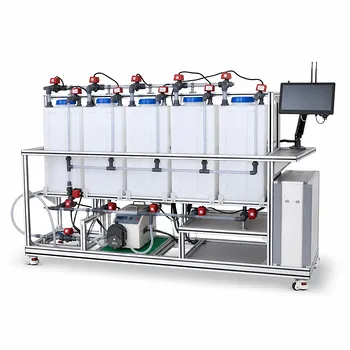
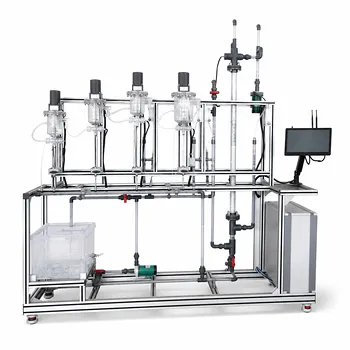
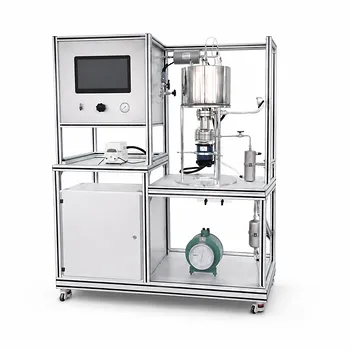
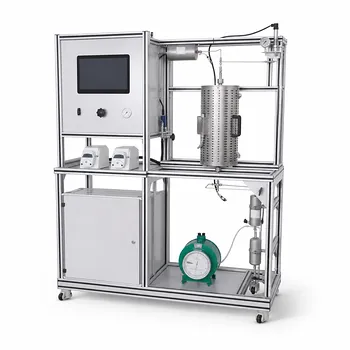
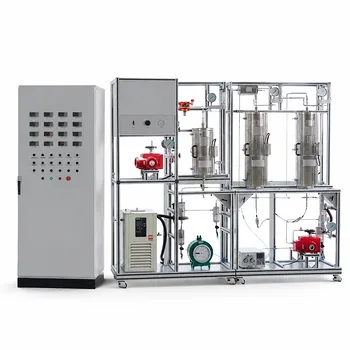
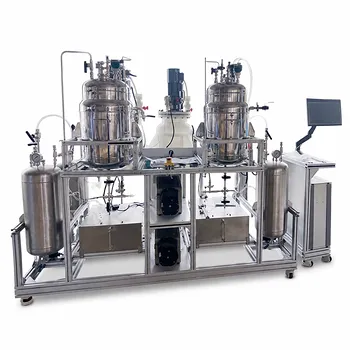
Here’s the stark reality: an electrochemical engineering pilot plant that doesn’t force students to confront mass transport, potential distribution, electrode kinetics, and thermodynamic equilibrium will produce engineers who can run a rig but can’t design a reactor. To effectively teach design and scale-up, the plant must make four inseparable phenomena directly measurable: the movement of ions (mass transfer via diffusion and migration), the spatial profile of the solution potential near electrodes, the activation overpotential driving the heterogeneous reaction, and the true thermodynamic cell voltage under shifting temperature, pressure, and concentration.
A teaching pilot plant is not a production machine; it is a diagnostic instrument. Its value lies not in making a product, but in revealing exactly why a reaction is slow, selective, or unstable—so that these root causes can be engineered out at scale.
The Four Pillars of Electrochemical Reactor Education
A pilot plant that obscures electrochemistry with only external measurements (total current, terminal voltage) teaches operations, not design. True reactor scale-up demands a causal understanding of four deeply coupled phenomena.
1. Mass Transfer (Diffusion and Migration Must Be Seen Separately)
In an electrochemical cell, reactants don’t just diffuse—they also migrate under the electric field. Scale-up catastrophes almost always begin with a misunderstanding of this transport.
At lab scale, a stir bar can mask a poor flow pattern. In a pilot plant, you must deliberately create and measure concentration gradients. You need sensors to track ion concentration near the electrode surface—not just bulk bath averages. When students see the limiting current plateau shift under different flow rates, they internalize why a scaled-up reactor dies if the pumps are sized for only the chemical reaction.
- Key measurement: Local current density and reactant concentration at the electrode boundary layer, using a rotating disc electrode or embedded micro-reference electrodes.
- Why it matters for scale-up: Commercial reactors live and die by the Sherwood number. Without pilot data on mass transfer coefficients, you’re guessing the electrode area needed for a target production rate.
2. Electric Potential Distribution (The Invisible Selectivity Knob)
The voltage you apply at the terminals is not what the reaction “feels.” The potential of the solution itself varies with distance from the electrode, and this potential distribution is the primary knob for product selectivity.
If a pilot plant only reports overall cell voltage, students miss the critical tool of using a Luggin capillary and a reference electrode to map the solution potential. They need to see that, at identical total applied volts, a poorly designed flow field can create local hot spots where a desired reduction becomes a wasteful hydrogen evolution.
- Key measurement: Spatial map of solution potential using a scanning reference electrode or a fixed probe array.
- Why it matters for scale-up: In a parallel-plate reactor, a non-uniform potential field means half the plate is making your product and the other half is making explosive gas. Pilot data teaches you to design the bipolar plates, not just the electrodes.
3. Electrode Kinetics (Surface Overpotential as the Real Driver)
The reaction doesn’t happen just because the thermodynamics allow it. It needs a surface overpotential—an extra energy push. That push is a measure of the catalyst’s true activity, independent of solution resistance.
A pilot plant must decouple this activation overpotential from the ohmic drop. This requires a potentiostat-capable setup that compensates for iR drop, allowing students to extract Tafel slopes and exchange current densities. When they scale up, they will know that you cannot just stack more cells; you must ensure each cell’s kinetic environment—temperature, surface state, local pH—remains identical.
- Key measurement: Current-interrupt or impedance spectroscopy data that isolates charge-transfer resistance.
- Why it matters for scale-up: If your pilot data says a 10% drop in overpotential doubles the side reaction, your larger reactor must control local overpotential with ten times the precision, or you’ll fail to meet purity specs.
4. Thermodynamic Equilibrium (The Moving Baseline)
Finally, students must measure and correct for the equilibrium cell potential as a function of concentration, temperature, and pressure. This potential is not a constant from a textbook; it changes dynamically with reactant depletion and heating.
Using the Nernst equation, you can predict the theoretical minimum voltage. But in a real pilot plant with flowing electrolyte, that equilibrium potential is a moving target. Students must learn to subtract this thermodynamic baseline from the applied voltage to see what’s left for kinetics and transport. Without this, an energy-balance calculation is a fantasy.
- Key measurement: Open-circuit voltage at multiple states of charge and temperature, using accurate concentration sensors (ion-selective electrodes, conductivity probes, or online titrators) to verify the Nernst relationship.
- Why it matters for scale-up: The heat generated in a larger stack shifts the Nernst voltage, which changes the effective overpotential, which changes selectivity—a feedback loop that must be modeled from pilot data, not assumed away.
The Measurement Gap: Why You Can’t Buy an Off-the-Shelf Solution
No single sensor gives you all four phenomena. A pilot plant that focuses only on flow meters and pressure gauges will produce data on hydraulics, not on electrochemistry. The hardest part is placing reference electrodes stably and in a way that doesn’t distort the current lines. A badly positioned probe tells you the potential of a disturbed field, not the true working environment.
Additionally, commercial potentiostats designed for coin cells struggle to handle the high currents of a pilot cell. You must integrate current-boosting hardware without creating oscillation or grounding errors. This often means building custom voltage-sensing protocols, which is itself a powerful teaching moment—but a real obstacle if the goal is merely “turnkey” operation.
A Practical Compromise: The Zinc Chloride Electrolysis Model
A teaching pilot plant does not need a complex organic synthesis. Using a classic model system like zinc chloride electrolysis with transparent cells, gas collection tubes, and in-line conductivity/temperature sensors lets students see redox products form while measuring all four phenomena. The chloride oxidation and zinc deposition are fast enough to show kinetic effects, yet safe enough to allow multiple probes. This lets the plant serve as a diagnostic testbed rather than a miniature production line.
Making the Right Choice for Your Educational Goal
Your instructional objective determines which measurement capabilities must be non-negotiable.
- If your primary focus is on deep electrochemical science: Insist on a three-electrode setup with a Luggin capillary, a working electrode of known geometry, and a potentiostat that can perform impedance spectroscopy. You are teaching the soil, not just the crop.
- If your primary focus is on industrial process reliability: Prioritize robust inline sensors (pH, conductivity, temperature) and flow control, with the ability to run long-term galvanostatic experiments. Use the data to build semi-empirical scale-up correlations, accepting that you won’t map every millivolt of the potential field.
- If your primary focus is on bridging both worlds: Invest in a modular flow cell where the same electrode assembly can be studied with a scanning reference probe and later run in continuous production mode. This teaches students that reactor design is the art of translating what you measure at a point into what you deliver in a volume.
Engineering instinct is not built from simulations alone. It is forged in the deliberate frustration of a pilot plant that won’t give you the right selectivity until you map the potential, slow the flow, and check the Nernst baseline—exactly as you will have to do in your first plant.
Summary Table:
| Electrochemical Phenomenon | Key Measurement Method | Impact on Reactor Scale-Up |
|---|---|---|
| Mass Transfer | Local current density & reactant conc. (RDE, micro-electrodes) | Determines required electrode area & mass transfer coeffs. |
| Potential Distribution | Spatial solution potential (Luggin capillary, reference probes) | Controls product selectivity; prevents local "hot spots" |
| Electrode Kinetics | Current-interrupt or impedance spectroscopy (decoupled iR drop) | Ensures precise control over reaction rate & purity specs |
| Thermodynamic Equilibrium | Open-circuit voltage at varying states of charge & temperature | Informs energy balances & thermal feedback loop models |
Bring Advanced Electrochemical Engineering to Your Lab
Ready to equip your students and researchers with the tools they need to master reactor design? LABPARK provides premium Educational and Vocational Unit Operations Pilot Plants in chemical engineering, bioprocess & biotech, and environmental & water treatment. Designed specifically for universities, research institutes, and enterprises, our modular systems bridge the gap between theory and industrial reality.
Contact LABPARK today to discuss your curriculum requirements and get a customized pilot plant solution!
Related Products
- Electrochemical Water Treatment Educational Unit Operations Pilot Plant
- Fixed-Bed Chemical Reaction and Gas Dust Tar Removal Unit Operations Pilot Plant
- Residence Time Distribution and Reactor Flow Characteristics Determination Educational Pilot Plant
- Tubular Reactor Flow Characteristics Determination Educational Unit Operations Pilot Plant
- Multi-Reactor Educational Pilot Plant for Reaction Engineering Unit Operations
People Also Ask
- What design features do educational electrochemical pilot plants utilize to manage gas liberation and water loss?
- How can unit operations pilot plants show lead-acid concentration vs state of charge? Real-time monitoring guide.
- How do educational electrochemical pilot plants scale up electrolysis? Master industrial engineering.
- How to Estimate Sulfate in Water Treatment Pilot Plant Deposits: Gravimetric Guide
- How can foaming be managed during steam generation experiments in water treatment unit operations pilot plants? Tips