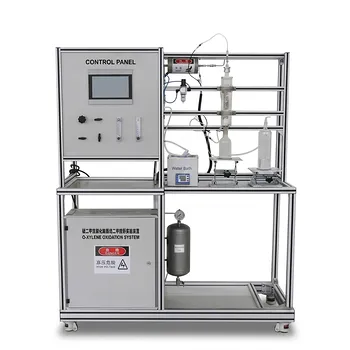
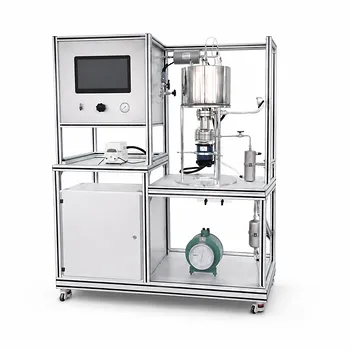
To validate mathematical models of fixed-bed reactor profiles, a pilot plant must function as a tightly integrated measurement platform—not merely a small-scale reactor. It requires online composition analysis to track conversion axially, precision mass flow control for defined inlet conditions, and a multi-point thermocouple array that maps the entire temperature profile along the catalyst bed.
A fixed-bed pilot plant for model validation generates the same axial and radial temperature and conversion profiles that simulations predict. By comparing real data against mathematical codes, students uncover where assumptions break down—whether in heat transfer coefficients, reaction kinetics, or fluid dynamics—and learn to refine their models based on physical evidence.
The Three Pillars of Profile Validation
The primary reference identifies three non-negotiable capabilities. Each targets a core variable that mathematical models of fixed-bed reactors aim to predict.
Online Composition Analysis
Models solve mass balances to yield concentration profiles along the reactor axis. A pilot plant must measure these concentrations in real time.
Gas chromatography (GC) or infrared (IR) gas analyzers placed at multiple axial points—or at the outlet—give students the conversion data they need. Without this, the mass balance side of the model remains entirely unvalidated.
Precision Flow Control
Mathematical models require a well-defined inlet velocity to compute residence time and axial dispersion. Mass flow controllers provide that precision.
By setting exact flow rates, students remove inlet uncertainty from the data set. This allows them to attribute any mismatch between measured and predicted conversion directly to kinetic or heat transfer assumptions, not to sloppy boundary conditions.
Multi-Point Temperature Mapping
The strongest coupling in a fixed-bed model is usually between temperature and reaction rate. A multi-point thermocouple system inserted along the catalyst bed captures the real axial and radial temperature profile.
This data exposes hot spots, radial gradients, and the true magnitude of heat dissipation. When students feed this profile back into their simulation, they can calculate the effective heat transfer coefficient and see how wall cooling or inlet temperature distributions deviate from idealized plug flow.
Why These Capabilities Matter for Model Validation
Having the right sensors is only half the story. The deeper need is to transform raw data into model scrutiny.
Closing the Loop Between Simulation and Reality
A fixed-bed model in MATLAB or COMSOL produces smooth, continuous profiles. The pilot plant returns discrete, noisy physical measurements.
By overlaying both, students face the gap firsthand. The online analyzer and thermocouple data become the empirical benchmark that forces a conversation: Is my kinetic rate expression wrong? Are my heat transfer boundary conditions unrealistic? The plant’s capabilities turn these into testable questions.
Exposing Hidden Assumptions
Educational reactor models often ignore axial dispersion, assume constant fluid properties, or treat the bed as a homogeneous continuum.
A well-instrumented plant reveals the consequences. A temperature profile that flattens unexpectedly in the downstream half might indicate heat loss through the wall—something a simple adiabatic model cannot reproduce. This teaches students that validation is not about matching a single number; it is about matching the shape of the entire profile.
Enabling Parameter Estimation
The same data set that validates a model can also tune it. By feeding experimental temperature and conversion profiles into a parameter estimation routine, students can back-calculate effective radial thermal conductivity or a wall heat transfer coefficient.
This turns the pilot plant into a physical “parameter fitting” tool, bridging the gap between textbook correlations (often derived from idealized systems) and the actual behavior of their catalyst packing.
Beyond the Sensors: Supporting Infrastructure
While the primary reference focuses on measurement, a few enabling systems make those measurements reliable and safe.
Integrated Data Acquisition
All sensors—thermocouples, GC, mass flow controllers—must be tied into a shared data acquisition and control platform. This allows students to capture synchronized data over time, see transient behavior during startup, and export data directly into simulation software for analysis.
Safety and Controlled Environment
Fixed-bed reactors often operate at elevated temperatures and pressures. The pilot plant must include over-temperature protection, pressure relief, and proper ventilation. A safe setup ensures students can focus on model validation without operational anxiety, while also learning the importance of process safety in reactor design.
Understanding the Trade-offs
A plant designed for model validation carries inherent limitations.
- Profile resolution vs. cost: More thermocouple points and multiple GC sampling lines increase capital cost and complexity. A fixed budget forces a choice between axial resolution and radial resolution.
- Probe interference: A multi-point thermocouple inserted into a small-diameter bed may disturb the packing or flow, altering the very profile it is supposed to measure. Students must learn to assess this systematic error.
- Model mismatch is not always plant failure: Real beds have wall effects, flow maldistribution, and catalyst deactivation that a simple 1D model may ignore. The plant’s job is to expose these, not to confirm the model exactly. Inexperienced users may misinterpret deviations as “wrong” experimental data.
- Operational skill barrier: High-fidelity data requires careful commissioning—calibrating GC, ensuring no leaks, stabilizing the bed. Without proper training, students may generate noise and blame the model.
Making the Right Choice for Your Educational Goal
A fixed-bed pilot plant’s specification should follow the learning objective, not the other way around.
- If your primary focus is teaching core reactor engineering concepts: Prioritize a simple axial thermocouple ladder and a reliable outlet GC. Students need to see the basic temperature and conversion relationship without overwhelming complexity.
- If your goal is advanced model validation and research: Invest in multi-point radial thermocouples, intermediate sampling ports, and fast online analyzers. The ability to map 2D temperature fields and intermediate conversion will allow rigorous testing of 2D heterogeneous models.
- If you are training future process engineers for industry: Emphasize robust mass flow control, data trending over long runs, and equipment that mirrors plant instrumentation. Students must learn to interpret gradual catalyst deactivation and heat loss exactly as they would in a real chemical plant.
A properly instrumented fixed-bed pilot plant does more than generate data—it teaches students that a mathematical model is a hypothesis, not a mirror, and that every assumption must be tested against the physical signals the bed itself provides.
Summary Table:
| Core Capability | Key Instrumentation | Role in Model Validation |
|---|---|---|
| Online Composition Analysis | Gas chromatography (GC) or IR gas analyzers | Tracks axial conversion to validate mass balance equations. |
| Precision Flow Control | Mass flow controllers (MFCs) | Establishes precise inlet velocity to remove boundary condition uncertainty. |
| Multi-Point Temperature Mapping | Thermocouple arrays along the catalyst bed | Maps thermal profiles to calculate heat transfer coefficients and detect hot spots. |
| Integrated Data Acquisition | Centralized DAQ software | Captures synchronized real-time data for easy export into simulation software. |
Bring Chemical Engineering Simulations to Life with LABPARK
Bridge the gap between mathematical models and physical reality. LABPARK provides state-of-the-art Educational and Vocational Unit Operations Pilot Plants in chemical engineering, bioprocess & biotech, and environmental & water treatment designed specifically for universities, research institutes, and enterprises.
Our custom-instrumented pilot plants empower your students and researchers to perform precise parameter estimation, validate complex kinetics, and master process safety.
Ready to upgrade your laboratory capabilities? Contact our application specialists today to discuss your custom project requirements!
Related Products
- Fixed-Bed Chemical Reaction and Gas Dust Tar Removal Unit Operations Pilot Plant
- Fixed Bed Gas Solid Catalytic Reaction Educational Pilot Plant
- Multi-Reactor Educational Pilot Plant for Reaction Engineering Unit Operations
- Educational Unit Operations Pilot Plant for Intraparticle Diffusion Effective Factor Measurement
- Ethylbenzene Dehydrogenation Educational Unit Operations Pilot Plant
People Also Ask
- When to transition from PID to adaptive control in pilot plants? Key process indicators.
- How do deviations in estimating latent heat impact pilot plant thermal systems? Avoid hardware mis-sizing.
- Why Compare Predicted and Experimental Excess Enthalpy? Key to Accurate Pilot Plant Scale-up
- How to study gasification in pilot plants? Compare exit gas composition & efficiency
- Why Use PTFE & Hastelloy in Chemical Pilot Plants? Prevent Corrosion & Ensure Safety