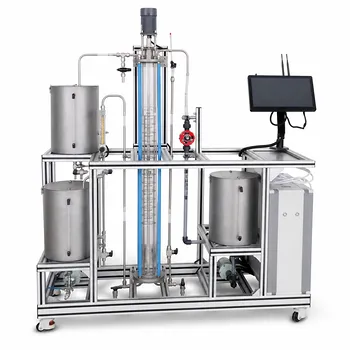
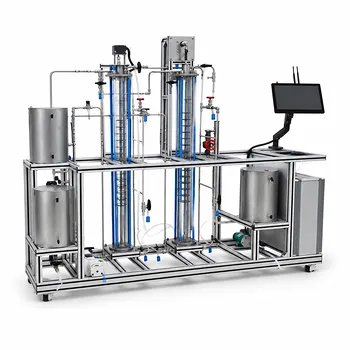
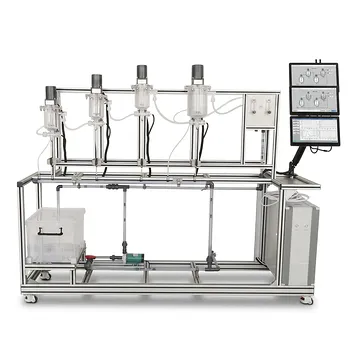
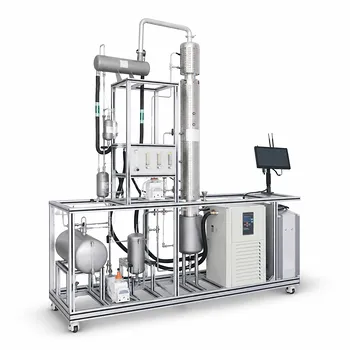
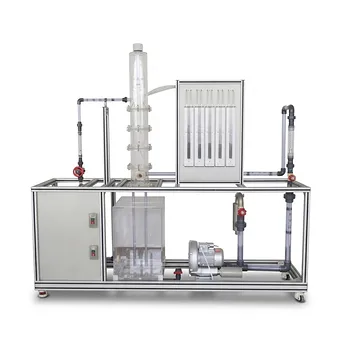
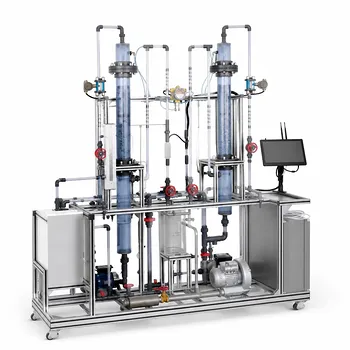
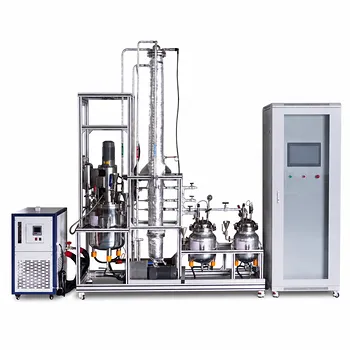
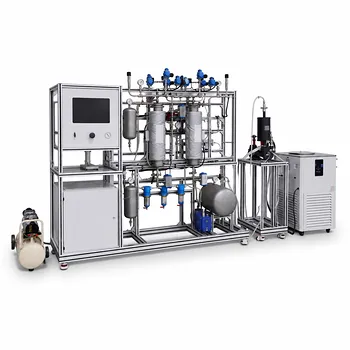
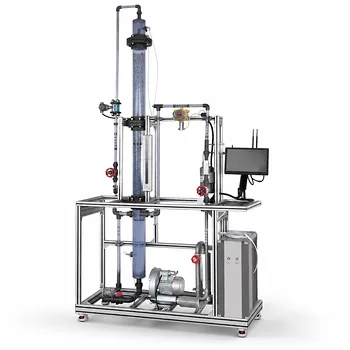
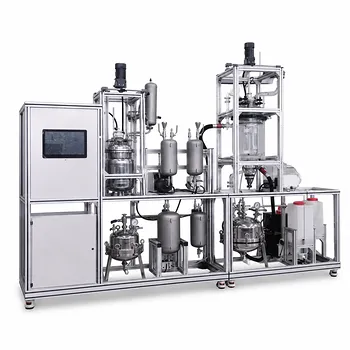
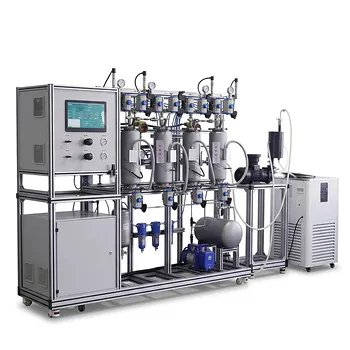
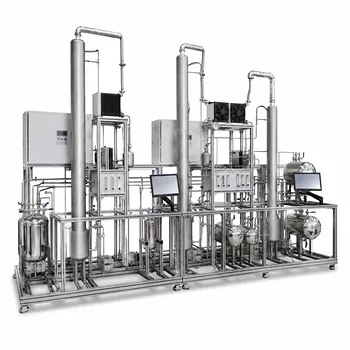
The most immediate process advantage of a multistage countercurrent extraction column pilot plant is its ability to achieve a given separation using only a fraction of the solvent demanded by a sequence of single-stage units. In a countercurrent column, fresh solvent contacts the most solute-depleted process stream, maintaining a steep concentration gradient across every theoretical stage. This continuous, staged contacting not only delivers vastly superior mass transfer efficiency—allowing a three-stage column to reduce solvent consumption by roughly 76% compared to equivalent single-stage operations—but also enables real-time study of industrial-scale dynamics that batch glassware simply cannot replicate.
The deep advantage sits in the countercurrent flow path: it sustains a strong driving force for mass transfer from feed inlet to raffinate outlet, slashíng solvent waste and directly cutting operating costs. For educators and researchers, the pilot-plant format transforms this thermodynamic edge into a living, tunable demonstration of process intensification.
The Principle of Countercurrent Contacting
Maximizing the Concentration Driving Force
In a single-stage unit, the feed and all the solvent are mixed once. After equilibrium, the remaining solute concentration in the raffinate is often still high, because the driving force collapses as the solvent becomes loaded.
A multistage countercurrent column solves this by sending fresh solvent in at the opposite end of the feed. The raffinate leaving the column last sees the cleanest solvent, so the final solute concentration can be driven extremely low. Meanwhile, the extract exits at the opposite end, heavily loaded, because it has contacted the richest feed. This staged, counter-directional flow keeps the average concentration difference between the two phases much larger than in any series of co-current single-stage steps.
Visualizing Solvent Efficiency: A Quantitative Comparison
The numbers make the benefit tangible. To reach the same separation target, a three-stage countercurrent column can get the job done with about 24 % of the solvent required by multiple single-stage batch extractions.
Flipping the ratio, that is a 76 % solvent reduction. For a pilot plant handling even modest volumes, such a difference directly translates into lower chemical purchase costs, reduced waste handling, and a visibly smaller environmental footprint—all while delivering an equal or better purity product.
Operational Advantages of a Continuous Pilot Plant
From Batch Artifacts to Steady-State Realism
Multiple single-stage units, whether run in series manually or via complex separating-funnel racks, remain inherently batch operations. They are slow, labor-intensive, and riddled with steps that introduce operator error—incomplete phase disengagement, variable contact times, or accidental carry-over.
A countercurrent extraction column operates continuously. Feed and solvent streams flow at set rates, and the system reaches a steady state where composition profiles remain constant. This not only boosts throughput but also lets students and researchers collect reproducible, time-invariant data that mirrors what they will encounter in industrial plants.
Automation and Hands-On Process Control
A pilot-plant column is more than a piece of glassware; it is a compact process system. Operators can adjust agitator speed, pulsed frequency, and phase flow ratios in real time and watch the separation respond.
This hands-on access teaches process dynamics that no static batch demonstration can. Students learn how changes in rotor speed affect droplet size and mass transfer, or how a slight pulsation amplitude shift can break up channeling. They troubleshoot flooding, optimize holdup, and directly connect theoretical stage calculations to measured outlet concentrations—building the muscle memory of a process engineer.
Understanding the Trade-offs
Increased Mechanical Complexity
A multistage column requires pumps, control valves, and often a pulsation unit. These moving parts add capital cost and maintenance demand. For labs that need only occasional, simple demonstrations, the increased mechanical footprint may outweigh the solvent savings.
Startup and Shutdown Demands
Reaching steady state in a continuous column takes time and careful adjustment. Unlike a quick single-stage shake-out in a separatory funnel, the column must be primed, the interface level stabilized, and the operating point verified. For quick screening of many different solvent systems, a batch approach can sometimes feel more agile—though it sacrifices efficiency and realism.
Making the Right Choice for Your Goal
After a short framing sentence, use this mapping to anchor your decision.
- If your primary focus is minimizing solvent consumption and waste: A multistage countercurrent column is the clear winner, regularly cutting solvent volumes by over 70 % compared to single-stage trains.
- If your primary focus is teaching authentic, continuous process control: The pilot-plant column provides a living, tunable system that closely mimics industrial extraction loops.
- If your primary focus is simple, infrequent demonstrations with minimal mechanical overhead: Multiple single-stage units may suffice, provided you accept the much higher solvent burn and the loss of steady-state realism.
Only the countercurrent column transforms solvent efficiency from a textbook number into a measurable, controllable, and teachable unit operation that prepares engineers for real-world process design.
Summary Table:
| Comparison Feature | Multistage Countercurrent Column | Multiple Single-Stage Units |
|---|---|---|
| Solvent Efficiency | Up to 76% reduction (continuous reuse) | High solvent consumption & waste |
| Operation Mode | Continuous, steady-state realism | Batch-based, labor-intensive |
| Process Control | Tunable (agitator speed, pulse frequency) | Minimal, static demonstration |
| System Complexity | Higher (requires pumps, valves, controls) | Low mechanical overhead |
Bring Industrial-Scale Realism to Your Laboratory
LABPARK offers premium Educational and Vocational Unit Operations Pilot Plants in chemical engineering, bioprocess & biotech, and environmental & water treatment. Designed specifically for universities, research institutes, and enterprises, our systems provide students and researchers with hands-on, tunable process control that textbooks cannot replicate.
Ready to elevate your engineering curriculum or research capabilities? Contact LABPARK today to find the perfect pilot plant solution for your facility!
Related Products
- Multi-Functional Special Distillation Educational Pilot Plant
- Educational Rotary Disc Liquid-Liquid Extraction Pilot Plant
- Multimodal Absorption and Desorption Pilot Plant for Unit Operations Training
- Multi-Modal Distillation Unit Operations Training Pilot Plant
- Comprehensive Liquid-Liquid Extraction Pilot Plant for Engineering Education
People Also Ask
- Why does simple distillation yield higher efficiency than flash distillation? Key thermodynamic differences.
- How to Verify Distillation Boundary Lines & Composition Regions with Pilot Plants
- How does double temperature difference control improve distillation pilot plants? Stabilize purity.
- How Batch vs Continuous Configuration Affects Distillation Pilot Plant Versatility & Footprint
- How to Estimate Distillation Pilot Plant Tray Efficiency? O'Connell's Correlation Guide