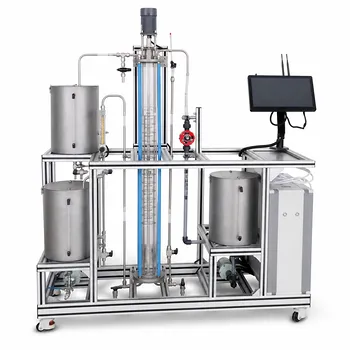
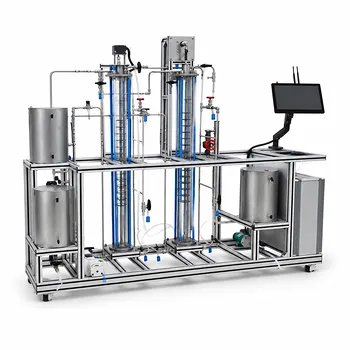
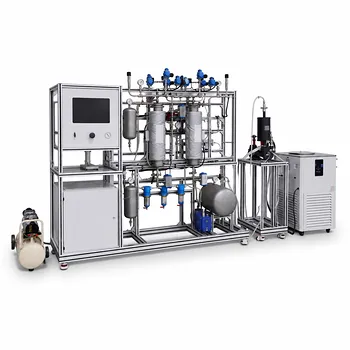
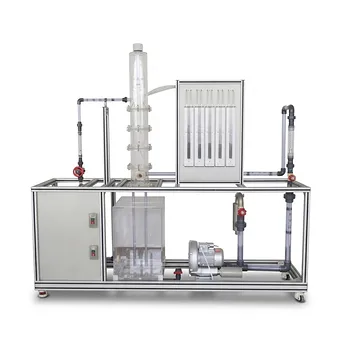
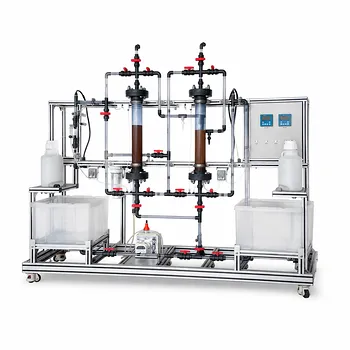
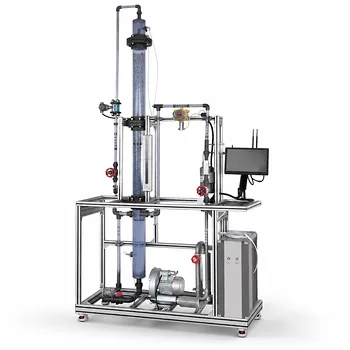
A fractional distillation pilot plant’s stability hinges on managing a few critical external inputs. The primary process disturbances are fluctuations in feed flow rate, feed composition, feed temperature, reboiler heating capacity, and condenser cooling capacity. In educational and research settings, these are mitigated by smoothing feed flow with level control loops, stabilizing feed temperature with a dedicated preheater control loop, and managing reboiler heating disturbances via cascade control strategies.
The most disruptive forces in a pilot column are not internal but external—variations in feed properties and thermal energy supply. The core of effective mitigation is converting these unpredictable upsets into controlled variations through properly designed regulation loops, allowing students and researchers to study dynamic responses safely and repeatably.
The Nature of Disturbances in a Pilot Plant
Why Pilot Plants Are Hypersensitive to Input Changes
Pilot-scale columns have low liquid holdup and minimal thermal inertia. A small change in feed conditions or energy input propagates through the entire column almost instantly, making steady-state operation fragile. This sensitivity, however, is by design—it lets operators observe cause-and-effect relationships in real time.
The Five Classic Disturbance Sources
The primary reference identifies five main disturbance variables:
- Feed flow rate ($F$) – sudden spikes or drops from upstream tanks or pumps.
- Feed composition ($Z_F$) – changes in the mixture entering the column, often harder to detect.
- Feed temperature ($T_F$) – variations from ambient conditions or upstream heat exchangers.
- Reboiler heating capacity – steam pressure drifts or fluctuations in electrical heating elements.
- Condenser cooling capacity – changes in cooling water temperature or flow rate.
Each of these directly upsets the column’s material and energy balances, shifting temperature profiles and degrading separation unless actively countered.
Mitigating Feed-Related Disturbances
Smoothing Feed Flow Rate Fluctuations
The recommended fix is an upstream level control loop. Instead of letting the column feed tank level dictate flow directly, a level controller adjusts a valve or pump to deliver a steady feed rate. This decoupling prevents sudden flow spikes that would otherwise create pressure surges and disrupt internal liquid-vapor traffic.
Stabilizing Feed Temperature
Feed enthalpy variations shift the vapor-liquid equilibrium at the feed stage. A preheater with its own dedicated temperature control loop eliminates this variable. The loop adjusts the heating medium (steam or electric) to keep $T_F$ constant, ensuring the feed’s thermal condition (subcooled, saturated, or partially vaporized) remains as designed.
Handling Feed Composition Variations
Composition changes are often the most stubborn disturbance—primary sources don’t always offer a simple instrumental fix. In pilot plants, operators can:
- Use feed-forward control by measuring composition early and adjusting the reflux ratio.
- Rely on the reflux ratio as the primary quality control handle (detailed later) to compensate for drifting feed purity. In educational contexts, deliberate composition steps are frequently introduced to observe column dynamics.
Managing Energy Balance Disturbances
Reboiler Heating: From Steam Fluctuations to Stable Vapor Flow
Reboiler duty swings are commonly caused by steam header pressure changes. A cascade control loop provides robust mitigation:
- An inner loop controls steam flow (or heating medium).
- An outer loop senses a critical column temperature (e.g., tray temperature near the bottom) and adjusts the inner setpoint. This cascade architecture isolates the column from upstream steam variability, giving students a clear demonstration of nested control benefits.
Condenser Cooling Capacity
Condenser disturbances—caused by cooling water temperature or flow shifts—can alter column pressure and reflux temperature. A similar cascade control approach is effective: a valve controlling cooling water flow rate is slaved to a reflux drum temperature or column pressure loop. Even simple flow control on cooling water greatly reduces pressure swings that would otherwise distort vapor-liquid equilibrium.
Beyond Instrumentation: Hydraulic and Other Considerations
The Role of Column Pressure Control
Column pressure must be held stable, because pressure shifts directly change the relative volatility of the mixture. In pilot plants, a pressure controller that vents non-condensables or modulates an inert gas blanket is standard. Without it, what appears as a composition disturbance is often a pressure-driven upset in disguise.
Material Balance: The Unseen Disturbance
Arbitrary changes in distillate or bottoms flow rates act like internal disturbances. Once the ratios violate the overall material balance, the column’s internal concentration profile drifts. The mitigation is simple but vital: maintain fixed ratios (e.g., distillate-to-feed ratio) or let level controllers on the reflux drum and reboiler sump automatically adjust product withdrawals to match inventory.
Hydrodynamic Limits as Self-Inflicted Disturbances
While not external disturbances, weeping, entrainment, and flooding are frequent operating issues that degrade mass transfer:
- Weeping (liquid leaking through tray perforations) occurs at low vapor velocities; it is prevented by staying above the weep point.
- Entrainment (liquid carried upward with vapor) increases with excessive vapor velocity and is kept in check by maintaining a vapor rate below the entrainment limit (often <0.1 kg liquid/kg gas).
- Flooding (vapor preventing liquid downflow) marks the upper hydraulic limit and is avoided by operating within the column’s turndown range and ensuring adequate plate spacing. These failures often surface when feed or energy disturbances push the column outside its design window, underscoring the need for coordinated control.
Understanding the Trade-offs
The Precision vs. Transparency Dilemma
Aggressive closed-loop control can mask the very dynamics students are meant to observe. A perfectly stabilized column reveals nothing about how disturbances propagate. In an educational pilot plant, some fluctuations are intentionally left unmitigated to show cause and effect—trading off steady-state purity for learning value.
Energy and Material Balance Interactions
Mitigating one disturbance can amplify another. For example, raising the reflux ratio to combat a feed composition upset improves product purity but increases reboiler steam demand and condenser load, risking hydraulic limits if the column is undersized. Similarly, over-smoothing feed flow can hide the impact of inventory control problems that would be critical in an industrial setting.
Complexity vs. Operability
Cascade and feed-forward loops add instrumentation and tuning complexity. For a research pilot plant, the trade-off is between research throughput (stable baselines) and operational realism (handling raw disturbances). Choose the level of automation that aligns with the learning objectives, not just what is technically possible.
Making the Right Choice for Your Goal
The appropriate mitigation strategy depends on the primary purpose of your pilot plant run.
- If your primary focus is demonstrating process dynamics: Keep some disturbances unpurified—e.g., intentionally vary $T_F$ or $F$—to let students observe the column’s transient response. Use basic feedback loops only for safety.
- If your primary focus is achieving high-purity separations for product samples: Implement full cascade control for reboiler and condenser, stabilize feed temperature, and use the reflux ratio as a final trim, sacrificing some educational transparency for stable baseline operation.
- If your primary focus is control theory education: Enable cascade loops on reboiler heating and pressure, then challenge students to design compensators for feed composition disturbances, using the column as a live process demonstrator.
When you treat disturbances not as failures but as a planned part of the curriculum, the pilot plant becomes an invaluable bridge between theoretical models and real-world process control.
Summary Table:
| Disturbance Source | Main Process Impact | Recommended Mitigation Strategy |
|---|---|---|
| Feed Flow Rate ($F$) | Pressure surges & fluid traffic upsets | Upstream level control loop to smooth flow |
| Feed Temperature ($T_F$) | Shifts vapor-liquid equilibrium | Dedicated preheater with temperature control loop |
| Feed Composition ($Z_F$) | Drifts concentration profiles | Reflux ratio adjustment & feed-forward control |
| Reboiler Heating | Steam pressure & vapor flow swings | Cascade control (steam flow + column temperature) |
| Condenser Cooling | Pressure & reflux temperature shifts | Cascade control (cooling water flow + drum temp/pressure) |
Optimize Your Process Control Training & Research with LABPARK
To safely study dynamic responses and achieve precise separations, your laboratory needs reliable, well-instrumented systems. LABPARK provides state-of-the-art Educational and Vocational Unit Operations Pilot Plants in chemical engineering, bioprocess & biotech, and environmental & water treatment.
Designed specifically for universities, research institutes, and enterprises, our pilot plants help you teach complex cascade control, feed-forward loops, and column hydraulics effectively.
Ready to upgrade your lab's capabilities? Contact us today to discuss your custom pilot plant configurations!
Related Products
- Multi-Modal Distillation Unit Operations Training Pilot Plant
- Continuous Sieve-Plate Distillation Pilot Plant for Unit Operations Laboratory Education
- Multi-Functional Special Distillation Educational Pilot Plant
- Educational Rotary Disc Liquid-Liquid Extraction Pilot Plant
- Dual-Mode Rectification Pilot Plant for Practical Training Unit Operations
People Also Ask
- How can energy balance equations for condensers & reboilers be validated experimentally? Guide
- How does catalyst water concentration affect distillation pilot plant design? Key separation train choices.
- How can real-time carbon number prediction improve distillation pilot plants? Optimize control.
- What are the primary reflux ratio control strategies? Master Distillation Unit Operations
- Why is vacuum operation capability an essential feature for a distillation unit operations pilot plant? Unlock Efficiency