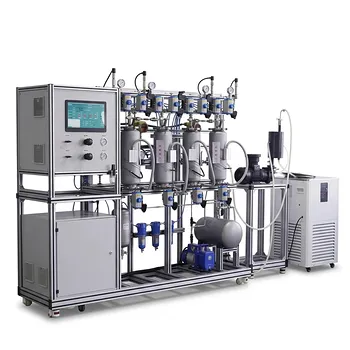
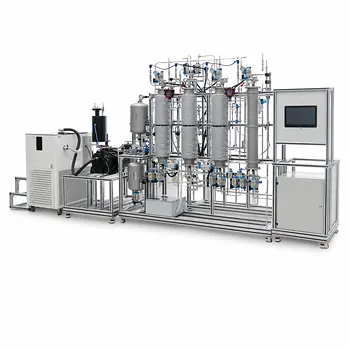
Three core process configurations dominate pilot-scale SFE separation.
After the supercritical solvent has extracted your target solute, you must separate the two to isolate the product. SFE pilot systems achieve this through three primary methods: isothermal depressurization, isobaric heating, and isothermal-isobaric adsorption. Each manipulates a different variable to force the solute out of solution.
The three primary SFE separation methods are isothermal depressurization (changing pressure), isobaric heating (changing temperature), and isothermal-isobaric adsorption (using a solid capture medium). Depressurization is the simplest and most common, but the choice ultimately depends on your purity, product stability, and energy-efficiency requirements.
Isothermal Depressurization: The Industry Standard
This is the workhorse of SFE separation, directly exploiting the relationship between pressure and solvent density.
How the Process Works
The solute-laden supercritical fluid passes through an expansion valve, causing a deliberate pressure drop at a constant temperature.
This sudden pressure reduction sharply decreases the solvent’s density, which in turn collapses its solvating power.
The solute precipitates out and is collected in a separator, while the now-gaseous CO2 is sent to a compressor for recycling.
Why It Is So Widely Used
The setup requires minimal equipment—just a valve and a separator vessel—making it mechanically straightforward and reliable.
Because no additional heat input is needed, it is often the most energy-efficient option for simple extractions.
This method is ideally suited for samples where the solute is not thermally labile and separation speed is a priority.
Isobaric Heating: Adding Thermal Control
When pressure reduction is not practical or would damage the solute, isobaric heating provides a precise alternative.
How the Process Works
The extraction mixture’s pressure is held constant while its temperature is increased in a heated separator.
Elevating the temperature reduces the density of the supercritical solvent at that fixed pressure, diminishing solubility.
The solute drops out, and the solvent stream is then cooled back down and re-pressurized before being recirculated.
Ideal Applications
This configuration excels when dealing with heat-stable compounds that might form aerosols or undesired crystals under sudden depressurization.
It also allows for finer separation of multiple solutes by precisely ramping temperature stages, improving fractionation.
Adsorption: Achieving Purity by Capture
For applications demanding the highest purity or removal of trace impurities, an adsorbent-based method operates without changing either pressure or temperature.
How the Process Works
The entire separator bed is packed with a solid adsorbent, such as activated carbon, while maintaining isothermal and isobaric conditions.
As the supercritical fluid mixture flows through the bed, the target solute selectively adheres to the adsorbent’s surface, effectively stripping it from the solvent.
Pure solvent exits the separator for direct recycling, and the solute is later recovered from the adsorbent—often via a mild co-solvent or a pressure swing.
When High Purity Is Non-Negotiable
This method is unmatched for scavenging low-concentration impurities or polishing a product to ultra-high purity levels.
Crucially, it avoids subjecting the extracted compound to extreme thermal or mechanical stress, preserving its integrity.
Understanding the Trade-offs
No single configuration is universally best. Your choice introduces distinct operational and economic factors.
Simplicity vs. Purity
Isothermal depressurization is the easiest to implement and scale, but it can struggle to achieve the very high purity that adsorption delivers.
Adsorption, while exceptionally pure, adds complexity in bed regeneration and adsorbent replacement, raising operating costs.
Energy and Solvent Management
The depressurization method requires powerful solvent recompression, which can be energy-intensive for high-pressure drops.
Isobaric heating shifts the energy demand to heating and cooling loops, which may be a more efficient pathway if your facility has integrated heat-exchange systems.
Product Sensitivity
If your solute degrades under sudden pressure changes (e.g., certain polymers or biological materials), dismiss the depressurization method immediately.
For thermally sensitive compounds, such as many natural product extracts, isobaric heating is also risky, tilting the balance toward adsorption or mild depressurization.
Making the Right Choice for Your Goal
Select a separation configuration based on your primary constraint, whether that’s cost, product quality, or equipment simplicity.
- If your primary focus is speed and mechanical simplicity: Use isothermal depressurization. It is the most straightforward path to a separation step and minimizes upfront capital expenditure.
- If your primary focus is heat-stable fractionation or avoiding aerosol formation: Choose isobaric heating. The controlled temperature rise provides a gentler pathway when pressure swings are undesirable.
- If your primary focus is maximum purity or removing trace contaminants: Deploy the adsorption method. It sacrifices throughput and simplicity for unmatched impurity capture.
A well-designed pilot system often integrates more than one of these configurations in series, but understanding these three core building blocks is the first step to engineering the separation train you truly need.
Summary Table:
| Configuration | Mechanism | Key Advantage | Best For |
|---|---|---|---|
| Isothermal Depressurization | Pressure drop at constant temp | Simple, energy-efficient | Standard, heat-insensitive solutes |
| Isobaric Heating | Temperature increase at constant pressure | High fractionation control | Preventing aerosol formation |
| Adsorption | Solid adsorbent bed capture | Ultra-high product purity | Heat-sensitive or trace impurities |
Ready to optimize your extraction processes? LABPARK provides advanced Educational and Vocational Unit Operations Pilot Plants in chemical engineering, bioprocess & biotech, and environmental & water treatment. Specifically designed for universities, research institutes, and enterprises, our pilot systems deliver the process control and hands-on learning required for cutting-edge SFE research. Contact our experts today to find the perfect configuration for your lab!
Related Products
- Supercritical High-Gravity Flash Evaporation Educational Unit Operations Pilot Plant
- Educational Rotary Disc Liquid-Liquid Extraction Pilot Plant
- Comprehensive Liquid-Liquid Extraction Pilot Plant for Engineering Education
- Gallium and Indium Selective Extraction Educational Pilot Plant
- Continuous Batch Extractive Distillation Educational Pilot Plant
People Also Ask
- How is the heat transfer area calculated for an evaporation unit operations pilot plant during experimental design? Guide
- How to select educational evaporator pilot plants for thermal & scaling solutions? Complete Guide
- How to Connect Benchtop Evaporation to Pilot Plants in Chemical Engineering Education
- How are Dühring plots applied in evaporation pilot plants? Practical guide to boiling point prediction
- What is the practical significance of Kb in pilot plant evaporation? Master process design.