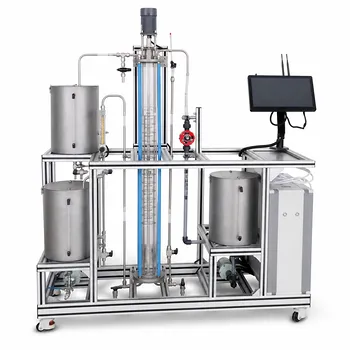
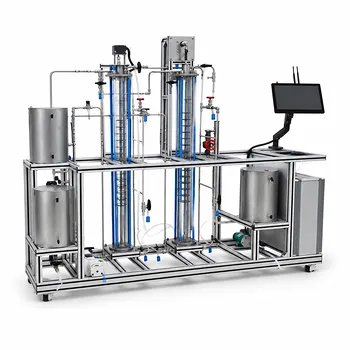
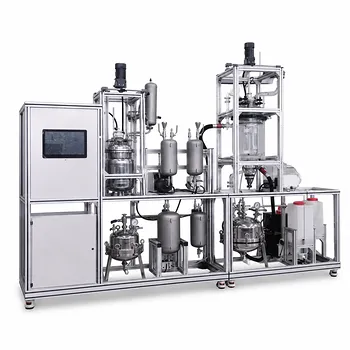
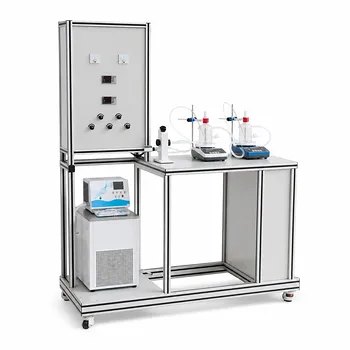
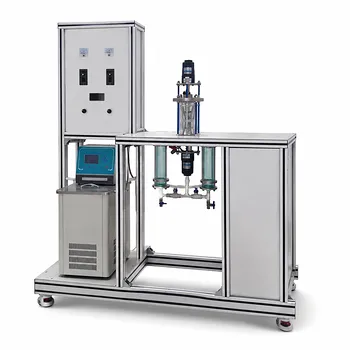
The single greatest practical advantage is immediacy. A continuous pilot plant delivers real-time, steady-state data in minutes, while a manual separating funnel simulation is a grueling, error-prone marathon that can take days to reach a single pseudo-equilibrium point. The pilot plant doesn't just simulate a process; it embodies it, transforming a theoretical exercise into tangible, industrial reality.
Manual simulations prioritize understanding the mechanism of countercurrent flow, but a continuous pilot plant is the definitive tool for studying dynamic efficiency and process control. The choice is between an abstract, static model and a concrete, responsive system that reveals the true behavior of a chemical process under operational stress.
The Fundamental Flaw in Manual Simulation
The manual separating funnel sequence is an incredible teaching tool for visualizing discrete stages. However, as a practical method for studying mass transfer, it suffers from a fundamental limitation it can never overcome—it is an inherently static and transient approximation of a dynamic steady-state reality.
The Trap of Transient Operation
A manual setup forces you to move discrete batches sequentially. True steady-state operation, where every point in the system has a constant concentration over time, is impossible to achieve with your hands.
A continuous pilot plant physically creates this steady state. Each stage in a column or mixer-settler reaches its own unique equilibrium point and holds it. You sample a stable system, eliminating the time-dependent guesswork of when a manual sequence has finally "equilibrated."
The Data Bottleneck: From Days to Minutes
The supplementary reference highlights a staggering constraint: a manual countercurrent simulation with separating funnels can require n+3 runs just to reach a semblance of equilibrium. For a five-stage system, that’s eight complete, manual cycles.
A pilot plant generation of a full separation profile in minutes. You simply adjust the flow rates and, once steady-state is visually and analytically confirmed, draw your samples—simultaneously from the raffinate and extract phases at multiple stages. The data-dense speed transforms what is a logistics problem in the lab into an analytical one.
Key Practical Advantages of the Continuous Pilot Plant
Beyond speed, the pilot plant unlocks entirely new dimensions of study that manual methods simply cannot access. It shifts the learning objective from manually executing a sequence of steps to analyzing dynamic process performance.
Dynamic Parameter Control
The manual method’s core limitation is that the "parameters" are set before the first shake. Leakage, inaccurate pouring, and variable settling times mean you are battling chaos, not controlling variables. A pilot plant reverses this.
The primary reference emphasizes that operators can actively adjust agitator speed, pulsed frequency, and phase flow rates. This is not just convenience; it’s education. You can directly observe how a process variable—like a rotor's RPMs—immediately impacts the interface between the two phases or the clarity of the raffinate, linking mechanical action to mass transfer efficiency in real time.
Demonstrating True Solvent Efficiency
A manual simulation uses a fixed volume of solvent per stage with low throughput. A continuous countercurrent pilot plant visually proves the principle of solvent economy. You physically pump the fresh solvent into the extractor's opposite end, witnessing it contact the nearly exhausted raffinate.
This tangible demonstration shows why, as the supplementary reference notes, a multi-stage countercurrent system can achieve a separation with only about 24% of the solvent that single-stage operations require. The pilot plant allows you to meter that exact reduced solvent volume and observe a highly concentrated extract, turning a mathematical efficiency number into a verified physical result.
Calculating Genuine Stage Efficiency
A graphical McCabe-Thiele analysis gives you theoretical stages. The pilot plant gives you actual stages. By sampling along the column height, you build a real operating line on the spot.
This process directly reveals actual stage efficiency versus the theoretical ideal. You’re not just plotting a diagram; you are measuring the mass transfer driving force at each point. The bridge between thermodynamic equilibrium on paper and kinetic reality in stainless steel becomes the centerpiece of the experiment.
Understanding the Trade-offs
A complete technical assessment requires an honest look at the limitations. The pilot plant is not a universal replacement for simplicity, and its advantages come with clear trade-offs.
- Higher Start-up Complexity: A pilot plant is not as simple as cleaning a glass funnel. It requires training on pumps, understanding of priming, and a systematic safety protocol for rotating equipment and potential solvent leaks, demanding more initial user competence.
- The Solvent Volume Paradox: While operationally efficient, a pilot plant can require a significantly larger total liquid volume to initially fill the lines, pumps, and column. For extremely high-value or scarce solutes, the manual funnel’s milliliter-scale capability might be a practical necessity.
- Process Transparency: An extraction column’s internals can obscure visualizing the mixing and settling behavior. The act of shaking a separating funnel makes phase disengagement immediately visible, a foundational lesson that can get lost in a sealed vertical column.
Making the Right Choice for Your Goal
The tool must match the objective. The manual simulation and the pilot plant teach different but complementary aspects of liquid-liquid extraction.
- If your primary focus is teaching the foundational principle of discrete stages: A manual funnel sequence is unmatched. Its tactile, transparent process makes the abstract concept of equilibrium-driven solute transfer concrete and memorable.
- If your primary focus is industrial unit operations and process dynamics: The continuous pilot plant is the only valid choice. It provides the hands-on experience of controlling and troubleshooting a live process, connecting parameter changes directly to separation efficiency.
- If your primary focus is generating reliable data for scale-up or design: Never rely on a funnel simulation. A pilot plant’s steady-state data on stage efficiency and flooding is engineering data, while a manual simulation yields only a rough approximation fraught with experimental error.
The funnel teaches the step, but the pilot plant reveals the process; knowing which lesson you need is the first act of engineering judgment.
Summary Table:
| Feature / Aspect | Manual Separating Funnels | Continuous Pilot Plant |
|---|---|---|
| Operation Type | Static & transient (batch-by-batch) | Dynamic, true steady-state |
| Time to Equilibrium | Days (requires multiple runs) | Minutes (real-time stabilization) |
| Parameter Control | Fixed parameters, prone to user error | Active adjustments (flow rates, agitator speed) |
| Solvent Efficiency | Low efficiency (high solvent demand) | High efficiency (uses ~24% of batch solvent) |
| Data for Scale-up | Rough approximation, high error rate | Reliable, precise engineering data |
Bring Industrial-Scale Precision to Your Laboratory
Transitioning from manual laboratory methods to continuous operation is essential for realistic process scaling. LABPARK provides high-quality Educational and Vocational Unit Operations Pilot Plants in chemical engineering, bioprocess & biotech, and environmental & water treatment. Designed specifically for universities, research institutes, and enterprises, our systems bridge the gap between theoretical classroom concepts and actual industrial operations.
Ready to upgrade your research and training capabilities? Contact LABPARK today to find the perfect pilot plant solution for your facility!
Related Products
- Educational Rotary Disc Liquid-Liquid Extraction Pilot Plant
- Continuous Sieve-Plate Distillation Pilot Plant for Unit Operations Laboratory Education
- Comprehensive Liquid-Liquid Extraction Pilot Plant for Engineering Education
- 100L Continuous Loop Hydrogenation Educational Unit Operations Pilot Plant
- Multi-Functional Special Distillation Educational Pilot Plant
People Also Ask
- How do density and IFT affect liquid-liquid extraction pilot plants? Optimize Column Performance
- How are ternary phase diagrams and LLE data applied in extraction experiments? Optimize Pilot Plant Scale-up
- In a liquid-liquid extraction pilot plant, how is a ternary-phase diagram utilized to determine solvent feed requirements?
- How Do Selectivity & Distribution Coefficients Influence LLE Pilot Plant Solvent Choice?
- How to Validate BIPs for LLE Pilot Plants? Steps to Align Simulations with Reality