The reaction is the undisputed bottleneck. When your gas-liquid absorption pilot plant operates in the kinetic subregime, the chemical transformation itself creeps along so slowly that the liquid becomes saturated with dissolved gas. Any effort to boost mass transfer—like cranking up agitation, switching to a high-surface-area packing, or increasing gas flow—will yield negligible improvement because the reaction simply cannot consume the available gas any faster. Your operational focus must shift entirely from interfacial mass transfer to accelerating the intrinsic reaction kinetics.
The kinetic subregime flips the conventional wisdom of absorption reactor design. Instead of chasing more interfacial area, you must treat the column as a homogeneous liquid-phase reactor. The overall rate is dictated by the liquid residence time and the reaction rate constant—not by how fast gas dissolves.
What the Kinetic Subregime Actually Means
The Liquid is Effectively Saturated
In the kinetic subregime, the reaction is so sluggish that the concentration of the dissolved gaseous reactant stays uniform and equal to the physical solubility value right up to the gas-liquid interface. There is no concentration gradient in the liquid film—the liquid simply remains loaded with unreacted gas.
This happens because the characteristic reaction time is far longer than the diffusion time. The dimensionless group $\alpha M^2$ drops well below unity, signaling that the reaction cannot “keep up” with mass transfer. Consequently, the dissolved gas concentration is independent of the reaction itself.
Mass Transfer Stops Being the Lever
Because the liquid phase is already saturated, the driving force for mass transfer—the difference between equilibrium and bulk concentration—is essentially zero across the liquid film. Any additional interfacial area you provide will meet a saturated liquid and will not increase the rate of gas uptake.
That is why increasing agitator speed, installing finer packing, or using a sparger with more surface area delivers no significant acceleration. You are solving a supply problem that doesn’t exist.
How the Plant Actually Behaves
Reaction Kinetics Dictate the Throughput
In this regime, the overall absorption rate per unit liquid volume is given directly by the kinetic expression: $r = k C_{A,\text{sat}}$, where $C_{A,\text{sat}}$ is set by Henry’s law and the partial pressure of the gas. So the total conversion in your reactor becomes a simple product of the volumetric reaction rate and the liquid hold-up.
This means your pilot plant’s performance responds sensitively to anything that changes $k$ (the rate constant) or the liquid inventory—not to changes in gas-side or liquid-side mass transfer coefficients.
The Role of Temperature Becomes Critical
Temperature is your strongest optimization knob. Raising the temperature increases the reaction rate constant exponentially. However, it also reduces the physical solubility of the gas (Henry’s constant rises). The net effect on the overall rate $k C_{A,\text{sat}}$ depends on the activation energy of the reaction relative to the heat of dissolution.
In many systems, the exponential jump in $k$ dominates, so a modest temperature increase can significantly accelerate the reaction. But you must always validate this experimentally, as the solubility penalty can partially offset the gain.
Liquid Holdup, Not Interfacial Area, Drives Scale-Up
Because the reaction dominates, the column or reactor behaves like a stirred tank full of reacting liquid. The total production rate scales with the liquid volume. Therefore, increasing the reactor size, raising the liquid level, or extending the residence time (by reducing liquid throughput) will proportionally boost conversion.
This is the opposite of a mass-transfer-limited regime, where you would chase higher specific surface area ($a$) or improved mixing.
Operational Implications for Your Pilot Plant
Adjusting Agitation or Packing Type Is a Waste
If you observe no improvement after switching from a low-surface-area to a high-surface-area packing, or after increasing the stirrer speed in a stirred cell, do not be surprised. This is a classic signature of the kinetic subregime. You can confidently abandon surface area enhancements and direct resources elsewhere.
Use Gas Flow Only to Maintain Partial Pressure
Your gas-side operation still matters for one reason: it must keep the partial pressure of the absorbing component constant. Since $C_{A,\text{sat}}$ is proportional to that partial pressure, a drop in gas-phase composition will reduce the driving force for the reaction. So maintain a sufficient gas flow to prevent depletion of the reactive species, but don’t expect higher gas velocity to improve the overall rate.
Measuring the Regime is Straightforward
A quick diagnostic: run the plant with a small amount of liquid and measure the absorption flux. Then increase the liquid volume while keeping all other conditions identical. If the total absorption rate scales directly with the liquid holdup, you are firmly in the kinetic subregime. This simple check avoids wasted effort on mass transfer “fixes.”
Understanding the Trade-Offs
The Advantage: Simpler Modelling and Predictable Behaviour
Operating in this regime makes the pilot plant extremely forgiving of imperfect gas-liquid contacting. You can use simpler internals, lower gas pressure drops, and still get reproducible data. The reaction rate can be studied cleanly without mass transfer confusion—ideal for extracting kinetic parameters.
The Downside: Large Liquid Inventories Are Required
Slow reactions demand long liquid residence times to achieve acceptable conversion. That often translates into physically large columns, high solvent hold-up, and higher capital costs at scale. You might also face thermal management challenges if the reaction is exothermic, because the large liquid volume acts as a heat sink, complicating temperature control.
Beware of False Optimisation Traps
A common mistake is to interpret a low overall absorption rate as a mass transfer problem and invest in expensive structured packing or intense agitation. Not only will this fail, but it can also introduce foaming, higher pressure drop, and needless complexity—all without moving the needle on conversion.
Making the Right Moves for Your Goal
Your path forward depends entirely on what you are trying to achieve with the pilot plant.
- If your primary focus is maximising the reaction rate for a given plant size: Stop modifying the gas-liquid contacting hardware. Instead, increase the liquid phase volume (e.g., raise the liquid level or add a storage tank) and elevate the operating temperature, validating the rate improvement experimentally.
- If your primary focus is studying the intrinsic chemical kinetics: The kinetic subregime is ideal. You can treat the liquid as a homogeneous batch reactor. Measure conversion as a function of time and temperature, confident that mass transfer limitations are absent.
- If your primary focus is scaling up to a commercial unit: Design the full-scale column primarily for liquid hold-up and residence time—not for interfacial area. Use low-cost internals that simply keep the packing wet and maintain uniform gas distribution.
- If your primary focus is reducing operating costs: Concentrate on solvent selection and temperature control. A faster-acting solvent or a slight rise in process temperature can dramatically cut liquid inventory requirements and pumping costs.
Pinpoint the true bottleneck—the sluggish chemistry—and every operational decision becomes simpler, more effective, and more economical.
Summary Table:
| Parameter / Action | Impact in Kinetic Subregime | Operational Recommendation |
|---|---|---|
| Agitation / Packing Area | Negligible effect; liquid phase is already saturated | Avoid wasting resources on physical mass transfer upgrades. |
| Temperature | High impact; exponentially increases the reaction rate constant ($k$) | Optimize temperature carefully, balancing $k$ with gas solubility. |
| Liquid Holdup | Direct proportional impact on total conversion | Increase liquid volume or residence time to boost throughput. |
| Gas Flow Rate | Minimal impact; only maintains reactant partial pressure | Keep gas flow steady to prevent composition depletion. |
Optimize Your Chemical Engineering & Process Research with LABPARK
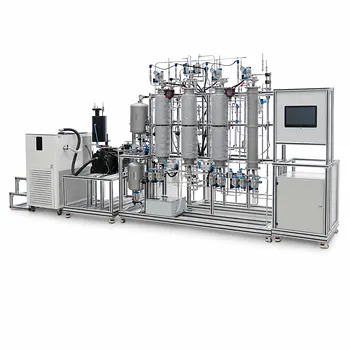
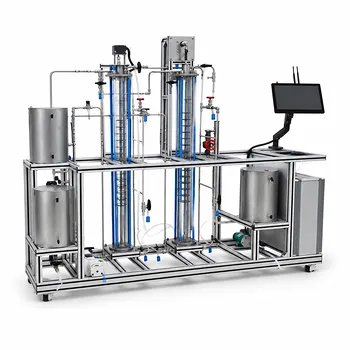
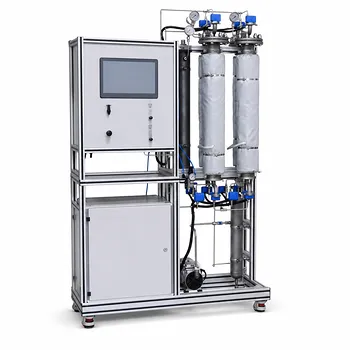
Are you looking to study complex reaction kinetics or scale up gas-liquid absorption systems? LABPARK provides state-of-the-art Educational and Vocational Unit Operations Pilot Plants in chemical engineering, bioprocess & biotech, and environmental & water treatment.
Designed specifically for universities, research institutes, and enterprises, our pilot plants deliver precise control, reliable data acquisition, and robust performance to accelerate your research and training objectives.
Contact our technical team today to discuss your custom pilot plant requirements!
Related Products
- Packed Bed Absorption Educational Unit Operations Pilot Plant
- Dual-Mode Gas Absorption and Desorption Unit Operations Training Pilot Plant
- Absorption and Desorption Educational Unit Operations Pilot Plant
- Carbon Dioxide Absorption and Desorption Educational Pilot Plant for Carbon Capture Studies
- Multi-Component Gas Pressure Swing Adsorption Pilot Plant for Unit Operations Education
People Also Ask
- How Do Flow Regimes Transition in Packed Bed Pilot Plants? Key Scale-up Insights
- How does reactant concentration determine absorption column control? Gas-film vs. dual-film.
- How is the packing height of an absorption column calculated? Master HTU & NTU Concepts
- How does static vs. operating holdup affect pilot plant calibration? Avoid Critical Scale-Up Errors
- Why is counter-current flow selected for gas absorption? Maximize Pilot Plant Efficiency