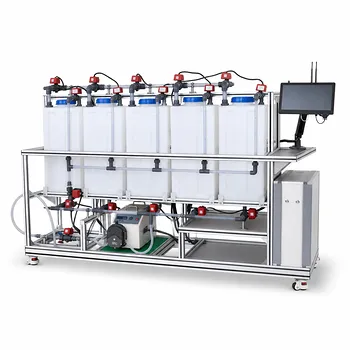
The core operational divide between suspended growth and fixed-film reactors lies in how the biomass is managed. In a suspended growth system like activated sludge, microorganisms float freely in the wastewater, requiring a downstream sedimentation tank and a return sludge loop to recycle settled biomass. In contrast, fixed-film (biofilm) reactors retain microorganisms attached to solid media—such as stones, plastic, or sand—inside the reactor, eliminating the need for a recycle stream.
While suspended growth systems offer broader tolerance to particulate-laden wastewater, fixed-film reactors deliver higher volumetric efficiency for soluble substrates but demand extremely low feed solids to prevent media plugging. The choice in a pilot plant hinges on whether operational flexibility or high-rate dissolved organics removal is the priority.
How Biomass Handling Dictates Reactor Design
The Role of the Sedimentation Tank and Recycle Loop
Suspended growth reactors rely on a downstream sedimentation tank to separate the mixed liquor into clarified effluent and settled biomass.
A significant portion of this settled sludge must be continuously pumped back to the reactor to maintain an active microbial population. This recycle loop adds a critical operational layer: balancing return flow rates, managing sludge age, and handling sludge wastage directly influence treatment performance and energy consumption.
Why Fixed-Film Systems Keep Biomass In-Place
Fixed-film reactors foster microbial growth as an attached biofilm on inert packing materials.
The biomass stays firmly inside the reactor, eliminating the need for external separation and recycle piping. This simplifies the hydraulic profile and removes the risk of biomass washout from a clarifier upset, allowing the reactor to sustain a higher specific biomass concentration per unit volume.
Impact on Pilot Plant Footprint and Control Complexity
A suspended growth pilot plant requires additional tankage, pumps, and instrumentation for the settling and return sludge loop.
This often results in a larger physical footprint and more complex control strategies, such as setting the correct solids retention time. Fixed-film pilots, by contrast, are inherently more compact and have fewer moving parts, reducing the potential points of mechanical failure during long-term testing.
Feed Characteristics and Their Operational Consequences
The Critical Suspended Solids Limitation in Fixed-Film Reactors
A major operational constraint for fixed-bed biofilm reactors is their intolerance to particulate matter in the feed.
If the influent wastewater carries significant suspended solids, the particles will rapidly plug the channels within the packed bed. This channeling sharply drops contact efficiency, creates dead zones, and can force the pilot run to an early shutdown.
Pre-Filtration: A Non-Negotiable Step
To protect the biofilm matrix, the feedstock for a fixed-film pilot must be pre-filtered or consist predominantly of soluble, easily convertible organic substrates.
Operators must rigorously characterize the influent’s particle size distribution before starting a run. Without this step, the reactor’s high-rate potential is nullified by chronic clogging.
Where Suspended Growth Handles the Mess
In contrast, stirred-tank suspended growth reactors naturally accommodate high particle-content wastewater.
The active mixing keeps all solids in suspension, and the downstream clarifier is designed to capture both biological flocs and settleable particulate organics. This makes suspended growth the more robust choice when piloting a raw, unfiltered industrial effluent that contains fibers, grit, or other debris.
Understanding the Key Engineering Parameters
Comparing Specific Surface Area and Mass Transfer
Pilot plants allow direct side-by-side analysis of the specific biofilm surface area available for reaction. Fixed-film reactors pack a large surface area into a small volume, intensifying substrate-to-biomass contact.
However, mass transfer becomes limited by diffusion through the biofilm layer as it thickens. Suspended growth systems rely on turbulent mixing to maximize substrate flux into microbial flocs, with performance tightly coupled to the power input for aeration or stirring.
Organic Loading Capacity and Hydrodynamic Behavior
Fixed-film reactors, fed with the right soluble feedstock, can handle high organic loading rates (often measured as kg COD/m³·day) with stable conversion efficiencies well above 90%.
Their hydrodynamic behavior is largely plug-flow, which minimizes short-circuiting. Suspended growth reactors, often operated as continuously stirred tanks, offer more hydraulic flexibility but can suffer from lower volumetric conversion rates at similar feed strengths.
Common Pitfalls to Avoid in Pilot Testing
- Treating fixed-film reactors as “set and forget”: Biofilm overgrowth can slough off and clog downstream sample lines, requiring regular monitoring and controlled backwashing.
- Ignoring the true solids profile of the feed: A single grab sample may miss intermittent solid slugs that irreversibly foul a fixed bed. Use continuous particle monitoring for reliable scale-up data.
- Neglecting dissolved oxygen mass transfer in high-rate fixed films: While mixing is passive, aerating a densely packed bed demands careful diffuser placement to maintain aerobic conditions without shearing the biofilm.
- Assuming identical biomass yield: Suspended growth systems generate more waste sludge that must be accounted for in the overall pilot plant mass balance, while fixed-film reactors typically have a lower observed yield.
Making the Right Choice for Your Pilot Goal
Your reactor choice should be driven by the specific question the pilot is meant to answer.
- If your primary focus is testing a high-strength, soluble organic stream: A fixed-film reactor will provide compact, high-rate data with minimal mechanical complexity.
- If your primary focus is treating a variable, particulate-laden industrial wastewater: A suspended growth system gives you the operational buffer to handle solids shocks without clogging.
- If your primary focus is investigating fundamental mass transfer or biofilm kinetics: Running both configurations in parallel using the same feedstock is the most powerful way to decouple hydraulic effects from biological limitations.
Match the reactor’s strengths to your feed’s reality, and the pilot data will tell a clear, scalable story.
Summary Table:
| Operational Feature | Suspended Growth Reactors | Fixed-Film (Biofilm) Reactors |
|---|---|---|
| Biomass State | Free-floating microorganisms (flocs) | Attached to solid media (biofilm) |
| Recycle Loop | Required (Return Activated Sludge) | Not required |
| Solids Tolerance | High (handles particulate-laden feed) | Low (prone to plugging; needs pre-filtration) |
| Footprint & Complexity | Larger footprint, more control points | Compact footprint, fewer moving parts |
| Primary Application | Variable, raw industrial effluents | High-rate soluble organic streams |
Elevate Your Water Treatment Research & Training with LABPARK
Choosing the right reactor configuration is critical for generating reliable scale-up data. LABPARK provides advanced Educational and Vocational Unit Operations Pilot Plants designed for universities, research institutes, and enterprises in environmental & water treatment, chemical engineering, and bioprocess & biotech.
Our custom-built pilot systems allow students and researchers to compare suspended growth and biofilm technologies in real-time, offering hands-on experience with industrial-grade instrumentation and control systems.
Need to equip your laboratory with robust wastewater pilot systems? Contact LABPARK today to discuss your research specifications and get a tailored solution!
Related Products
- Solid Waste Pyrolysis and Refining Educational Pilot Plant for Unit Operations
- Thermal Desorption Exhaust Gas and Tail Water Treatment Educational Pilot Plant
- Electrochemical Water Treatment Educational Unit Operations Pilot Plant
- Dual-Mode Rectification Pilot Plant for Practical Training Unit Operations
- Continuous Batch Extractive Distillation Educational Pilot Plant
People Also Ask
- How do educational unit operations pilot plants bridge theory and design? Bridge the Engineering Gap
- How do unit operation requirements differ between traditional chemical processes and bioprocesses? Build Better Pilot Plant Curricula
- How do educational unit operations pilot plants address safety and waste management when scaling up?
- How do educational unit operations pilot plants bridge theory and industrial process development? Hands-On Learning
- How do steady-state and dynamic simulations complement pilot plants? Validate scale-up and controllability