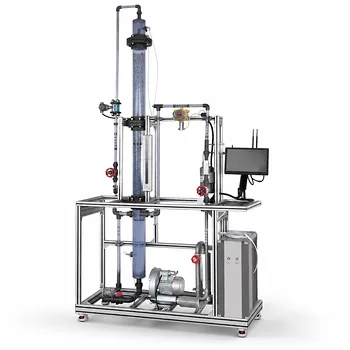
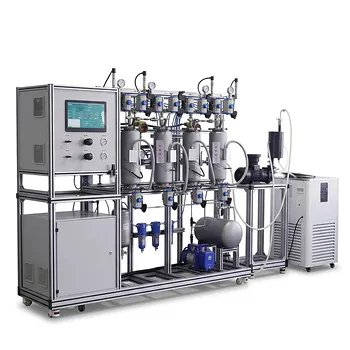
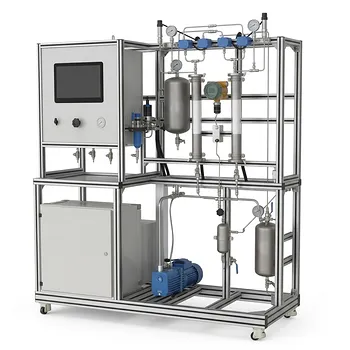
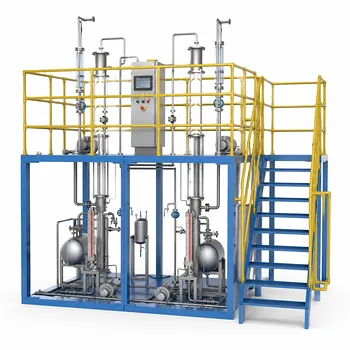
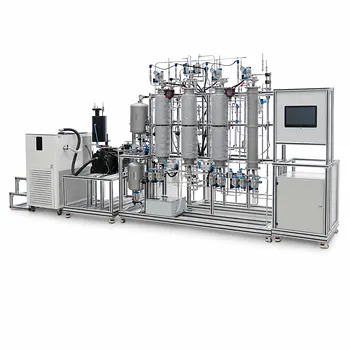
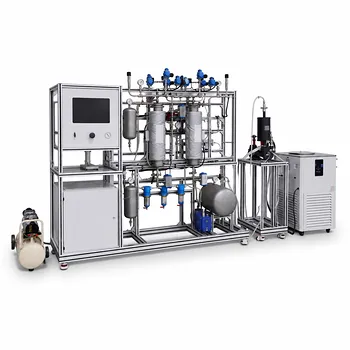
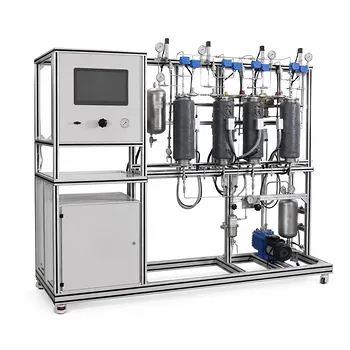
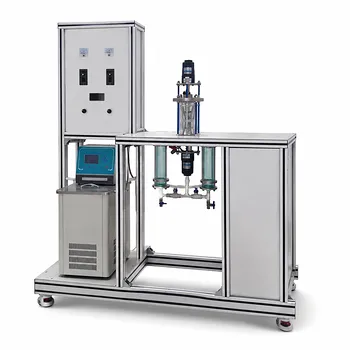
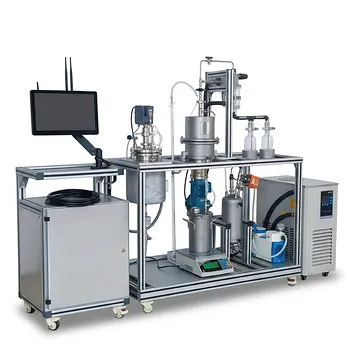
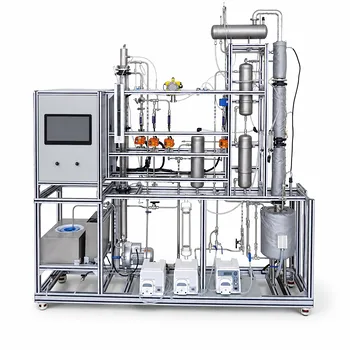
The shift from batch to continuous separation is more than a process upgrade—it’s a paradigm shift in how students learn adsorption engineering. A Simulated Moving Bed (SMB) adsorption pilot plant delivers dramatic operational savings, slashing adsorbent consumption to roughly 4% and desorbent use to half of what a traditional fixed‑bed column requires. Educationally, it forces students to master the real‑time dynamics of valve‑switching, zone‑flow control, and continuous mass transfer, competencies that fixed‑bed units simply cannot teach.
Traditional fixed‑bed adsorption operates in wasteful batch mode, leaving students with limited insight into modern industrial separations. An SMB pilot plant overcomes this by simulating a true counter‑current process, achieving 99.5%+ purity while cutting consumables to a fraction of fixed‑bed levels. The result is a hands‑on platform that teaches the control strategies behind high‑performance pharmaceutical and biochemical separations.
Redefining Operational Efficiency: Continuous vs. Batch
The Counter‑Current Advantage in a Fixed‑Bed World
In a fixed‑bed column, the solid adsorbent sits idle while liquid flows through it in a single pass. Contact is inherently co‑current and staged, meaning that mass transfer driving forces decay quickly and the bed is never fully utilized.
An SMB pilot plant fundamentally changes this geometry. A series of packed columns connected by a multi‑port rotary valve creates a simulated counter‑current solid‑liquid contact. The adsorbent appears to move continuously against the liquid stream, maximizing concentration gradients across every column stage and delivering a true steady‑state separation.
Drastic Reductions in Adsorbent and Desorbent Consumption
Batch fixed‑bed operations demand large safety factors because the bed is used inefficiently. An SMB unit, by contrast, keeps the adsorbent in constant productive contact. Adsorbent inventory drops to approximately 1/25 (4%) of an equivalent fixed‑bed system because every gram of stationary phase works continuously.
The solvent economy is equally transformative. Internal recycling loops allow the desorbent to be reused across zones rather than discarded after a single pass. Desorbent consumption falls by roughly 50%, an operational advantage that also makes the lab greener and more aligned with modern process‑intensification principles.
High‑Purity Separations for Difficult‑to‑Separate Mixtures
Many heat‑sensitive or structurally similar compounds—optical isomers, glucose–fructose pairs—are nearly impossible to resolve economically in a single fixed‑bed pass. SMB units routinely achieve purities exceeding 99.5% because the counter‑current motion magnifies selectivity.
Each zone in the SMB is tuned with a precise flow‑rate ratio that sharpens the separation front. The extract and raffinate streams are withdrawn continuously at opposite ends, preventing remixing and preserving the resolution built up across the column train. Students see first‑hand how subtle flow adjustments convert a marginal separation into a pharmaceutical‑grade output.
Educational Value: Teaching Modern Process Control
Hands‑On with Valve‑Switching Dynamics
The SMB’s heart is a rotary valve that sequentially shifts the feed, desorbent, extract, and raffinate ports along the column series. Students learn to control the switching frequency—the “virtual solid velocity”—and observe how it directly impacts product purity and recovery.
Every rotation of the valve is a live lesson in dynamic process behavior. Slow switching smears the separation; fast switching wastes adsorbent capacity. This real‑time feedback loop turns the pilot plant into a problem‑solving workshop that fixed‑bed labs, with their static piping, can never replicate.
Mastering Zone Flow‑Rate Ratios
An SMB is divided into four functional zones, each governed by a specific internal flow rate. Adjusting the ratio between the feed, raffinate, extract, and desorbent flows is the primary knob for controlling separation performance.
Students must calculate and experimentally refine these ratios to avoid contamination of the product streams. The exercise forces a deep understanding of both equilibrium adsorption isotherms and kinetic mass transfer limitations—concepts that remain abstract in a single‑column batch experiment.
Understanding Transient and Steady‑State Mass Transfer
Fixed‑bed columns spend most of their life in an unsteady state that is difficult to model. An SMB unit teaches students to distinguish startup transients from true steady‑state operation and to measure concentration profiles along the simulated solid movement.
By sampling intermediate columns and comparing results with the equilibrium‑dispersive model, students see how diffusion, axial dispersion, and solid‑film resistance conspire to limit efficiency. This integrated view of mass transfer is precisely what modern chemical engineering curricula demand.
Understanding the Trade‑offs
Increased Complexity and Control Requirements
An SMB pilot plant is a more sophisticated instrument. The multi‑column loop, rotary valve, and multiple metering pumps require careful commissioning and a working knowledge of PLC‑based sequential control. For labs that only need to demonstrate the basic principle of adsorption, a fixed‑bed column remains a simpler, lower‑cost choice.
Higher Initial Investment and Maintenance
The precise rotary valve and the array of columns and detectors make an SMB unit more expensive than a basic fixed‑bed rig. Spare parts, particularly valve seals, need periodic replacement. Labs must budget for both the capital cost and the specialized technician training needed to keep the unit running.
Overkill for Simple Teaching Demonstrations
If the goal is merely to illustrate a breakthrough curve or a Langmuir isotherm, a fixed‑bed column is perfectly adequate. The SMB’s power shines when the curriculum moves beyond fundamentals into process intensification, continuous manufacturing, and advanced separations—areas that increasingly define industrial practice.
Making the Right Choice for Your Lab’s Mission
How you equip your pilot‑plant hall depends on the competencies you need to build.
- If your primary focus is teaching fundamental adsorption principles: A traditional fixed‑bed column remains a cost‑effective and intuitive starting point that lets students run basic breakthrough and regeneration cycles.
- If your primary focus is preparing students for modern biopharmaceutical and fine‑chemical industries: An SMB pilot plant is indispensable—it embeds the continuous‑processing mindset and advanced control skills that employers now demand.
- If your primary focus is energy‑ and solvent‑efficient process development: The SMB’s drastic savings in adsorbent and desorbent make it the only rational choice for developing scalable, high‑purity separations.
- If your primary focus is cutting‑edge research in simulated moving bed technology: The unit becomes a research platform in its own right, enabling studies on zone optimization, reactive SMB configurations, and multi‑component separations.
An SMB adsorption pilot plant is more than hardware—it is a bridge from classical unit operations to the continuous‑flow processes that define the future of chemical and biochemical manufacturing.
Summary Table:
| Feature | Fixed-Bed Column | SMB Pilot Plant |
|---|---|---|
| Operation Mode | Batch / Semi-continuous | Continuous counter-current |
| Adsorbent Needs | Baseline (100%) | Slashed to ~4% |
| Desorbent Needs | Baseline (100%) | Reduced by ~50% |
| Separation Purity | Moderate | High (99.5%+) |
| Control Learning | Static / Basic breakthrough | Dynamic valve & zone flow |
Bring Industrial-Scale Innovation to Your Lab
Ready to transition from batch to continuous separation? LABPARK provides state-of-the-art Educational and Vocational Unit Operations Pilot Plants in chemical engineering, bioprocess & biotech, and environmental & water treatment.
Whether you are a university upgrading your engineering curriculum, a research institute testing novel separations, or an enterprise scaling up processes, we have the right pilot plant solution for you.
Contact LABPARK Today to discuss your laboratory needs and receive a tailored proposal!
Related Products
- Packed Bed Absorption Educational Unit Operations Pilot Plant
- Multimodal Absorption and Desorption Pilot Plant for Unit Operations Training
- Multi-Component Gas Pressure Swing Adsorption Pilot Plant for Unit Operations Education
- Absorption and Desorption Educational Unit Operations Pilot Plant
- High-Gravity Emulsification and Mass Transfer Educational Pilot Plant
People Also Ask
- How Do Flow Regimes Transition in Packed Bed Pilot Plants? Key Scale-up Insights
- How does reactant concentration determine absorption column control? Gas-film vs. dual-film.
- How is the packing height of an absorption column calculated? Master HTU & NTU Concepts
- How does static vs. operating holdup affect pilot plant calibration? Avoid Critical Scale-Up Errors
- Why is counter-current flow selected for gas absorption? Maximize Pilot Plant Efficiency