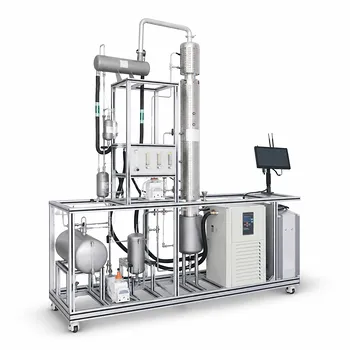
Two distinct mass transport mechanisms govern separation in a pervaporation unit operations pilot plant: the solution-diffusion model, which dominates in dense polymeric and inorganic membranes, and the molecular sieving (capillary flow) model, which applies to microporous membranes. By systematically manipulating pressure, temperature, and flow conditions, students and researchers can isolate and quantify the contributions of sorption, diffusion, and size‑exclusion to overall membrane performance.
The deep value of a pervaporation pilot plant lies not merely in demonstrating these models, but in enabling controlled experiments that distinguish between sorption‑limited and diffusion‑limited regimes. This hands‑on validation directly links membrane material properties to industrial separation efficiency, making abstract transport theory tangible and tunable.
The Two Fundamental Mass Transport Models in Pervaporation
The Solution-Diffusion Mechanism: The Standard for Dense Membranes
This widely accepted model describes transport through non‑porous, dense membrane layers.
It proceeds in three sequential steps: preferential sorption of the target component at the upstream feed‑membrane interface, diffusion through the polymer matrix under a concentration gradient (governed by Fick’s law), and desorption as vapor on the downstream side.
The overall driving force is a gradient in chemical potential—practically realized as a difference in partial vapor pressure between the feed liquid (kept pressurized to remain liquid) and the permeate vacuum side.
The separation efficiency therefore depends on both the solubility (physical‑chemical affinity) and the diffusivity of each component in the membrane material.
The Molecular Sieving / Capillary Flow Model: A Size‑Exclusion Paradigm
For microporous membranes (e.g., zeolites or certain ceramic materials), the separation is governed by pore size and distribution relative to the molecular dimensions of the feed components.
Molecules preferentially sorb on the upstream pore surfaces, flow through the capillary pores, and evaporate at the low‑pressure outlet.
This model treats the membrane as a physical barrier where larger molecules are excluded while smaller ones permeate.
It is especially relevant when investigating inorganic membranes, though most educational polymer‑based systems follow the solution‑diffusion path.
From Theory to Experiment: How a Pilot Plant Reveals Transport Phenomena
Controlling the Driving Force: Pressure and Temperature Gradients
A typical pervaporation pilot plant maintains the feed liquid under sufficient pressure to prevent boiling, while applying vacuum on the permeate side.
This creates the partial vapor pressure gradient that powers the entire separation.
By varying the downstream vacuum level or the feed temperature, students directly observe how flux scales with driving force.
Temperature manipulation is particularly powerful because it affects both solubility and diffusivity, allowing estimation of activation energies for permeation via Arrhenius‑type plots.
Isolating Diffusion vs. Sorption: The Role of Membrane Thickness and Batch Recirculation
The batch configuration—where the feed is recirculated until the desired retentate concentration is reached—offers a unique window into sorption‑diffusion interplay.
As the bulk concentration changes during a run, monitoring flux versus composition effectively reveals the underlying sorption isotherm.
Membrane thickness can be varied across experiments: if flux is inversely proportional to thickness, the process is diffusion‑limited; if flux remains nearly constant, sorption resistance dominates.
This hands‑on manipulation makes Fick’s law a concrete, measurable reality rather than a textbook abstraction.
Confronting Non‑Idealities: Boundary Layers and Concentration Polarization
In real‑world operation, the fluid velocity past the membrane creates a hydrodynamic boundary layer.
When the permeating species is rapidly removed, its concentration at the membrane surface can drop below the bulk value—a phenomenon called concentration polarization—which reduces the effective driving force.
A pilot plant allows students to vary the feed flow rate and study how this diminishes mass transfer resistance.
Understanding this effect bridges ideal transport theory with practical membrane module design and is critical for scaling up any pervaporation process.
Understanding the Trade‑offs in Pilot‑Scale Pervaporation Studies
Selectivity versus Flux: The Pervaporation Compromise
Membrane materials almost invariably exhibit a trade‑off: higher selectivity for a target component tends to come with lower overall flux.
In the plant, this can be demonstrated by comparing a hydrophilic poly(vinyl alcohol) membrane (high water selectivity for solvent dehydration) against an organophilic silicone‑rubber membrane (moderate selectivity but higher organic flux).
Quantifying this compromise prepares researchers to select or design membranes that balance product purity and required membrane area—a core aspect of economic feasibility.
Batch Operation’s Hidden Costs: Energy and Redilution
The flexible batch recirculation mode used in most lab‑scale plants is excellent for education, but introduces an important process limitation.
Each pass dilutes the permeate back into the retentate, lowering the effective driving force over time and requiring disproportionately more membrane area and energy to reach very low residual concentrations.
Contrasting batch results with a hypothetical continuous multi‑stage configuration teaches future engineers how operational choices directly impact energy consumption and capital cost.
This is a vital insight for translating laboratory findings into industrial designs.
Economic Reality Check: When Pervaporation Wins against Distillation
For breaking azeotropes or dehydrating organic solvents, pilot‑scale pervaporation can already compete with energy‑intensive distillation.
However, for separating close‑boiling organic‑organic mixtures, current membrane materials often fall short of the required selectivity‑flux combination.
Experimental runs on the pilot plant allow direct comparison with distillation limits, giving students the tools to assess where pervaporation offers a genuine advantage and where membrane innovation is still needed.
Making the Right Choice for Your Research or Teaching Goal
Your experimental strategy should mirror your primary objective:
- If your primary focus is fundamental membrane science: Systematically vary feed concentration and temperature while measuring flux and permeate composition to decouple sorption and diffusion contributions, validating the solution-diffusion model against the molecular sieving alternative.
- If your primary focus is process optimization for solvent dehydration: Operate the plant in batch recirculation mode to map performance from high to low water content, identifying the transition from diffusion‑limited to sorption‑limited control and pinpointing the minimum feasible retentate concentration.
- If your primary focus is teaching transport phenomena: Use the visible vacuum and flow controls to demonstrate how feed pressure, permeate pressure, membrane thickness, and cross‑flow velocity directly alter mass transfer rates, making abstract concepts like Fick’s law and boundary layer resistance physically intuitive.
Ultimately, the pervaporation pilot plant transforms a black‑box separation into a transparent, tuneable platform where each step of the mass transport puzzle—sorption, diffusion, desorption, and size exclusion—can be observed, measured, and mastered.
Summary Table:
| Mechanism | Membrane Type | Driving Force | Separation Basis |
|---|---|---|---|
| Solution-Diffusion | Dense polymeric & inorganic | Partial vapor pressure gradient | Chemical affinity (solubility) & diffusivity |
| Molecular Sieving | Microporous (zeolites/ceramics) | Partial vapor pressure gradient | Size exclusion (pore size vs. molecular dimensions) |
Bring Membrane Separation Theory to Life in Your Lab
Looking to enhance your laboratory's hands-on teaching and research capabilities? LABPARK provides premium Educational and Vocational Unit Operations Pilot Plants in chemical engineering, bioprocess & biotech, and environmental & water treatment designed for universities, research institutes, and enterprises.
Our advanced pilot plants enable students and researchers to isolate, quantify, and master complex transport phenomena like Fick's law, concentration polarization, and boundary layer resistance in real-time.
Ready to elevate your engineering curriculum or research output? Contact LABPARK today to request a quote or discuss your custom pilot plant specifications.
Related Products
- Multi Pump Fluid Transport Process Piping Unit Operations Training Pilot Plant
- Multimodal Absorption and Desorption Pilot Plant for Unit Operations Training
- Rising and Falling Film Evaporation Educational Unit Operations Pilot Plant
- Supercritical High-Gravity Flash Evaporation Educational Unit Operations Pilot Plant
- Natural Product Extraction Unit Operations Training Pilot Plant
People Also Ask
- Why distinguish Newtonian & non-Newtonian fluids in pilot plants? Prevent design errors.
- Why is the chemical plant startup schedule crucial? De-risk scale-up with pilot plants.
- When to transition from PID to adaptive control in pilot plants? Key process indicators.
- How to study gasification in pilot plants? Compare exit gas composition & efficiency
- How do deviations in estimating latent heat impact pilot plant thermal systems? Avoid hardware mis-sizing.