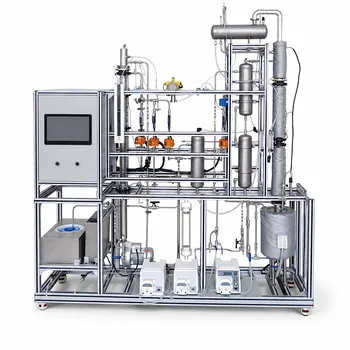
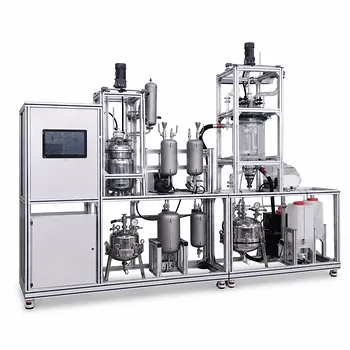
Understanding the core difference hinges on the phase states being contacted. Solvent extraction, or liquid-liquid extraction, is a separation process for liquid feedstocks using two immiscible liquids. In contrast, leaching is a solid-liquid operation where a soluble constituent is pulled from a solid matrix. This fundamental distinction dictates entirely different equipment designs, operating principles, and experimental objectives in a pilot plant setting.
While both process classes transfer a solute into a solvent, the physics of managing solids versus liquids creates a fundamental divide. A liquid-liquid extraction pilot plant is designed to maximize liquid-liquid interfacial area and manage emulsion stability, while a leaching pilot plant must solve the mechanical challenges of solid transport, slurry handling, and solid-liquid phase separation.
Deciphering the Core Physics of the Separation
The operating principle of each unit is a direct response to its physical constraints. This dictates not just the hardware but the very mindset of the engineer setting up the demonstration.
The Liquid-Liquid Interface in Solvent Extraction
The goal is to transfer a solute from one liquid phase to another immiscible liquid phase. This requires creating a massive interfacial area for mass transfer.
The pilot plant equipment must first disperse one liquid into the other, then provide a calm zone for the droplets to coalesce and settle back into two distinct phases. The equilibrium is governed by the partition coefficient of the solute in the two solvents.
The Solid-Liquid Leaching Mechanism
Leaching targets a solute trapped within a solid matrix. The solvent must penetrate the solid's pores, dissolve the solute, and allow it to diffuse back into the bulk liquid.
The rate-limiting step is often diffusion within the solid, not the fluid film. Consequently, pilot plant demonstrations focus heavily on particle size reduction, temperature, and contact time—parameters that accelerate internal diffusion. The equilibrium here is governed by solid-liquid saturation curves.
Pilot Plant Equipment Selection: A Tale of Two Systems
Selecting equipment for a demonstration reveals the practical engineering trade-offs between the two operations. The hardware is purpose-built for either a two-liquid or a solid-fluid system.
Solvent Extraction: Columns and Mixer-Settlers
For liquid-liquid systems, equipment is chosen based on the number of theoretical stages, settling characteristics, and throughput.
-
Mixer-Settlers: A classic, intuitive choice for demonstrations. Each stage is a separate vessel with a mixing zone and a settling zone. They offer high stage efficiency and are excellent for visualizing the step-by-step approach to equilibrium. They are particularly robust for systems that emulsify easily.
-
Vertical Extraction Columns: These provide multiple stages in a single, tall vessel. Simple packed or plate columns work for easy-to-disperse systems. For more demanding separations, mechanically agitated columns (like a Scheibel or rotating disc contactor) add energy to improve dispersion for larger throughputs, while pulsed columns achieve the same for smaller, low-flow applications using a reciprocating pulse. A key selection factor is footprint: columns save floor space but need headroom.
Leaching Equipment: Fixed Beds and Agitated Vessels
Leaching demonstrations are classified by how the solid and solvent are contacted. The physics of solid handling is paramount.
-
Fixed-Bed or Percolation Leaching: The solid is a stationary bed, and solvent is percolated through it. This is directly analogous to industrial heap leaching. A pilot-scale setup lets users compare cross-current versus counter-current flow. Counter-current operation, where fresh solvent contacts the most spent solid, is a powerful demonstration of achieving a high-concentration extract with minimal solvent use.
-
Agitated Vessels: Here, the solid is suspended in the solvent via mechanical agitation. This maximizes direct contact and is ideal for fine solids that would clog a fixed bed. Pilot plants often use a train of agitated tanks to simulate a multi-stage counter-current system, allowing researchers to study mass transfer kinetics and the chemical compatibility, for example, in an acid leaching or alkali leaching process.
Understanding the Trade-offs and Common Pitfalls
Blindly applying a “one-size-fits-all” approach to either demonstration will lead to failed experiments. Recognizing the inherent limitations builds a trustworthy experimental program.
The Penalty of Misjudging Settling Characteristics
In solvent extraction, a stable emulsion at a primary interface is a catastrophic failure. It halts throughput and destroys stage efficiency. When demonstrating these principles, centrifugal extractors must be introduced as the solution for short-contact-time, unstable systems, even though they add mechanical complexity. Similarly, a liquid-liquid system needing many stages but limited in floor area forces the selection of a vertical column, sacrificing the visual clarity of a mixer-settler for spatial feasibility.
The Complexity of Solid Transport and Entrainment
The critical pitfall in a leaching pilot plant is not chemical, but mechanical. Clogged inter-stage lines or a failed slurry pump will end a demonstration instantly. An over-reliance on an idealized fixed-bed setup for a fine, swelling solid will lead to channeling and poor extraction. The operator must learn to evaluate a feedstock's mechanical properties and select an agitated leaching method, even if the solvent chemistry is simpler, just to ensure reliable solid-liquid contacting and phase separation.
Making the Right Choice for Your Pilot Plant Goal
The selection of equipment and operating principle is not just about the process chemistry; it’s a direct function of your educational or research objective.
- If your primary focus is to visually demonstrate equilibrium stage behavior: Select a multi-stage mixer-settler for solvent extraction or a multi-tank agitated leaching battery for leaching. Both make sample collection and stage-by-stage analysis intuitive.
- If your primary focus is to research column hydrodynamics and mass transfer coefficients: A pulsed or agitated vertical extraction column is mandatory for liquid-liquid work, while a continuous counter-current percolation column is ideal for studying solid-liquid leaching kinetics.
- If your primary focus is demonstrating industrial process optimization: Use the leaching pilot plant to run comparative tests between cross-current and counter-current solvent flow, quantitatively proving how counter-current operation minimizes solvent consumption and maximizes extract concentration.
Choosing the correct demonstration is about matching the physical reality of the feed to the right mechanism for solute transfer, ensuring the fundamental principle isn't lost to mechanical failure.
Summary Table:
| Feature | Solvent Extraction (Liquid-Liquid) | Leaching (Solid-Liquid) |
|---|---|---|
| Feedstock Phase | Two immiscible liquids | Solid matrix + liquid solvent |
| Mass Transfer Mechanism | Solute transfer across liquid-liquid interface | Solvent penetration, dissolution, and pore diffusion |
| Common Equipment | Mixer-settlers, packed/pulsed columns, centrifugal extractors | Fixed-bed percolation columns, agitated vessel trains |
| Critical Design Challenge | Managing emulsion stability and phase separation | Handling solid transport, slurry pumping, and clogging |
| Key Process Parameters | Partition coefficient, agitation speed, settling time | Particle size, extraction temperature, residence time |
Elevate Your Engineering Lab with LABPARK Pilot Plants
Choosing the right equipment is critical for accurate process demonstrations. LABPARK provides premium Educational and Vocational Unit Operations Pilot Plants across chemical engineering, bioprocess & biotech, and environmental & water treatment.
Engineered specifically for universities, research institutes, and enterprises, our pilot plants bridge the gap between theory and industrial reality.
Ready to upgrade your laboratory capabilities? Contact LABPARK today to discuss your custom pilot plant needs with our technical team!
Related Products
- Natural Product Extraction Unit Operations Training Pilot Plant
- Comprehensive Liquid-Liquid Extraction Pilot Plant for Engineering Education
- Continuous Sieve-Plate Distillation Pilot Plant for Unit Operations Laboratory Education
- Solid Waste Pyrolysis and Refining Educational Pilot Plant for Unit Operations
- Green Anhydrous Ethanol Purification Extractive Distillation Unit Operations Training Pilot Plant
People Also Ask
- How to Demo Solubility Sensitivity in SFE Pilot Plants? Practical Thermodynamics
- How do pilot plants differentiate physical vs chemical extraction? Enhance Chemical Engineering Training
- Why do emulsions form during extraction scale-up? Resolve pilot plant phase separation issues.
- How are HTU and NTU applied to determine extraction column height? Guide to Pilot Plant Scaling
- What key factors contribute to emulsion formation during liquid-liquid extraction? Scale-up mitigation strategies.