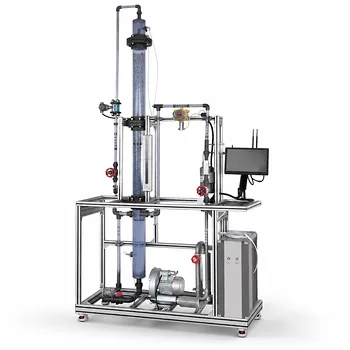
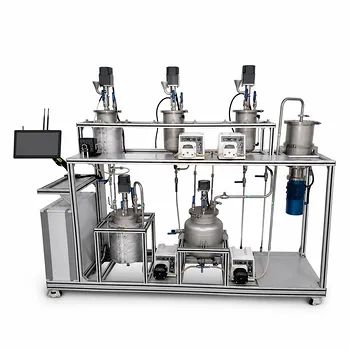
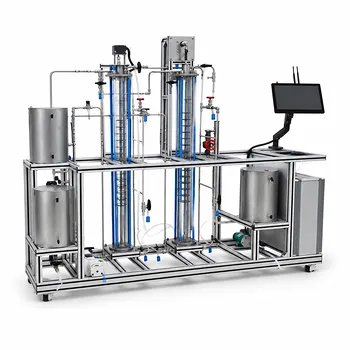
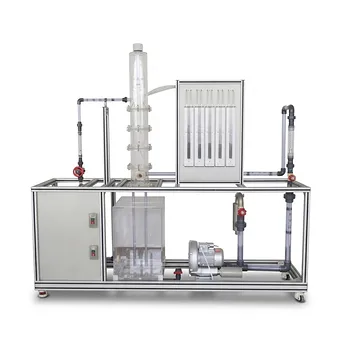
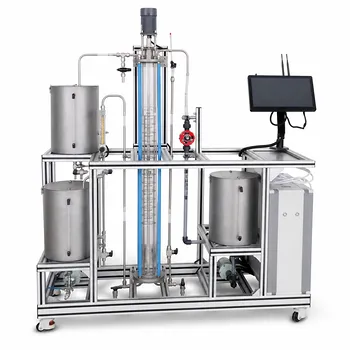
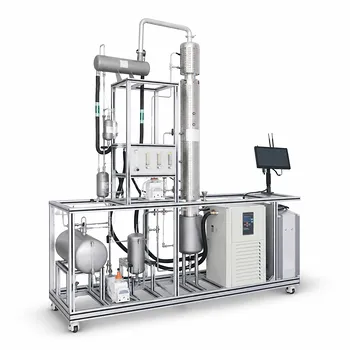
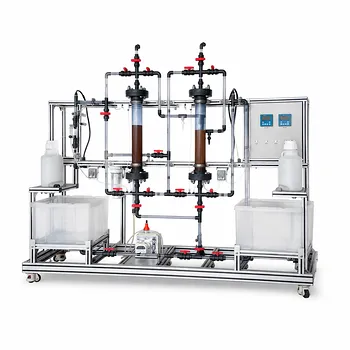
The core difference comes down to geometry. Random packings—think dumped rings or saddles—provide a straightforward, cost-effective way to demonstrate basic gas-liquid contact in a pilot plant. Structured packings use ordered, corrugated sheets to deliver dramatically higher mass transfer efficiency and ultra-low pressure drops, making them essential for vacuum distillation and high-performance research.
The right choice hinges on your pilot plant’s primary mission. For budget-friendly teaching of fundamental principles, random packing excels. For high-efficiency separations, vacuum operation, or demonstrating process intensification, structured packing is the definitive option—despite a higher initial investment and greater sensitivity to fouling.
Understanding the Fundamental Differences
The first split between these two families is how they arrange surface area for vapor-liquid interaction. This single factor ripples through cost, ease of use, and process capability.
Geometry Dictates Performance
Random packing consists of individual elements—like Pall rings, cascade mini rings, or saddles—dumped into the column. This creates a random, tortuous path for vapor that offers moderate surface area and promotes effective contact in many common applications.
Structured packing is fabricated as corrugated sheets or wire gauze arranged in a highly ordered geometry. This deliberate orientation minimizes flow resistance and maximises the specific surface area available for mass transfer.
Cost, Installation, and Maintenance
Random packings are significantly cheaper per cubic meter and are easy to install. You simply dump them in—no special alignment is required. They also tolerate a wider range of liquid properties and are less prone to plugging.
Structured packings are more expensive and require careful installation to avoid gaps or channels. Their tight, ordered passageways make them sensitive to clogging by viscous fluids or suspended solids, a limitation that demands cleaner process streams.
The Critical Role of Pressure Drop and Vacuum Distillation
When you move from atmospheric operation to vacuum distillation, the thermal sensitivity of your materials becomes the controlling factor. This is where the packing choice can make or break the experiment.
Why Low Pressure Drop Matters
Under vacuum, every pascal of pressure lost across the column raises the boiling point at the bottom. A high pressure drop can elevate temperatures to the point where heat-sensitive compounds thermally degrade, ruining a separation.
Structured packing offers a pressure drop as low as around 100 Pa/m while delivering a Height of a Theoretical Plate (HETP) of less than 0.5 meters. This combination keeps operating temperatures low, preserves product integrity, and makes vacuum distillation research both feasible and reliable at pilot scale.
Demonstrating Process Intensification
For universities and research institutes, structured packing is not just a better component—it’s a teaching tool. It allows students to analyze real-world mass transfer efficiency, column capacity limits, and pressure drop characteristics under vacuum conditions.
Integrating structured packing into a pilot plant demonstrates superior separation efficiency in a limited column height, directly showcasing the principles of process intensification that drive modern industrial design.
Understanding the Trade-offs
No single packing type is universally superior. An objective assessment must weigh performance gains against practical constraints.
The Cost of High Performance
Structured packing’s higher cost per cubic meter is undeniable. However, its efficiency often allows a shorter column, which can partially offset the investment. The real operational trade-off is its sensitivity to fouling. Liquids with even moderate viscosities, particulates, or scaling tendencies will quickly degrade performance, requiring more frequent cleaning or replacement.
When Random Packing Falls Short
Random packing’s lower surface area and higher pressure drop mean you would need a taller column to achieve the same separation—a physical limitation in many pilot plant settings. For vacuum distillation or any service where minimizing pressure drop is critical, random packing simply cannot deliver the low-resistance flow path necessary to prevent thermal damage to sensitive compounds.
Making the Right Choice for Your Pilot Plant
Your selection should directly map to the core learning or research objectives of the pilot plant.
- If your primary focus is teaching basic distillation principles on a tight budget: Random packing is the practical choice. It offers straightforward installation, rugged operation, and enough efficiency to clearly demonstrate vapor-liquid equilibrium concepts without the cost or risk of fouling.
- If your primary focus is high-efficiency separations or vacuum distillation: Structured packing is essential. Its low pressure drop and high surface area per volume are mandatory for maintaining low temperatures and achieving sharp cuts in a compact column, making it the only viable option for demonstrating these industrially critical scenarios.
- If your primary focus is advanced research on column internals or process intensification: Structured packing provides the data-rich environment you need. The ability to quantify low pressure drops and high turndown capacity turns the pilot plant into a true research instrument, not just a teaching aid.
Align the packing type with your process goals, and your pilot plant will deliver both the educational depth and the research capability you need.
Summary Table:
| Feature | Random Packing | Structured Packing |
|---|---|---|
| Arrangement | Dumped, random elements | Ordered, corrugated sheets |
| Efficiency (HETP) | Moderate | High (HETP < 0.5 m) |
| Pressure Drop | Moderate to High | Ultra-low (~100 Pa/m) |
| Fouling Resistance | High (handles dirty streams) | Low (prone to clogging) |
| Relative Cost | Economical | Higher investment |
| Primary Application | Basic teaching & routine separations | Vacuum distillation & process intensification |
Are you designing a chemical engineering laboratory? LABPARK provides high-quality Educational and Vocational Unit Operations Pilot Plants in chemical engineering, bioprocess & biotech, and environmental & water treatment for universities, research institutes, and enterprises.
Whether you need robust random packing columns for student instruction or high-performance structured packing systems for advanced vacuum distillation research, we deliver the precision and scale you need.
Contact LABPARK today to discuss your custom pilot plant requirements!
Related Products
- Packed Bed Absorption Educational Unit Operations Pilot Plant
- Absorption and Desorption Educational Unit Operations Pilot Plant
- Multimodal Absorption and Desorption Pilot Plant for Unit Operations Training
- Multi-Modal Distillation Unit Operations Training Pilot Plant
- Multi-Functional Special Distillation Educational Pilot Plant
People Also Ask
- How Do Flow Regimes Transition in Packed Bed Pilot Plants? Key Scale-up Insights
- How does reactant concentration determine absorption column control? Gas-film vs. dual-film.
- How is the packing height of an absorption column calculated? Master HTU & NTU Concepts
- How does static vs. operating holdup affect pilot plant calibration? Avoid Critical Scale-Up Errors
- Why is counter-current flow selected for gas absorption? Maximize Pilot Plant Efficiency