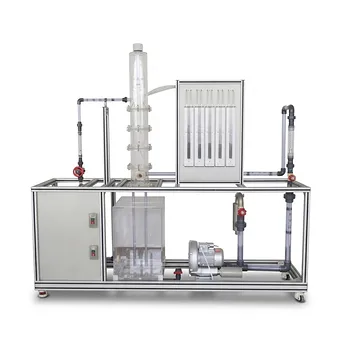
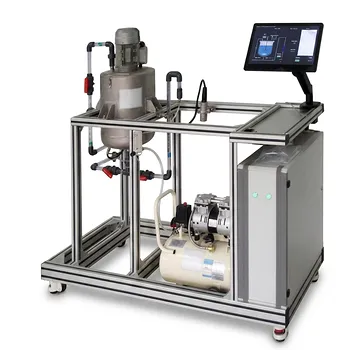
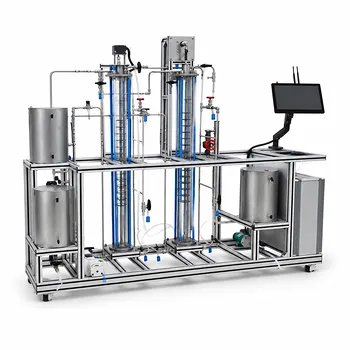
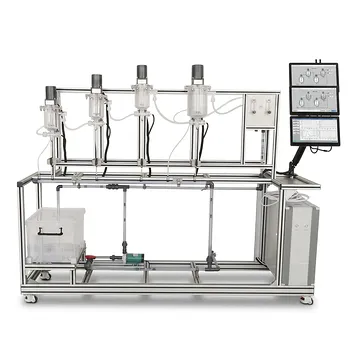
You’re comparing two workhorses of bioprocess teaching, and the difference comes down to how you put energy into the liquid.
In a mechanically agitated fermentor, a rotating impeller shears the gas into small bubbles and drives strong convective mixing. A bubble column, by contrast, has no moving parts in the liquid—it depends entirely on the buoyancy of rising gas bubbles to stir the broth and create interfacial area. These distinct approaches lead to very different design, operation, and learning outcomes in a unit ops lab.
The real lesson is that agitated fermentors give you direct, tunable control over mass transfer but add mechanical complexity and energy cost; bubble columns simplify hardware while forcing students to think deeply about fluid dynamics, bubble size distribution, and the way hydrodynamics dictate performance.
How Mechanical Agitation Shapes Mass Transfer and Control
Mixing and bubble creation are inseparable in a stirred tank. The impeller performs two jobs at once.
High $k_La$ Through Shear and Dispersion
The rotating Rushton turbine (or similar radial impeller) smashes the entering gas stream into very fine bubbles. This drastically increases the gas-liquid interfacial area $a$. Combined with strong bulk circulation, the liquid film resistance is minimized, yielding a volumetric mass transfer coefficient ($k_La$) that can be pushed to high values simply by increasing agitator speed or gas flow rate.
Predictable and Adjustable Performance
Because $k_La$ correlates strongly with power input per unit volume and superficial gas velocity, it is relatively easy for students to develop empirical correlations in the lab. They learn that by altering RPM, they can directly tune oxygen transfer to meet the demands of a hypothetical culture. This “knob‑turning” immediacy is a major pedagogical strength.
Mechanical Complexity as a Learning Point
The side‑entry agitator shaft requires a sterile seal (often a double mechanical seal), a motor, and a gearbox. Maintenance is higher, and students quickly grasp why mechanical design, seal selection, and energy cost are real considerations in industrial bioreactors—not just theoretical footnotes.
Bubble Columns: When Buoyancy Does the Work
Without any internal moving parts, a bubble column shifts the design burden entirely onto the gas sparger and the column geometry.
Mixing Driven Solely by Gas Rise
The power input comes from the isothermal expansion of the gas as it rises against the liquid head. Bubble swarms create a recirculation pattern (upward in the center, downward near the wall) that provides gentle, low‑shear mixing. This makes bubble columns particularly attractive for shear‑sensitive cultures, but it also limits mixing intensity in viscous or non‑Newtonian broths—a constraint students can quantify in experiments.
Hydrodynamic Sensitivities Become Front and Center
In a bubble column, the entire mass‑transfer behavior is governed by the superficial gas velocity ($U_G$). Students must identify and maintain a specific flow regime (pure bubbly flow for consistent performance) and observe how a seemingly small increase in gas flow can transition the column into a churn‑turbulent regime where coalescence and large bubbles reduce $k_La$. This teaches the concept of operational windows that are not always obvious at first glance.
Axial Dispersion and Pressure Gradients
Because mixing is less intense than in a stirred tank, axial dispersion—the spread of tracer along the column height—becomes a measurable and meaningful parameter. Additionally, the liquid head pressure gradient causes a variation in gas holdup and bubble size from bottom to top. Bubble segregation (where small bubbles have longer residence times) adds a layer of realism: students see that the “residence time distribution” of the gas phase directly impacts conversion and mass transfer, a nuance often invisible in a well‑mixed fermentor.
Understanding the Trade-offs in a Teaching Environment
No reactor is universally superior. Side‑by‑side operation reveals limitations that textbooks alone cannot convey.
- Agitated fermentors demand higher power consumption, and the moving seal introduces a contamination risk when sterility is simulated. Impellers also generate high shear stress, which may damage filamentous cultures or red blood cells—a critical consideration for bioprocess students.
- Bubble columns achieve lower $k_La$ per unit volume and can suffer from gas channeling or poor mixing if the sparger design is inadequate. In tall, narrow columns, significant axial gradients mean that the bulk liquid is not homogeneous, a concept that challenges students’ assumption of perfect mixing.
By purposely operating both vessels under identical aeration conditions, a lab can demonstrate that the “better” choice depends entirely on the biological system and the process objective, not just on mass transfer rate.
Making the Right Choice for Your Lab Curriculum
How you deploy these reactors should reflect the concepts you most want students to internalize.
- If your primary focus is quantitative $k_La$ measurement and straightforward process control: Lean heavily on the mechanically agitated fermentor. It allows clean, repeatable experiments where students can rapidly correlate agitation, aeration, and oxygen transfer.
- If your primary focus is hydrodynamics, mixing time analysis, and regime mapping: The bubble column is superior. It forces students to confront flow regimes, residence time distributions, and how pressure gradients alter local bubble behavior.
- If your goal is to teach selection methodology for real bioprocesses: Run both in parallel. Let students discover that an agitated vessel provides confidence in $k_La$ but at the price of shear and complexity, while a bubble column demands more careful hydrodynamic design but offers gentleness and mechanical simplicity—exactly the engineering trade‑off they will face in industry.
Whether you start with the stirring or the rising bubbles, the real lesson is never the vessel itself, but the skill of matching the reactor to the biology.
Summary Table:
| Feature | Mechanically Agitated Fermentor | Bubble Column Bioreactor |
|---|---|---|
| Mixing Mechanism | Rotating impeller (mechanical shear) | Gas buoyancy (no moving parts) |
| Mass Transfer ($k_La$) | High & easily tunable via RPM/aeration | Lower; governed by gas velocity ($U_G$) |
| Shear Stress | High (can damage shear-sensitive cells) | Low (gentle mixing for fragile cultures) |
| System Complexity | High (requires motors, seals, maintenance) | Low (simple column geometry, low maintenance) |
| Key Learning Focus | Mass transfer correlations & process control | Hydrodynamics, flow regimes & axial dispersion |
Equip Your Bioprocess Lab with LABPARK
Choosing the right bioreactor is key to delivering impactful engineering training. LABPARK provides premium Educational and Vocational Unit Operations Pilot Plants in chemical engineering, bioprocess & biotech, and environmental & water treatment. Designed specifically for universities, research institutes, and enterprises, our systems offer students hands-on experience with both mechanical agitation and bubble column hydrodynamics.
Ready to upgrade your lab curriculum? Contact our engineering experts today to find the perfect pilot plant solution for your institution.
Related Products
- Plate Column Hydrodynamics Tray Demonstration Educational Pilot Plant
- Agitation and Mixing Educational Unit Operations Pilot Plant
- Comprehensive Liquid-Liquid Extraction Pilot Plant for Engineering Education
- Bio-fermentation Ethanol Production Practical Training Unit Operations Pilot Plant
- Multi-Stage Stirred Tanks in Series Residence Time Distribution and Mixing Performance Determination Educational Pilot Plant
People Also Ask
- How to update chemometric calibration models in pilot plants? Best practices for process engineers.
- How does nuclear yield inefficiency translate to chemical engineering education? Optimize kinetics with pilot plants.
- How can educational pilot plants be used to teach process safety and risk assessment in chemical engineering curricula?
- Why Correct Sig Figs & Rounding Matter in Educational Pilot Plants: Ensure Data Accuracy
- Why Calculate Sieve Tray Pressure Drop? Optimize Distillation Pilot Plant Performance