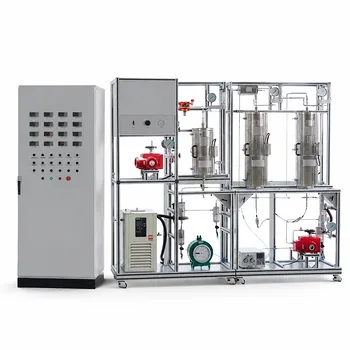
Side-by-side demonstration of direct quench and indirect cooling in a pilot plant turns an abstract textbook trade-off into a visceral, experimental reality. This hands-on comparison uniquely teaches students how heat management dictates reactor safety, product yield, and capital-versus-operating cost decisions in exothermic processes. By operating both configurations, learners directly observe thermal runaway control, high-grade energy recovery, and the profound impact of quenching on reaction pathways.
Experiencing both direct quench and indirect cooling side‑by‑side gives students an irreplaceable intuition for the core tension in reactor engineering: do you minimize upfront cost by injecting cold gas, or maximize energy efficiency by recovering heat at the highest possible temperature? Only through direct comparison can they truly internalize the process safety, energy integration, and design trade-offs that define industrial success.
From Abstract Equations to Intuitive Understanding
Why a Single Configuration Isn’t Enough
Textbook problems often isolate one cooling method, leaving students with a formulaic view.
A pilot plant that runs both configurations forces them to confront the real-time consequences of each choice—something no simulation can fully replicate.
The difference between quickly dumping heat with cold bypass gas and steadily extracting it through a heat exchanger becomes a felt, measurable reality.
Seeing Heat Management as a Strategic Lever
Temperature control is not merely a safety requirement.
It is the primary lever for steering yield, selectivity, and energy costs in an exothermic reactor.
When students adjust bypass flows or heat exchanger utility rates and watch the product distribution shift, they grasp that cooling is a design tool, not an afterthought.
Teaching Thermal Runaway Control Through Direct Experience
The Direct Quench Approach: Rapid Quenching, Lower Complexity
Injecting cold feed gas at inter‑bed locations instantly suppresses temperature excursions.
Students learn how to prevent runaway with a few valve adjustments, while also appreciating the inherent simplicity and lower capital cost.
The system’s fast dynamics turn the concept of “quenching” into an obvious, visually confirmed phenomenon.
The Indirect Cooling Approach: Precision Through Heat Exchange
Using inter‑bed heat exchangers recovers reaction heat at high temperature, often capable of generating high‑pressure steam.
Students gain hands‑on experience with heat transfer coefficients, utility flow control, and the slower, steadier dynamics of an exchanger‑based system.
They see why precise temperature maintenance demands careful tuning and a deeper understanding of thermal lag.
Critical Safety Lesson: Comparing Runaway Scenarios
By deliberately perturbing each system, students observe that direct quench responds almost instantly, buying precious seconds, while indirect cooling offers a more gradual but sustained response.
This side‑by‑side contrast drills in the fundamental trade‑off between immediate intervention and long‑term stability.
Unlocking the Energy Recovery Trade‑off
Low‑Temperature Quenching: A Hot Shower Down the Drain
Direct quench blends cold gas into the process stream, effectively degrading high‑grade heat into a lower‑temperature mixture.
Students measure the outcome and realize that the energy, though safely removed, is now too cold to generate valuable steam—a tangible lesson in lost economic potential.
Indirect Cooling: Capturing High‑Value Heat
Because heat exchangers extract energy at the highest process temperature, students can quantify the potential for co‑generation.
They see that a reactor cooled indirectly can supply high‑pressure steam to a turbine or another unit, transforming a cost center into a revenue stream.
Side‑by‑Side Economic Contrast
When students compare energy flows from both configurations in the same pilot plant session, they calculate real payback times for the added investment in heat exchangers.
The trade‑off between capital intensity and energy recovery ceases to be an abstract number and becomes a financially grounded decision.
Making Reaction Pathways Visible: Temperature Profiles and Yield
Visualizing the Temperature Trajectory Across Beds
With multiple thermocouples along the catalyst beds, students can map the exact temperature profile as they adjust bypass flows or utility rates.
A sudden drop from a quench injection creates a clear “sawtooth” pattern, while indirect cooling yields a smoother, more gradual descent—each pattern steering the reaction differently.
Steering Between the Equilibrium and Maximum Rate Curves
Supplementary knowledge of equilibrium and maximum‑rate curves becomes concrete.
Students watch how rapid quenching can pull the operating point away from optimum if not placed correctly, while indirect cooling tends to keep the trajectory closer to a high‑yield pathway.
This direct manipulation teaches process optimization in a way that classroom charts never can.
Understanding the Trade‑offs and Limitations
When Direct Quench Wins
- Lower capital cost and simpler construction.
- Immediate temperature suppression for runaway control.
- Best suited when heat recovery is not a priority or when space is limited.
However, it degrades valuable thermal energy and may miss the optimal temperature window for maximum yield if not carefully staged.
When Indirect Cooling Prevails
- Higher thermal efficiency and the ability to export high‑pressure steam.
- Better integration with plant‑wide energy networks.
- Often yields smoother temperature profiles that favor selectivity. The price is greater equipment complexity, higher investment, and a slower dynamic response that demands robust control strategies.
The Missing Middle Ground
Side‑by‑side experimentation lets students explore hybrid strategies, such as combining inter‑bed heat exchange with supplementary quench gas.
They learn that real‑world designs often blend both cooling philosophies, and they gain the confidence to evaluate where each element earns its place.
How to Maximize Your Pilot Plant’s Educational Impact
Align your experimental sessions with the specific learning outcomes you value most.
These tailored approaches turn the dual‑configuration pilot plant into a precision teaching tool.
- If your primary focus is process safety and control: Design runaway scenarios that force students to switch between cooling modes and analyze response times.
- If your primary focus is energy integration and sustainability: Assign a heat recovery audit, requiring students to calculate steam generation potential and compare the CO₂ footprint of each configuration.
- If your primary focus is reactor design optimization: Task students with mapping temperature profiles onto equilibrium curves and proposing mixed‑cooling arrangements for a given feedstock.
- If your primary focus is techno‑economic evaluation: Hand them a simulated business case and ask for a capital/operating cost comparison, with a justified recommendation.
The true educational benefit is not in learning which cooling method is “better,” but in developing the engineering judgment to know when each one is essential—a skill that stays long after the pilot plant is shut down.
Summary Table:
| Feature / Metric | Direct Quench Cooling | Indirect Cooling |
|---|---|---|
| Capital Cost & Complexity | Low (Simpler build, bypass valves only) | High (Requires complex heat exchangers) |
| Runaway Control Response | Instantaneous response to temperature spikes | Slower, gradual response due to thermal lag |
| Energy Recovery Value | Low (Degrades thermal energy into cold mix) | High (Recovers heat to generate high-pressure steam) |
| Temperature Profile | Sharp "sawtooth" profile at injection points | Smooth, gradual temperature gradient |
| Process Optimization Goal | Fast safety stabilization and low upfront cost | High thermal efficiency and plant-wide integration |
Bring Industrial Reality to Your Chemical Engineering Labs
Help your students bridge the gap between textbook equations and real-world process safety. LABPARK provides premium Educational and Vocational Unit Operations Pilot Plants in chemical engineering, bioprocess & biotech, and environmental & water treatment specifically engineered for universities, research institutes, and enterprises.
Our custom-built reactor systems allow learners to safely simulate thermal runaway, control heat recovery, and master process dynamics in real time.
Ready to upgrade your laboratory training capabilities? Contact LABPARK today to request a quote or design consultation!
Related Products
- Fixed-Bed Chemical Reaction and Gas Dust Tar Removal Unit Operations Pilot Plant
- Multi-Reactor Educational Pilot Plant for Reaction Engineering Unit Operations
- Fixed Bed Gas Solid Catalytic Reaction Educational Pilot Plant
- 100L Continuous Loop Hydrogenation Educational Unit Operations Pilot Plant
- Internal Circulation Gradient Free Catalytic Reaction Educational Pilot Plant
People Also Ask
- When to transition from PID to adaptive control in pilot plants? Key process indicators.
- How do deviations in estimating latent heat impact pilot plant thermal systems? Avoid hardware mis-sizing.
- Why Compare Predicted and Experimental Excess Enthalpy? Key to Accurate Pilot Plant Scale-up
- How to study gasification in pilot plants? Compare exit gas composition & efficiency
- Why Use PTFE & Hastelloy in Chemical Pilot Plants? Prevent Corrosion & Ensure Safety