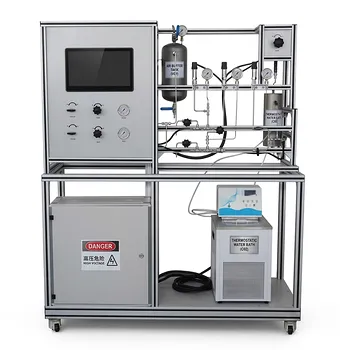
Here’s the core distinction at a glance: Steam flow rate control directly throttles the steam entering the heat exchanger to manage heat input, while condensate discharge control manipulates the liquid level inside the exchanger to vary the heat transfer surface area available. Both methods ultimately regulate the process fluid’s outlet temperature, but they do so through fundamentally different physical mechanisms and with markedly different dynamic behaviors. The right choice in your pilot plant hinges on whether you prioritize fast response or inherent stability, and on the practical realities of your steam supply and exchanger design.
The central takeaway: Steam flow control gives you immediate, high-gain responsiveness but demands careful attention to steam pressure stability and valve sizing. Condensate level control offers exceptional self-stabilizing behavior and eliminates steam valve headaches, at the cost of a pronounced time lag and the need for a vessel with enough liquid volume to make the strategy work.
Two Paths to Temperature Control
In any steam-heated unit operation, the overriding goal is nearly always the same: keep the process fluid’s exit temperature at a precise setpoint. The question is which variable you choose to manipulate to achieve that goal. The two most common approaches in pilot plants reveal a clear trade-off between speed and simplicity.
How Steam Flow Rate Control Works
This method positions a control valve on the steam inlet line. By opening or closing the valve, you directly increase or decrease the mass of steam entering the heat exchanger per unit time. More steam delivers more latent heat, so the process fluid temperature rises quickly. Less steam reduces the heat input just as directly. Because you are altering the energy source itself, the loop can react almost instantly to a change in demand or setpoint. The primary reference highlights one crucial caveat: if the steam supply pressure fluctuates, the relationship between valve position and steam flow becomes nonlinear, making cascade control—where a steam flow controller is slaved to a master temperature controller—practically essential.
How Condensate Discharge Control Works
Here, the manipulating element is a control valve on the condensate outlet line. Rather than limiting how much steam enters, you control how much condensate leaves. Restricting the outlet causes the liquid level inside the heat exchanger to rise, partially flooding the tubes. This flooding reduces the effective heat transfer area (F) that is in contact with condensing steam. Since the heat transfer rate is directly proportional to that area, a higher level means a lower rate of energy transfer to the process. Draining the condensate exposes more surface area, allowing the heat transfer rate to climb back up. The temperature changes because you are, in effect, varying the “active size” of the exchanger.
Note: This method does not directly limit steam flow; the steam continues to condense wherever it touches a cool tube surface, but that surface area becomes smaller as the level rises.
Control Dynamics in a Pilot Plant Environment
The differences in dynamic behavior between these two strategies are what really dictate their fit for a pilot plant.
Responsiveness and Time Lag
Steam flow control is highly responsive. The loop sees an immediate change in steam flow when the valve moves, so the process fluid temperature begins to shift with minimal dead time. In contrast, condensate level control inherently introduces a significant time lag. When you move the condensate valve, you are not instantly changing heat input; you are changing a liquid level that must physically build up or drain before the heat transfer area is altered enough to affect temperature. If the exchanger has a large shell volume, this delay can be substantial, making tight tuning a challenge for fast-moving processes.
Stability and Self-Regulation
The condensate method is exceptionally stable. As the process fluid draws more or less heat, the steam condensing rate changes naturally, and the level tends to find a new equilibrium on its own. The effective process gain is relatively low, and the sluggish response acts like a built-in damper. Steam flow control, on the other hand, can be more sensitive to disturbances, particularly from steam pressure swings. Without cascade control, a simple steam valve loop may oscillate when upstream conditions are erratic.
Valve Sizing and Installation Practicalities
A full-size steam control valve can be large, expensive, and prone to noise or erosion issues at low flows. Condensate control elegantly avoids steam valve sizing problems entirely. The condensate valve is smaller, operates at a much lower pressure, and handles liquid with far less mechanical stress. However, this method demands that the heat exchanger has sufficient physical volume to accommodate a fluctuating condensate level. If the shell or channel is too compact, you simply cannot generate enough level change to meaningfully modulate the heat transfer area—making the strategy unworkable.
Understanding the Trade-offs
Objectively, neither method is universally superior. Your choice will be driven by what you are willing to sacrifice.
- Steam flow control sacrifices some stability and valve simplicity for speed. It works beautifully when steam pressure is well regulated, but can become finicky and require cascade instrumentation when supply conditions are variable.
- Condensate level control sacrifices speed and demands a physically suitable exchanger, but gives you a remarkably robust, low-maintenance loop. The time lag, however, can be a deal-breaker for pilot plants that must track rapid temperature ramps or respond to fast load changes.
A common pitfall is attempting condensate level control in a heat exchanger that is too small to hold enough liquid. The result is a nearly on/off behavior with a tiny control band, which defeats the purpose of smooth control. Another mistake is assuming steam flow control will work well without any pressure compensation—if your boiler load fluctuates, you will likely need cascade control to maintain performance.
Making the Right Choice for Your Operation
Your decision should align with the realities of your pilot plant’s equipment, your steam supply, and the control performance you need. The following guide frames that decision around your primary objective.
- If your primary focus is rapid setpoint tracking and minimal process lag: Prefer steam flow rate control. Its immediate response is unmatched, provided you can manage steam pressure fluctuations, using cascade control if necessary.
- If your primary focus is exceptional loop stability and low mechanical stress on valves: Choose condensate discharge control. The process is naturally self-dampening and you avoid large steam-side valve issues, but only if your exchanger has enough volume to develop a useful level range.
- If your primary focus is operating under a highly variable steam supply pressure: Condensate control offers a distinct advantage. Since it modulates the effective exchanger area rather than steam flow directly, it is far less sensitive to upstream pressure swings, often eliminating the need for an extra flow loop.
- If your primary focus is on a small, compact heat exchanger with limited internal volume: Steam flow control will be the only practical method. Without room for a significant condensate level, the level-based strategy cannot deliver the necessary turn-down.
Ultimately, selecting the right technique is about matching the control method’s inherent dynamics to the physical constraints and performance demands of your pilot plant. When that alignment is made, the path to tight, reliable temperature control becomes decisively clear.
Summary Table:
| Feature | Steam Flow Rate Control | Condensate Discharge Control |
|---|---|---|
| Manipulated Variable | Steam inlet flow rate | Condensate level (flooded heat transfer area) |
| Response Time | Rapid and immediate | Slow (significant physical time lag) |
| System Stability | Sensitive to steam pressure fluctuations | Highly self-stabilizing and dampened |
| Valve Requirements | Large steam control valve (high wear/noise) | Smaller, low-stress liquid control valve |
| Exchanger Constraints | Works with compact heat exchangers | Requires sufficient internal shell volume |
Optimize Your Process Control with LABPARK
Are you looking to design or upgrade your laboratory facilities? LABPARK provides advanced Educational and Vocational Unit Operations Pilot Plants in chemical engineering, bioprocess & biotech, and environmental & water treatment. Tailored for universities, research institutes, and enterprises, our systems are engineered to help you master complex thermal dynamics and process controls with hands-on reliability.
Contact our engineering experts today to find the ideal pilot plant configuration for your research and educational needs!
Related Products
- Three-Tube Heat Transfer Educational Pilot Plant for Unit Operations Training
- Comprehensive Multi-Modal Heat Transfer Unit Operations Pilot Plant for Engineering Training
- Dual Mode Heat Transfer Pilot Plant for Unit Operations Training
- Comprehensive Heat Transfer Coefficient Determination Educational Unit Operations Pilot Plant
- Hot Filtration Educational Unit Operations Pilot Plant Laboratory System
People Also Ask
- When is ε-NTU preferred over LMTD in pilot plants? Predict heat exchanger performance without iteration.
- Why is the study of thermal boundary layers and Prandtl numbers critical in heat transfer unit operations pilot plants?
- How does cascade control achieve superior disturbance rejection in heat transfer pilot plants?
- How does transitioning to a multi-shell heat exchanger affect required area? Optimize pilot plant design.
- How does regular perturbation analysis aid in predicting nonlinear temperature distributions? Pilot plant insights