Knowledge Chemical Engineering Education What are the core design requirements for constructing a functioning battery cell? Key Lab Principles
Author avatar

Tech Team · LABPARK

Updated 1 month ago

What are the core design requirements for constructing a functioning battery cell? Key Lab Principles


The core design requirements for a functioning lab-scale battery cell boil down to four fundamental pillars. You must establish two distinct half-cells, each housing an element in two oxidation states—typically a solid metal and a solution of its ions. These half-cells must be bridged by an electrolyte that allows ion migration to preserve electrical neutrality. The negative terminal must be the material with the greater thermodynamic drive to lose electrons. Finally, the open-circuit voltage is not arbitrary; you engineer it by selecting active material pairs, their concentrations, and the operating temperature.

The laboratory battery cell is an exercise in controlled redox separation. You need two complementary half-cells, a continuous ionic pathway, correct polarity assignment based on oxidation potential, and a voltage determined by Nernstian thermodynamics—not guesswork.

The Electrochemical Blueprint of a Lab-Scale Cell

Principle 1: Two Half-Cells with Redox Couples

Every functioning cell demands a redox pair. Each half-cell must contain an element in two oxidation states—most commonly a metal electrode immersed in a solution of its own ions (e.g., Zn²⁺/Zn). This creates the electrochemical potential that drives the reaction.

You cannot mix the two active materials directly; they must remain spatially separated to force electrons through the external circuit. The physical separation of oxidation and reduction sites is the foundational design constraint.

Principle 2: An Ionic Pathway for Charge Neutrality

Without charge balance, current stops. A salt bridge or porous separator soaked in an inert electrolyte connects the half-cells, allowing ions—not electrons—to flow.

This ionic conduction loop prevents the build-up of net charge that would instantly kill the electrochemical driving force. The electrolyte must be chemically compatible with both half-cells and offer low ionic resistance to avoid large voltage drops under load.

Principle 3: Assigning the Negative Terminal Correctly

The polarity of a cell is dictated by thermodynamics, not arbitrary wiring. The negative electrode (anode) must be the material with the greater reduction potential negative—the species with a stronger tendency to give up electrons.

In a Zn/Cu Daniell cell, zinc oxidizes more readily, so it becomes the negative terminal. Getting this wrong reverses the spontaneous direction and delivers zero useful voltage. Lab builds must reference the electrochemical series to assign terminals before assembly.

Principle 4: Engineering the Output Voltage

You control the open-circuit voltage through three levers: the identity of the redox couples, the concentration of the active ions, and temperature. The Nernst equation quantifies this relationship, revealing that even small concentration differences can shift voltage by tens of millivolts.

For a truly stable, repeatable measurement, you must also consider junction potentials at the salt bridge interfaces. These small offsets are an unavoidable design parameter when two different electrolyte solutions meet.

Understanding the Trade-offs in Lab Implementations

Choosing highly diluted electrolytes for educational clarity produces a cell voltage that drifts as the reaction progresses, because the Nernst term changes as ions are consumed. That sacrifices the very stability you want to demonstrate.

Even an ideal thermodynamic voltage can be masked by a poorly designed separator. A thick, low-porosity barrier raises ionic resistance, causing a significant iR drop under any load. The result is a measured terminal voltage far below the design value, mimicking a failed cell.

Temperature control is a double-edged sword. Higher temperatures reduce electrolyte viscosity and improve ion mobility, but they also accelerate self-discharge and can corrode electrode materials faster. In a teaching lab, consistent room-temperature operation often proves more predictable than aggressive heating.

Finally, contaminant ions from impure reagents or atmospheric oxygen can set up competing half-reactions. A cell that delivers erratic voltages or slowly decays often suffers from these parasitic processes, not a flaw in the core design principles.

Making the Right Choice for Your Lab Goal

Your selection of materials, concentrations, and cell geometry should directly serve your specific experimental objective.

  • If your primary focus is demonstrating fundamental thermodynamics: Use a classic Daniell cell (Zn | Zn²⁺ || Cu²⁺ | Cu) with 1.0 M solutions and a simple agar salt bridge. This delivers a textbook ~1.1 V and cleanly illustrates the Nernst equation.
  • If your primary focus is long-term stability for extended measurements: Choose electrode couples with slow self-discharge kinetics, seal the cell to minimize oxygen ingress, and maintain equal ionic strengths in both compartments to reduce liquid junction potential drift.
  • If your primary focus is maximizing open-circuit voltage with safe, common materials: Pair a strongly reducing metal like magnesium or aluminum with a copper or silver cathode and high-concentration electrolytes—but note that kinetics may limit practical current draw, so voltage alone does not guarantee usable power.
  • If your primary focus is teaching the impact of concentration changes: Build a symmetric cell with identical metal electrodes but different salt concentrations. The voltage will depend entirely on the concentration ratio, isolating the Nernst effect without introducing new redox couples.

A successful lab cell is never just a recipe—it is a deliberate application of these four pillars, balanced against the real-world compromises of your environment and goals.

Summary Table:

Design Pillar Core Function Lab Implementation Tip
Two Half-Cells Generates electrochemical potential Spatially separate active redox couples to force external electron flow.
Ionic Pathway Maintains charge neutrality Use a low-resistance salt bridge or porous separator to minimize voltage drop.
Negative Terminal Provides the electron source Identify and assign the anode using the thermodynamic electrochemical series.
Voltage Control Defines open-circuit voltage Adjust concentration, temperature, and material pairs via the Nernst equation.

Elevate Your Chemical Engineering Lab with LABPARK

Translating electrochemical theory into hands-on practice requires precise, reliable equipment. LABPARK provides state-of-the-art Educational and Vocational Unit Operations Pilot Plants in chemical engineering, bioprocess & biotech, and environmental & water treatment.

Designed specifically for universities, research institutes, and enterprises, our pilot plants help students and researchers safely explore thermodynamics, transport phenomena, and reaction kinetics with industry-grade control systems.

Ready to enhance your curriculum or research capabilities? Contact us today to find the ideal pilot plant solution for your facility!

Related Products

People Also Ask

Related Products

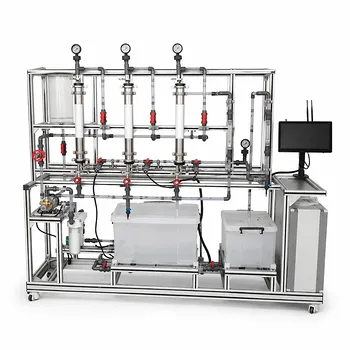
Electrolyte Distillation Purification and Formulation Educational Pilot Plant

Electrolyte Distillation Purification and Formulation Educational Pilot Plant

Integrated bench-to-pilot scale educational pilot plant for electrolyte distillation, purification, and formulation with borosilicate glass construction, PLC automation, touchscreen HMI, and advanced industrial safety features for hands-on chemical process training, ideal for chemical engineering and materials science curricula.

Water Electrolysis Hydrogen Production and Storage Educational Pilot Plant

Water Electrolysis Hydrogen Production and Storage Educational Pilot Plant

Integrated pilot-scale training system for higher education engineering labs. Features AWE/PEM electrolysis, adjustable DC power, PLC controls, gas-liquid separation, and pressurized hydrogen storage. Hands-on learning in green hydrogen, process control, and safety, ideal for chemical and energy departments.

Electrolytic Hydrogen Production Educational Unit Operations Pilot Plant

Electrolytic Hydrogen Production Educational Unit Operations Pilot Plant

Bench-scale electrolytic hydrogen production pilot plant designed for university engineering labs. Provides hands-on training in water electrolysis, gas-liquid separation, and process safety. Fully customizable system with digital PID control, corrosion-resistant components, and hydrogen gas detector. Ideal for chemical engineering curricula.

Electrochemical Water Treatment Educational Unit Operations Pilot Plant

Electrochemical Water Treatment Educational Unit Operations Pilot Plant

Enhance engineering education with this pilot-scale electrochemical water treatment plant. Designed for hands-on learning of efficient salt removal, electrolytic reactions, and real-time data acquisition. Features multi-mode control, corrosion-resistant PVC, low-voltage safety, and wireless connectivity for modern teaching labs.

Multi-Reactor Educational Pilot Plant for Reaction Engineering Unit Operations

Multi-Reactor Educational Pilot Plant for Reaction Engineering Unit Operations

Integrated bench-scale educational pilot plant for chemical engineering teaching featuring fixed bed fluidized bed and stirred tank reactors with web-based digital twin controls and safety interlocks for hands-on unit operations and reaction engineering comparative studies in one compact system.

Alkaline Membrane Water Electrolysis Educational Pilot Plant Unit Operations Training System

Alkaline Membrane Water Electrolysis Educational Pilot Plant Unit Operations Training System

Hands-on educational pilot plant for alkaline membrane water electrolysis hydrogen production, integrating unit operations training with industrial PLC control, real-time data logging, customizable design, durable 316L stainless steel construction, explosion-proof safety, and modern 5G connectivity for university laboratories.

Multi-Functional Membrane Separation Educational Pilot Plant for Unit Operations Lab

Multi-Functional Membrane Separation Educational Pilot Plant for Unit Operations Lab

The Multi-functional Membrane Separation Educational Unit Operations Pilot Plant is an integrated bench-scale laboratory system designed for teaching undergraduate engineering education. It features Ultrafiltration, Nanofiltration, and Reverse Osmosis modules in a compact, mobile unit for practical hands-on learning.

Multifunctional Membrane Separation Educational Pilot Plant with Ultrafiltration, Nanofiltration, Reverse Osmosis

Multifunctional Membrane Separation Educational Pilot Plant with Ultrafiltration, Nanofiltration, Reverse Osmosis

An integrated laboratory bench-scale membrane separation system for higher education engineering labs combining Ultrafiltration, Nanofiltration, and Reverse Osmosis processes. Features industrial PLC control with touch-screen HMI, transparent piping, and academic assessment software. Ideal for chemical and environmental engineering curricula.

Hot Filtration Educational Unit Operations Pilot Plant Laboratory System

Hot Filtration Educational Unit Operations Pilot Plant Laboratory System

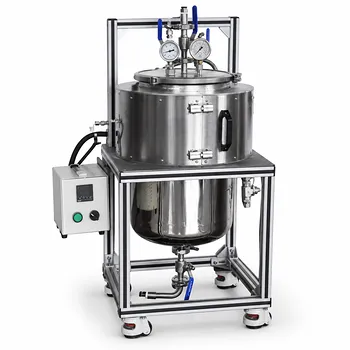
This integrated laboratory bench-scale hot filtration pilot plant enables students to study solid-liquid separation under thermal conditions, featuring a stainless steel vessel, removable heating jacket, and multi-layer filter plates for unit operations education, ideal for chemical engineering laboratory curriculum.

Liquid-Liquid Mass Transfer Coefficient Determination Educational Pilot Plant

Liquid-Liquid Mass Transfer Coefficient Determination Educational Pilot Plant

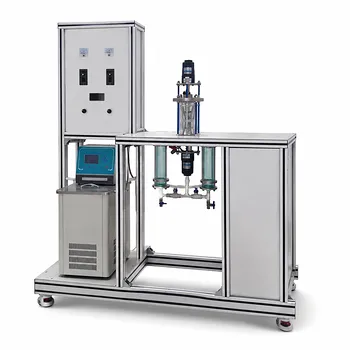
This bench-scale educational pilot plant for liquid-liquid mass transfer coefficient determination offers precise control of phase boundary, temperature, and agitation, enabling hands-on study of transport phenomena and unit operations in chemical engineering labs for teaching.

Constant Pressure Filtration Educational Unit Operations Pilot Plant

Constant Pressure Filtration Educational Unit Operations Pilot Plant

Hands-on educational pilot plant for constant pressure filtration. Classic plate and frame filter press allows students to study kinetics, determine specific cake resistance, perform cake washing and evaluate washing rates. Ideal for chemical engineering curriculum. Mobile, customizable, safety-compliant design.

Ion Exchange Water Purification Educational Pilot Plant for Engineering Unit Operations

Ion Exchange Water Purification Educational Pilot Plant for Engineering Unit Operations

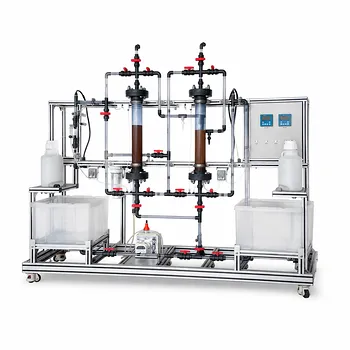
This bench-scale ion exchange pilot plant trains engineering students in water purification. Dual transparent columns simulate industrial softening and demineralization. Students observe fluid dynamics, perform resin regeneration, and analyze breakthrough curves. The corrosion-resistant frame ensures durability in unit operations experiments.

Multi Functional Catalytic Reaction and Reactor Evaluation Educational Unit Operations Pilot Plant

Multi Functional Catalytic Reaction and Reactor Evaluation Educational Unit Operations Pilot Plant

Bench-scale educational pilot plant for catalytic reaction and reactor evaluation, integrating fixed bed, fluidized bed, and stirred tank reactors. Students compare reactor designs, evaluate catalysts, and study reaction kinetics and hydrodynamics. Perfect for unit operations labs in chemical engineering curricula.

Educational Compression Refrigeration Performance Determination Unit Operations Pilot Plant

Educational Compression Refrigeration Performance Determination Unit Operations Pilot Plant

This educational pilot plant for compression refrigeration performance determination offers dual COP evaluation, regenerative cycle comparison, and calorimeter calibration. Customizable for curriculum integration, it features environmentally conscious design. Supports thermodynamic mapping on pressure-enthalpy diagrams and synchronous monitoring with centralized instrumentation.

Methanol Synthesis and Catalyst Performance Evaluation Educational Unit Operations Pilot Plant

Methanol Synthesis and Catalyst Performance Evaluation Educational Unit Operations Pilot Plant

Bench-scale methanol synthesis and catalyst evaluation educational pilot plant for chemical engineering labs to study catalytic kinetics, high-pressure operations, process control, and unit operations under realistic conditions with industrial safety features, precision gas delivery, data acquisition, and intelligent monitoring.

100L Continuous Loop Hydrogenation Educational Unit Operations Pilot Plant

100L Continuous Loop Hydrogenation Educational Unit Operations Pilot Plant

This 100L continuous loop hydrogenation pilot plant is designed for chemical engineering education, featuring 316 stainless steel construction, advanced gas-liquid mass transfer components, explosion-proof safety systems, and a 15.6-inch touchscreen with 5G connectivity, cloud data logging, bridging theory and industry.

General Purpose Cosmetics Production Unit Operations Training Pilot Plant

General Purpose Cosmetics Production Unit Operations Training Pilot Plant

Integrated pilot-scale cosmetics production training plant for chemical engineering education featuring utility supply emulsification blending and filtration modules with dual touchscreen manual control customizable mobile design ideal for practical hands-on unit operations and advanced process control learning.

Continuous Batch Extractive Distillation Educational Pilot Plant

Continuous Batch Extractive Distillation Educational Pilot Plant

Versatile pilot plant for continuous, batch, and extractive distillation training. High-borosilicate glass column for visualizing hydraulics, 15.6-inch touchscreen with data logging, precise reflux ratio control 1-99, and durable corrosion-resistant frame. Ideal for chemical engineering education and process research.

Supercritical High-Gravity Flash Evaporation Educational Unit Operations Pilot Plant

Supercritical High-Gravity Flash Evaporation Educational Unit Operations Pilot Plant

Bench-scale integrated teaching system for advanced separation and mass transfer, combining supercritical high-gravity flash evaporation with heating, chemical reaction, and material collection, featuring modular design, Stainless Steel 316L construction, transparent visualization, touchscreen control, and safety systems for chemical engineering education.

Rising and Falling Film Evaporation Educational Unit Operations Pilot Plant

Rising and Falling Film Evaporation Educational Unit Operations Pilot Plant

Hands-on educational pilot plant for studying rising and falling film evaporation, flow regimes, and heat transfer. Customizable for university labs with industrial instrumentation and data acquisition. Enables comparative evaluation of evaporation modes and energy efficiency.


Leave Your Message