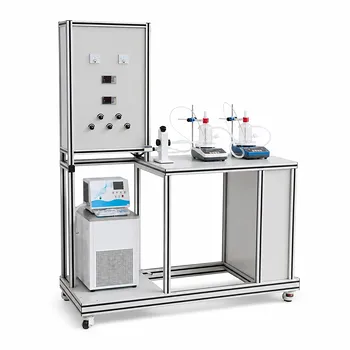
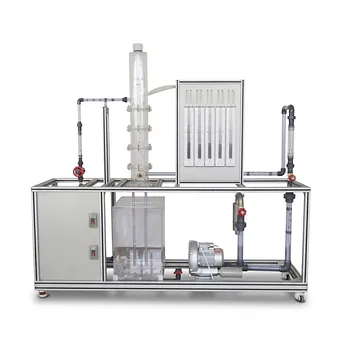
Packed beds and tray-type internals are the two foundational configurations you’ll find inside a liquid-liquid extraction column in a unit operations laboratory. A packed column uses either random or structured packing to create a continuous contact zone between the two immiscible liquids, while a tray column—typically with sieve trays lacking downcomers—forces the liquids through a series of discrete stages.
The core design challenge is not just picking an internal type, but sizing the column to safely operate between 50% and 90% of its flooding limit. This window lets students explore real hydraulic phenomena like loading and flooding without risking a shutdown, while also avoiding the opposite problem of channeling that kills mass transfer efficiency in oversized columns.
The Two Core Internal Configurations
Packed Beds: Maximizing Continuous Contact Surface
Packed columns are the most common standard in teaching and pilot-scale extraction because they provide an elegant demonstration of continuous counter-current contact. Structured packing (corrugated metal or plastic sheets, or fine gauze) or random packing (rings, saddles) is poured or stacked inside the tower to create a maze of wetted surface area.
The goal is to maximize the interfacial area where the dispersed phase (tiny droplets) meets the continuous phase. In a lab, this direct visualisation of droplet rise or fall through a packed bed helps students connect textbook theory to a real hydraulic gradient.
Tray Columns: Stage-Wise Contact for Specific Separations
When a system demands a defined number of theoretical stages, sieve-type trays without downcomers become the internals of choice. Unlike distillation trays, these have no downcomers because both liquids flow through the same perforations, just in opposite directions.
They function by creating a cascade of mixing zones. This configuration is particularly useful for lab experiments that require sampling at different heights to build a McCabe-Thiele diagram, as each tray represents a discrete equilibrium step.
Critical Design Considerations for Lab-Scale Columns
Selecting Internals Based on the Required Number of Stages
The separation difficulty dictates the column type. For simple separations requiring 3 or fewer theoretical stages, a simple packed or even a spray tower is adequate and cost-effective in a laboratory.
If the system demands 4 to 10 stages, a sieve tray tower or a pulsed column becomes the recommended choice. For complex separations above 10 stages, mechanically agitated devices—rotating disc or reciprocating plate columns—are often introduced, though they are less common in a basic unit ops lab.
Preventing Flow Channeling in Packed Beds
Every packed column has a height limit. If the packed section grows too tall, the liquid phases begin to migrate toward the wall, creating a preferential path that ruins the uniform distribution.
This channeling effect reduces the effective interfacial area and can make experimental results misleading. In educational pilot plants, packing is typically limited to a reasonable height-to-diameter ratio, and the bed may even be broken into multiple shorter sections with redistribution between them.
The Overlooked Role of Liquid Distribution
Proper liquid distribution is non-negotiable for reliable mass transfer data. For small-diameter laboratory columns, a simple central half-open pipe or an inlet nozzle is often sufficient.
However, as column diameter increases—even in a pilot-scale setup—a dedicated distributor becomes necessary. Orifice distributors pass liquid through small holes while gas (or the light phase) moves up through riser tubes, while weir distributors use notch overflow to handle a wider range of flow rates. Any gravity-fed distributor must be perfectly level, or maldistribution will invalidate the experiment immediately.
Sizing the Column: A Balancing Act
The Flooding Danger Zone
If you pick a diameter that is too narrow, the high phase velocities will cause droplets to coalesce and reverse direction. This flooding condition leads to a rapid loss of phase separation and often forces a complete process shutdown.
For a teaching lab, a sudden flood is a dramatic but valuable learning moment—provided the column is designed to contain the liquids safely.
The Silent Threat of Channeling
The opposite mistake—selecting an oversized column—is less dramatic but just as damaging. When the column diameter is too large, the liquid phases move so slowly that they find the path of least resistance, forming rivulets instead of a dispersed cloud.
This channeling starves most of the packing or tray area of the necessary phase contact, producing separation results that fail to match theoretical predictions.
Hitting the Operating Sweet Spot
The reliable operating window for an educational extraction column is between 50% and 90% of the flooding limit. At this level, the column demonstrates loading behavior, where mass transfer efficiency actually increases as the holdup of the dispersed phase rises, right up to the point just before flooding.
Sizing the tower diameter based on the design liquid rates and the packing factor (for packed columns) ensures that students can safely approach, but not accidentally exceed, this flood point.
Understanding the Trade-offs
Packed vs. Tray: When to Choose Each
Packed columns excel with low-interfacial-tension systems and when you need a small pressure drop per unit height, but they are more susceptible to channeling if the liquid distribution is poor. They also offer fewer distinct sampling points for stage-by-stage analysis.
Sieve tray columns, on the other hand, provide discrete sampling locations and can handle a wider range of liquid flow rates without weeping or entrainment becoming severe. The downside is a higher pressure drop and a more complex mechanical construction, even in glass lab columns.
Footprint vs. Headroom
The physical laboratory space often dictates the final design. Vertical extraction columns require minimal floor space but significant headroom. If your lab has a low ceiling, a horizontal mixer-settler train may be the only option.
Conversely, if floor space is at a premium, the tall vertical column is the natural choice, forcing you to address potential liquid distribution issues with the right internals.
When Simple Gravity Isn’t Enough
Systems with a high viscosity, an extremely low interfacial tension, or a tiny density difference are notoriously difficult to separate by gravity alone. In these cases, a standard packed or tray column may simply fail to produce clear phases. The trade-off is to introduce energy-input equipment like centrifugal extractors or pulsed columns, which are more complex but essential for completing the separation and obtaining meaningful data.
Making the Right Choice for Your Lab Experiment
Your choice of column internals and dimensions should be driven by the specific learning objective or separation goal.
- If your primary focus is demonstrating stage-wise contact and building a McCabe-Thiele diagram: Choose a sieve tray column without downcomers. The discrete sampling taps let students measure actual stage compositions directly.
- If your primary focus is observing continuous counter-current flow and hydraulic limits like flooding and loading: A packed column with a glass shell and structured packing is invaluable. Make sure to size the diameter to keep operation in that 50–90% flood window.
- If your primary focus is separating a heat-sensitive or high-viscosity mixture: Re-evaluate whether a gravity-driven column is enough. You may need to add a pulsed mechanism or switch to a rotating disc contactor, even at the pilot scale.
- If your primary focus is maximizing throughput in a limited footprint: A vertical packed column is your default, but pay extreme attention to the liquid distributor design and bed height to avoid channeling from the start.
Trust the fundamentals: match the internals to the required theoretical stages, size the column for the design liquid rates, and always leave a safe operating margin to turn a potential plant trip into a powerful teaching moment.
Summary Table:
| Feature | Packed Beds (Continuous) | Tray Columns (Stage-Wise) |
|---|---|---|
| Contact Type | Continuous contact (via random/structured packing) | Stage-wise contact (via sieve trays without downcomers) |
| Optimal Stages | Simple separations (≤ 3 stages) | Discrete separations (4 to 10 stages) |
| Main Advantage | Low pressure drop, high interfacial area | Easy stage sampling for McCabe-Thiele diagrams |
| Primary Risk | Phase channeling and wall migration | Higher pressure drop, complex mechanical design |
| Operating Range | 50% to 90% of flooding limit | 50% to 90% of flooding limit |
Bring Industry-Grade Unit Operations to Your Lab
Are you looking to upgrade your chemical engineering curriculum or research facilities? LABPARK provides state-of-the-art Educational and Vocational Unit Operations Pilot Plants in chemical engineering, bioprocess & biotech, and environmental & water treatment for universities, research institutes, and enterprises.
Our custom-designed liquid-liquid extraction columns are engineered to demonstrate critical hydraulic phenomena safely, helping students master complex concepts like loading, flooding, and channeling in a controlled environment.
Get in touch with our engineering team to design the perfect system for your lab—contact LABPARK today!
Related Products
- Educational Rotary Disc Liquid-Liquid Extraction Pilot Plant
- Comprehensive Liquid-Liquid Extraction Pilot Plant for Engineering Education
- Gallium and Indium Selective Extraction Educational Pilot Plant
- Packed Bed Absorption Educational Unit Operations Pilot Plant
- Multi-Functional Special Distillation Educational Pilot Plant
People Also Ask
- How do density and IFT affect liquid-liquid extraction pilot plants? Optimize Column Performance
- How to Estimate KD for Liquid-Liquid Extraction Pilot Plants Using Henry's Law when Lab Data is Limited
- How to Select a Liquid-Liquid Extraction Pilot Plant with Space Constraints: Key Factors
- In a liquid-liquid extraction pilot plant, how is a ternary-phase diagram utilized to determine solvent feed requirements?
- How to resolve emulsion in liquid-liquid extraction? 5 ways to ensure efficient phase separation