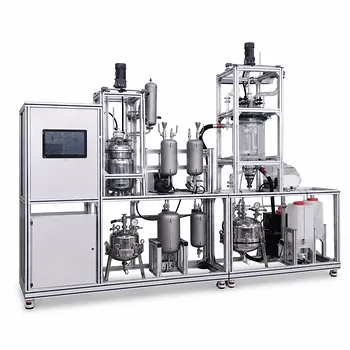
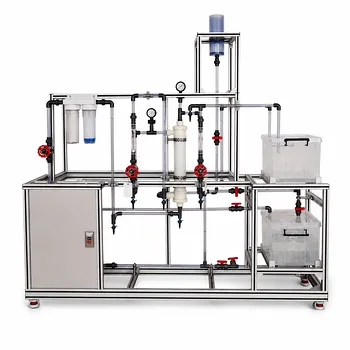
Supercritical fluids unlock a fundamentally cleaner and faster extraction process by behaving like a hybrid of a liquid and a gas. Their liquid-like density gives them powerful solvating ability, while their gas-like diffusivity and low viscosity drive dramatically faster mass transfer. Studying them in a chemical engineering pilot plant reveals these advantages in action: learners can safely manipulate pressure and temperature to switch the solvent from a dense extracting phase to a separable gas, recovering products with no solvent residue and minimal energy waste.
The real benefit of studying supercritical fluid extraction isn’t just learning a “green” technique—it’s gaining a hands-on understanding of how to replace multi-step purification with a single, tunable physical property change. A dedicated pilot plant turns this from a textbook abstraction into a design skill, allowing students to directly map process parameters to yield, selectivity, and sustainability.
Why Supercritical Fluids Outperform Traditional Extraction Solvents
The Unique Dual Identity of a Supercritical Fluid
A fluid above its critical point combines the high density of a liquid (400–900 kg/m³ under pressure) with the low viscosity (3–9 × 10⁻⁵ Pa·s) and high diffusivity (0.2 × 10⁻³ m²/s) of a gas. This eliminates the sluggish mass transfer that bottlenecks liquid-liquid extraction.
Because the solvent power is density-driven, small changes in pressure or temperature instantaneously alter solubility. That gives operators a precision-control lever that conventional solvents cannot offer.
Elimination of Solvent Residue and Purification Steps
The most significant industrial benefit is simple solvent recovery via depressurization. When the fluid returns to a gas, it separates completely from the extract, leaving zero solvent contamination in the product. There is no need for energy-intensive distillation or stripping—the solvent is recycled in a closed loop.
This “self-removing” solvent effect slashes downstream processing costs and is the reason supercritical CO₂ has become the gold standard for food-grade decaffeination and pharmaceutical extractions.
Accelerated Mass Transfer and Shorter Cycle Times
With diffusivities roughly an order of magnitude higher than liquids, supercritical fluids penetrate solid matrices far faster. Extractions that might take hours in Soxhlet systems can be completed in minutes with higher overall yields.
The enhanced mass transfer also means less solvent volume is needed overall, which further reduces both operational expenses and the environmental footprint.
Processing Heat-Sensitive, High-Value Compounds
Because supercritical CO₂ operates at moderate temperatures (often just above 31 °C), it can extract thermolabile biomolecules—essential oils, antioxidants, cannabinoids—without thermal degradation. This preserves bioactivity and aroma profiles that would be destroyed by steam distillation or hot organic solvents.
For industries moving toward natural, clean-label products, this capability alone justifies the shift away from volatile organic compounds.
How Chemical Engineering Pilot Plants Make the Technology Teachable
From Abstract State Diagrams to Tangible Cause-and-Effect
A supercritical fluid extraction pilot plant brings the phase envelope to life. Students and researchers physically adjust temperature and pressure, then watch the effect on extraction yield, selectivity, and phase behavior. That direct feedback transforms theoretical knowledge of thermodynamics and transport phenomena into practical process intuition.
The primary reference underscores this: the pilot plant enables safe manipulation of the very parameters—pressure, temperature, co-solvent addition—that control the supercritical state, demonstrating exactly how physical property shifts translate into optimized extraction and even supercritical fluid chromatography.
Embedding Quality by Design and Experimental Frameworks
Modern pilot plants are instrumented to support a Quality by Design (QbD) approach. Students can classify variables into controllable parameters (C), noise factors (N), and experimental variables (X), then run structured Design of Experiments (DoE) to map robustness regions.
This teaches not just the “how” of extraction but the mindset of systematic process development: identifying sensitivity, interactions, and failure edges before scale-up.
Bridging Classic and Green Techniques in One Lab
Integrating a supercritical extraction unit alongside a traditional Soxhlet extractor creates a comparative curriculum. Learners can contrast the diffusion-limited, multi-cycle nature of Soxhlet with the rapid single-pass SFE method, quantifying differences in yield, solvent consumption, and extract purity.
Such side-by-side analysis grounds the “green chemistry” narrative in hard data—students measure the actual reduction in hazardous waste and energy use, cementing the business case for sustainable design.
Safe, Hands-On Engagement with High-Pressure Processes
Industrial supercritical operations are high-pressure systems requiring rigorous safety protocols. A well-designed pilot plant provides a controlled, transparent environment where students can operate valves, view separation vessels, and monitor real-time pressure/temperature curves.
This demystifies what would otherwise be a remote, black-box process on a plant tour and builds the confidence to design and troubleshoot high-pressure unit operations in future professional roles.
Understanding the Trade-offs and Real-World Limitations
Capital Cost and Energy for Compression
The biggest barrier is the high-pressure infrastructure: pumps, thick-walled vessels, and high-spec seals demand significantly greater capital investment than simple stirred-tank extraction. While energy savings appear downstream, the compression work to reach supercritical conditions can be substantial, especially if CO₂ recovery loops are not optimized.
A balanced evaluation must weigh the avoided cost of solvent disposal and purification against the upfront equipment expense.
Solubility Gaps and the Need for Co-Solvents
Pure supercritical CO₂ is a non-polar solvent. It excels with lipids, essential oils, and non-polar small molecules but struggles with polar compounds. Adding a co-solvent such as ethanol can expand the solvating range, but this reintroduces a liquid component that may complicate downstream separation and requires removal if zero-residue claims are to hold.
The pilot plant teaches this nuance directly: varying co-solvent percentage is itself a critical process variable that demands careful design.
Not Always the Fastest Route for Bulk, Low-Value Products
For high-volume, low-margin commodities where a little solvent residue is acceptable, traditional extraction may remain more economically viable. Supercritical technology delivers its strongest value where purity, bioactivity, and regulatory cleanliness are paramount—a classic case of matching the technology to the product, not assuming universal superiority.
Making the Right Choice for Your Educational or Research Goal
The decision to build a supercritical fluid extraction pilot plant or incorporate SCF modules into an existing unit ops lab should be driven by the learning outcomes you prioritize.
- If your primary focus is teaching green chemistry and sustainability: Prioritize a system that clearly demonstrates solvent elimination, CO₂ recycling, and energy comparison. Use it to replace hazardous VOC-based labs and let students measure the environmental metrics directly.
- If your primary focus is advanced process control and DoE: Select a highly instrumented plant with fine pressure/temperature control and the ability to log real-time data. Build experiments around C&E matrices, sensitivity analysis, and design-space mapping.
- If your primary focus is bridging classical and modern extraction: Combine the SFE unit with a traditional Soxhlet station. Structure the course around a comparative study where students quantify the trade-offs in yield, time, purity, and cost for a botanical extract.
- If your primary focus is industry readiness for pharmaceuticals and food science: Incorporate protocols that mimic cGMP documentation and train students on the entire cycle—from raw material preparation to extract collection and solvent recovery—as a simulated batch record exercise.
A supercritical extraction pilot plant is not just another unit operation; it is a platform for teaching how to trade off thermodynamic potential against economic and safety realities, empowering the next generation of engineers to design separation processes that are truly sustainable by design.
Summary Table:
| Feature | Supercritical Fluid Extraction (SFE) | Traditional Extraction (e.g., Soxhlet) |
|---|---|---|
| Mass Transfer | Rapid (high diffusivity, low viscosity) | Slow (diffusion-limited) |
| Solvent Residue | Zero residue (via gas depressurization) | High risk (requires distillation/stripping) |
| Temperature | Low/Moderate (e.g., 31°C for CO2) | High heat (risks thermal degradation) |
| Process Control | Tunable (pressure/temp adjustment) | Fixed by solvent properties |
Bring Advanced Green Chemistry into Your Lab
Ready to equip your students and researchers with hands-on experience in sustainable process engineering?
LABPARK provides high-quality Educational and Vocational Unit Operations Pilot Plants in chemical engineering, bioprocess & biotech, and environmental & water treatment. Specifically designed for universities, research institutes, and enterprises, our plants allow you to:
- Enhance Practical Intuition: Bridge the gap between thermodynamic theory and real-world cause-and-effect.
- Teach Safety First: Provide safe, controlled environments for mastering high-pressure unit operations.
- Foster Quality by Design (QbD): Support advanced instrumentation and data-logging for modern research.
Contact LABPARK today to discuss how our pilot plants can elevate your curriculum and research capabilities!
Related Products
- Supercritical High-Gravity Flash Evaporation Educational Unit Operations Pilot Plant
- Comprehensive Liquid-Liquid Extraction Pilot Plant for Engineering Education
- Gallium and Indium Selective Extraction Educational Pilot Plant
- Natural Product Extraction Unit Operations Training Pilot Plant
- Continuous Batch Extractive Distillation Educational Pilot Plant
People Also Ask
- How is the heat transfer area calculated for an evaporation unit operations pilot plant during experimental design? Guide
- How to select educational evaporator pilot plants for thermal & scaling solutions? Complete Guide
- How to Connect Benchtop Evaporation to Pilot Plants in Chemical Engineering Education
- How are Dühring plots applied in evaporation pilot plants? Practical guide to boiling point prediction
- What is the practical significance of Kb in pilot plant evaporation? Master process design.