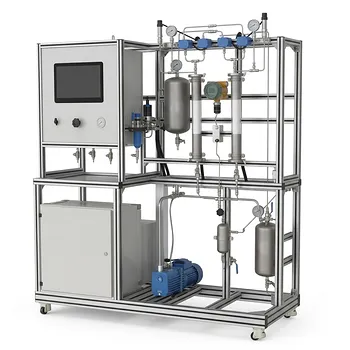
Supercritical water oxidation (SCWO) pilot plants give you the fastest, most complete destruction of hazardous organic pollutants available today—all while generating the critical engineering data needed to make the technology safe and scalable. In a single, tightly controlled experimental run, these plants can convert toxic compounds like phenols or pesticide residues into harmless carbon dioxide, water, and nitrogen, achieving greater than 97% total organic carbon removal in seconds. The real advantage is that they move beyond simple chemistry demonstrations: they allow environmental engineers to systematically optimize destruction efficiency, test corrosion-resistant materials, and collect the scale‑up data that turns a laboratory reaction into an industrial‑grade treatment solution.
The heart of the SCWO pilot‑plant advantage is its unique ability to produce high‑fidelity, real‑world performance data under extreme conditions—reaction kinetics, material compatibility, and heat integration—that cannot be obtained from bench‑scale experiments. This makes it the essential bridge between the theoretical speed and completeness of supercritical oxidation and a dependable, cost‑effective field‑deployable system.
Why the Supercritical State Transforms Wastewater Treatment
To understand the pilot‑plant value, you first need to see what happens to water beyond its critical point (374.2 °C and 22.0 MPa). The science here is the engine behind the advantages.
A Single‑Phase, Non‑Polar Solvent with No Mass‑Transfer Lag
When water enters its supercritical state, its dielectric constant plunges. It stops behaving like the polar liquid we know and becomes an excellent non‑polar solvent.
This change lets organic pollutants and oxygen dissolve completely into a single homogeneous phase. You eliminate the phase‑boundary mass‑transfer limitations that slow down conventional wet oxidation. The result? The oxidation reaction can proceed at an explosive rate—essentially “burning” the waste in water without a flame.
Rapid, Deep Destruction of the Toughest Pollutants
Because the entire reaction happens in one phase, SCWO obliterates complex, toxic organic molecules with extraordinary speed and thoroughness.
Measured total organic carbon (TOC) removal frequently exceeds 97% within seconds, even for notoriously recalcitrant streams like paper‑making wastewater or pesticide residues. The final outputs are benign gases (CO₂, N₂) and clean water. Meanwhile, inorganic salts become insoluble in the low‑density supercritical environment and precipitate out, enabling straightforward separation.
What an SCWO Pilot Plant Actually Enables You to Do
The deep need behind asking about “advantages” is almost always about reducing risk, gaining confidence, and building know‑how before committing to a full‑scale installation. A pilot plant is your high‑fidelity proving ground.
Build a Reliable Reaction Kinetic Model
Running an SCWO pilot plant lets you systematically vary temperature, pressure, residence time, and oxidant dosage while monitoring destruction efficiency in real time.
You can map out the exact reaction pathways for your specific wastewater matrix. This data is mandatory for designing a commercial reactor that hits treatment targets without over‑engineering—and it simply cannot be extracted from small‑volume batch autoclaves.
Evaluate and Select Materials that Survive the Process
Supercritical water mixed with oxygen and aggressive ions is exceptionally corrosive. A pilot plant exposes candidate alloys, ceramics, or coatings to the real chemical and thermal environment over hundreds of hours.
You can measure corrosion rates, identify failure modes, and validate liner or cladding strategies before investing millions in a full‑scale reactor. This single advantage often determines whether an industrial project moves forward.
Integrate Energy Recovery and Validate Thermal Balance
SCWO reactions are highly exothermic. A pilot plant is your platform to test heat exchangers, heat‑recovery schemes, and even autothermal operation.
By accurately measuring heat flows, you can design a system where the oxidation energy preheats the incoming waste stream, drastically reducing external fuel demand and operating cost. The pilot‑scale data makes your economic model credible.
Accelerate Education and Technology Transfer
For universities and research institutes, an SCWO pilot plant becomes a living laboratory. Students and researchers interact directly with advanced high‑pressure reactor design, process control at extreme conditions, and next‑generation water treatment concepts.
This hands‑on exposure builds the workforce that will eventually deploy SCWO, and it generates the published research that drives regulatory acceptance and industry adoption.
Understanding the Trade‑Offs and Challenges
No technology as powerful as SCWO comes without a price. A trustworthy technical advisor must highlight these realities so you can plan for them.
Severe Corrosion and Material Demands
The combination of high temperature, oxygen, and often halogen‑ or sulfur‑containing waste streams creates a nightmare for metal alloys. Finding a material that balances corrosion resistance, strength, and cost remains one of the hardest engineering challenges. Pilot plants are where you learn whether your chosen material truly holds up.
Salt Precipitation and Reactor Plugging
While salt precipitation is a benefit for separation, it can quickly become a liability. Supercritical water’s low density causes inorganic salts to nucleate and stick to reactor walls, potentially blocking flow paths. Pilot testing reveals the fouling rate and helps validate cleaning strategies, salt‑separation designs (e.g., reverse‑flow reactors), or pre‑treatment steps.
High Capital and Operational Energy Penalty
Operating at >22 MPa and >374 °C requires heavy‑wall vessels, high‑pressure pumps, and robust safety systems. Unless you can achieve autothermal operation by exploiting the reaction’s own heat, the external energy demand can be substantial. Pilot‑scale trials are essential to prove that a specific waste stream is concentrated enough to sustain itself thermally, making the process economically viable.
Making the Right Choice for Your Environmental Treatment Program
Your decision to invest in an SCWO pilot plant should align with exactly what you need to learn or demonstrate. Use this goal‑based guide.
- If your primary focus is understanding destruction kinetics for a novel toxic waste: An SCWO pilot plant is non‑negotiable; it gives you the continuous‑flow, gradient‑free data needed to build a predictive kinetic model that bench‑scale gear cannot provide.
- If your primary focus is de‑risking a commercial‑scale design: The pilot plant becomes your materials‑qualification and energy‑integration workhorse, answering the make‑or‑break questions about corrosion life and thermal self‑sustainability before major capital is committed.
- If your primary focus is training tomorrow’s environmental engineers and advancing scientific knowledge: The pilot plant serves as a magnet for top talent and a platform for publishing high‑impact studies on advanced oxidation, reactor engineering, and green treatment technology.
- If your primary focus is evaluating SCWO against other advanced oxidation processes for a specific EPA or local discharge limit: A pilot run provides the definitive effluent quality data (TOC, ecotoxicity, byproduct speciation) that allow a direct, credible comparison with alternatives like catalytic wet oxidation.
Ultimately, the advantage of an SCWO pilot plant is not just that it works—it’s that it transforms an exceptionally aggressive chemistry into a predictable, engineerable, and teachable environmental solution.
Summary Table:
| Key Advantage | Real-World Value | Main Challenge / Trade-off |
|---|---|---|
| Complete Destruction | >97% TOC removal in seconds, converting toxics to CO₂ & H₂O | Severe corrosion under high Temp & Pressure |
| High-Fidelity Data | Builds precise kinetic models and qualifies reactor materials | Risk of salt precipitation & reactor plugging |
| Thermal Integration | Tests autothermal operation to reduce external energy costs | High capital cost and safety requirements |
Accelerate Your Environmental Engineering Research with LABPARK
Are you looking to scale up advanced wastewater treatment technologies or train the next generation of engineers? LABPARK provides state-of-the-art Educational and Vocational Unit Operations Pilot Plants in chemical engineering, bioprocess & biotech, and environmental & water treatment.
Designed specifically for universities, research institutes, and enterprises, our pilot plants enable you to safely model reaction kinetics, test material limits, and validate energy efficiency.
Ready to elevate your research and training capabilities? Contact LABPARK today to discuss your customized pilot plant solutions!
Related Products
- Supercritical High-Gravity Flash Evaporation Educational Unit Operations Pilot Plant
- Electrochemical Water Treatment Educational Unit Operations Pilot Plant
- Photocatalytic Membrane Separation and Degradation Unit Operations Pilot Plant
- Thermal Desorption Exhaust Gas and Tail Water Treatment Educational Pilot Plant
- Continuous Batch Extractive Distillation Educational Pilot Plant
People Also Ask
- How is the heat transfer area calculated for an evaporation unit operations pilot plant during experimental design? Guide
- How to select educational evaporator pilot plants for thermal & scaling solutions? Complete Guide
- How to Connect Benchtop Evaporation to Pilot Plants in Chemical Engineering Education
- How are Dühring plots applied in evaporation pilot plants? Practical guide to boiling point prediction
- What is the practical significance of Kb in pilot plant evaporation? Master process design.