Knowledge Chemical Engineering Education What are the advantages of using structured packing instead of random packing in a chemical engineering unit operations pilot plant?
Author avatar

Tech Team · LABPARK

Updated 2 months ago

What are the advantages of using structured packing instead of random packing in a chemical engineering unit operations pilot plant?


The core advantage is superior separation efficiency with minimal pressure drop. In a chemical engineering unit operations pilot plant, structured packing systematically outperforms random packing by offering a lower Height of a Theoretical Plate (HETP) — typically under 0.5 meters — and a remarkably low pressure drop of around 100 Pa/m. This makes it the definitive choice for vacuum distillation experiments and any scenario where high-purity separations must be achieved in a compact column, closely mirroring modern industrial practice.

Structured packing’s ordered design delivers a step-change in separation efficiency and pressure drop characteristics compared to random packing, making it the go-to solution for pilot plants focused on vacuum distillation, process intensification, and high-purity separations — even though it demands a higher upfront investment and cleaner feed streams.

The Fundamental Performance Edge: Efficiency and Pressure Drop

The performance gap between structured and random packing is not marginal; it is a fundamental shift in how vapor and liquid interact, directly translating to better data and more compelling educational demonstrations.

Lower HETP, Higher Throughput

Structured packing’s corrugated sheets or wire gauze create a highly uniform, wetted surface.
This geometry allows for far greater mass transfer per unit height than a random bed of Pall rings or saddles.
The result is an HETP often less than half of what random packing can deliver, enabling the same separation in a significantly shorter column.
For a pilot plant, that means you can study complex separations within typical laboratory ceiling heights without sacrificing resolution.

The Critical Role of Low Pressure Drop in Vacuum Operations

In vacuum distillation, every Pascal of pressure drop raises the boiling point at the column bottom.
That temperature spike can thermally degrade heat-sensitive compounds, invalidating your experiment.
Structured packing’s open, ordered channels offer minimal resistance to vapor flow, routinely achieving pressure drops of only 100 Pa/m — a fraction of what random packing generates.
This directly preserves sample integrity and makes it the only safe choice for demonstrating separations under deep vacuum.

Teaching Process Intensification with Advanced Packing

A pilot plant is more than a piece of hardware; it’s a teaching instrument. Structured packing allows you to bridge the gap between textbook fundamentals and the process intensification strategies that define today’s chemical industry.

From Basics to Modern Practice

Random packing is excellent for introducing gas-liquid contact mechanics, but it represents a mature, commoditized technology.
Structured packing showcases high-performance, intensified design — the very principles students will encounter in modern plants.
By integrating it into your unit operations lab, you enable students to measure and analyze ultra-low pressure drops, high capacity limits, and exceptional turn-down ratios firsthand.
This transforms an abstract concept into a tangible, data-rich experience.

Structured Packing as a Platform for Research

For research-oriented pilot plants, structured packing offers a highly reproducible and controllable environment.
It allows you to push the boundaries of column capacity and efficiency under consistent fluid distribution, something random beds inherently struggle with.
Metal wire gauze structured packings, in particular, use capillary action to ensure perfect surface wetting, delivering the highest possible mass transfer coefficients in a pilot-scale unit.
This reproducibility is essential for generating publishable, scalable data.

Understanding the Trade-offs: When Structured Packing Isn't the Best Fit

No technology is universally ideal. An objective advisor must highlight where structured packing’s advantages fade and its weaknesses emerge.

Cost Considerations

The initial cost per cubic meter of structured packing is substantially higher than random packing.
If your pilot plant’s primary goal is to demonstrate basic separation principles under atmospheric pressure, that premium may not be justified.
However, the cost must be weighed against the value of enabling vacuum experiments and high-purity demonstrations; in those scenarios, the performance often offsets the price.

Sensitivity to Clogging and Viscous Materials

The very feature that makes structured packing efficient — its tight, ordered channels — becomes a liability with dirty or viscous feeds.
Structured beds are prone to fouling and plugging by suspended solids or highly viscous liquids, leading to channeling and rapid efficiency loss.
Random packing, with its open, chaotic void spaces, offers far greater tolerance to solids and fouling services.
For a pilot plant handling real-world crude mixtures or polymerizing compounds, random packing remains the safer choice.

Mechanical Strength and Material Selection

Not all structured packings are equal. Metal plate corrugated packing offers high mechanical strength and better resistance to fouling at a lower cost, but its efficiency is slightly lower and pressure drop higher than wire gauze versions.
Wire gauze structured packing delivers the ultimate in efficiency and low pressure drop through capillary wetting, but it is more fragile and demands cleaner, non-corrosive environments.
Choosing the right material is as critical as choosing the packing type itself.

Making the Right Choice for Your Pilot Plant

The decision must align with the core learning and research objectives of your facility.

  • If your primary focus is vacuum distillation or processing heat-sensitive compounds: Choose structured packing. Its extremely low pressure drop is non-negotiable for protecting product integrity and demonstrating real-world high-performance separations.
  • If your primary focus is teaching fundamental gas-liquid contact principles on a tight budget: Random packing remains a cost-effective, robust option that simplifies maintenance and setup.
  • If your pilot plant must handle viscous, fouling, or multiphase feeds with solids: Stick with a high-performance random packing. The risk of clogging in structured beds would lead to downtime and invalid experimental results.
  • If you need to showcase process intensification and generate scalable research data: Invest in structured packing. Its superior efficiency, reproducibility, and capacity make it the benchmark for modern chemical engineering education.

Ultimately, structured packing is not just an upgrade — it is a strategic tool that redefines the experimental horizon of a pilot plant, provided its boundary conditions are respected.

Summary Table:

Feature Structured Packing Random Packing
Separation Efficiency (HETP) Extremely High (Typically < 0.5 m) Moderate to Low (Higher HETP)
Pressure Drop Exceptionally Low (~100 Pa/m) Higher resistance to vapor flow
Resistance to Clogging Low (Prone to fouling/viscous feeds) High (Tolerant to solids and polymers)
Initial Cost Substantially Higher Cost-effective / Lower upfront investment
Best Suited For Vacuum distillation, high-purity research Fundamental teaching, fouling services

Optimize Your Unit Operations Lab with LABPARK

Are you designing a new chemical engineering laboratory or upgrading your research facilities? LABPARK provides state-of-the-art Educational and Vocational Unit Operations Pilot Plants in chemical engineering, bioprocess & biotech, and environmental & water treatment designed specifically for universities, research institutes, and enterprises.

Whether you need custom pilot columns featuring high-efficiency structured packing for advanced separation studies or robust setups with random packing for fundamental training, we deliver engineering systems that bridge the gap between classroom theory and industrial practice.

Contact LABPARK today to discuss your laboratory specifications and receive a customized technical proposal!

Related Products

People Also Ask

Related Products

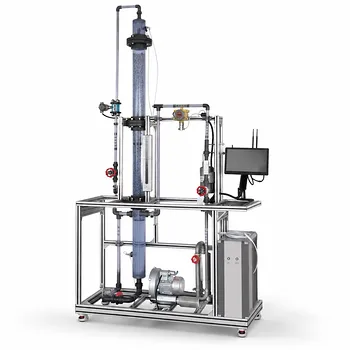
Packed Bed Absorption Educational Unit Operations Pilot Plant

Packed Bed Absorption Educational Unit Operations Pilot Plant

Study gas-liquid absorption, pressure drop, flooding, and mass transfer coefficients with this pilot plant. Transparent packed column, industrial touchscreen, real-time sensor data, automated analysis. Investigate two-phase flow, loading points, column efficiency. Comprehensive data logging and assessment software included.

Educational Compression Refrigeration Performance Determination Unit Operations Pilot Plant

Educational Compression Refrigeration Performance Determination Unit Operations Pilot Plant

This educational pilot plant for compression refrigeration performance determination offers dual COP evaluation, regenerative cycle comparison, and calorimeter calibration. Customizable for curriculum integration, it features environmentally conscious design. Supports thermodynamic mapping on pressure-enthalpy diagrams and synchronous monitoring with centralized instrumentation.

Constant Pressure Filtration Educational Unit Operations Pilot Plant

Constant Pressure Filtration Educational Unit Operations Pilot Plant

Hands-on educational pilot plant for constant pressure filtration. Classic plate and frame filter press allows students to study kinetics, determine specific cake resistance, perform cake washing and evaluate washing rates. Ideal for chemical engineering curriculum. Mobile, customizable, safety-compliant design.

General Purpose Cosmetics Production Unit Operations Training Pilot Plant

General Purpose Cosmetics Production Unit Operations Training Pilot Plant

Integrated pilot-scale cosmetics production training plant for chemical engineering education featuring utility supply emulsification blending and filtration modules with dual touchscreen manual control customizable mobile design ideal for practical hands-on unit operations and advanced process control learning.

Multi Functional Catalytic Reaction and Reactor Evaluation Educational Unit Operations Pilot Plant

Multi Functional Catalytic Reaction and Reactor Evaluation Educational Unit Operations Pilot Plant

Bench-scale educational pilot plant for catalytic reaction and reactor evaluation, integrating fixed bed, fluidized bed, and stirred tank reactors. Students compare reactor designs, evaluate catalysts, and study reaction kinetics and hydrodynamics. Perfect for unit operations labs in chemical engineering curricula.

Polymerization Granulation and Pellet Processing Educational Unit Operations Pilot Plant

Polymerization Granulation and Pellet Processing Educational Unit Operations Pilot Plant

Integrated pilot plant for teaching polymer processing from polymerization to pelletizing. Includes 30L reactor, hydrolyzer, extruder-granulator, vibration dryer, crusher, and sieve. Atmospheric pressure operation for safety, corrosion-resistant SS, customizable for chemical and polymer engineering education. Ideal for university labs.

Micro-Scale Gas-Solid Catalytic Reaction Educational Pilot Plant

Micro-Scale Gas-Solid Catalytic Reaction Educational Pilot Plant

Explore heterogeneous catalysis with this micro-scale gas-solid catalytic reaction educational pilot plant. Designed for university labs, it enables hands-on study of reaction kinetics and transport phenomena in a benchtop packed bed reactor with high-precision flow control and touchscreen automation.

Rising and Falling Film Evaporation Educational Unit Operations Pilot Plant

Rising and Falling Film Evaporation Educational Unit Operations Pilot Plant

Hands-on educational pilot plant for studying rising and falling film evaporation, flow regimes, and heat transfer. Customizable for university labs with industrial instrumentation and data acquisition. Enables comparative evaluation of evaporation modes and energy efficiency.

Multi-Stage Stirred Tanks in Series Residence Time Distribution and Mixing Performance Determination Educational Pilot Plant

Multi-Stage Stirred Tanks in Series Residence Time Distribution and Mixing Performance Determination Educational Pilot Plant

Explore residence time distribution and mixing performance in series stirred tanks with this educational pilot plant. Real-time conductivity sensors, interactive 3D simulation, and industrial-grade PC for chemical engineering lab training. Customizable to curricula.

Continuous Batch Extractive Distillation Educational Pilot Plant

Continuous Batch Extractive Distillation Educational Pilot Plant

Versatile pilot plant for continuous, batch, and extractive distillation training. High-borosilicate glass column for visualizing hydraulics, 15.6-inch touchscreen with data logging, precise reflux ratio control 1-99, and durable corrosion-resistant frame. Ideal for chemical engineering education and process research.

Centrifugal Pump Performance Determination Educational Unit Operations Pilot Plant

Centrifugal Pump Performance Determination Educational Unit Operations Pilot Plant

This lab system determines centrifugal pump performance curves for unit operations. Students configure dual pumps in series or parallel for hands-on learning. Includes industrial controls, clear piping, and data logging. Customizable for chemical, mechanical, and environmental engineering programs.

Gas-Solid Heterogeneous Separation Demonstration Educational Unit Operations Pilot Plant

Gas-Solid Heterogeneous Separation Demonstration Educational Unit Operations Pilot Plant

Comprehensive visual transparent gas-solid separation pilot plant for chemical engineering labs. Demonstrates gravity settling inertial settling cyclone and bag filter technologies. Enables real-time analysis of fluid-particle mechanics pressure drop and collection efficiency. Ideal for undergraduate unit operations courses.

High-Gravity Emulsification and Mass Transfer Educational Pilot Plant

High-Gravity Emulsification and Mass Transfer Educational Pilot Plant

This integrated educational pilot plant utilizes rotating packed bed technology to demonstrate high-gravity emulsification and mass transfer, providing engineering students with hands-on experience in process intensification and unit operations through a modular, customizable design with digital monitoring.

Carbon Dioxide PVT Curve Determination Educational Unit Operations Pilot Plant

Carbon Dioxide PVT Curve Determination Educational Unit Operations Pilot Plant

Enable hands-on learning of thermodynamic principles with this carbon dioxide PVT curve determination pilot plant. Students visualize critical opalescence, phase transitions, and generate P-V isotherms across liquid, gas, and supercritical regions. Robust safety features, adaptable for university engineering labs.

Centrifugal Pump Performance and Orifice Flowmeter Calibration Educational Pilot Plant

Centrifugal Pump Performance and Orifice Flowmeter Calibration Educational Pilot Plant

This versatile educational pilot plant enables engineering students to conduct centrifugal pump performance tests, orifice flowmeter calibration, and fluid mechanics experiments using a transparent flow loop, industrial HMI, and 3D virtual simulation for a comprehensive hands-on learning experience.

Multi-Functional Membrane Separation Educational Pilot Plant for Unit Operations Lab

Multi-Functional Membrane Separation Educational Pilot Plant for Unit Operations Lab

The Multi-functional Membrane Separation Educational Unit Operations Pilot Plant is an integrated bench-scale laboratory system designed for teaching undergraduate engineering education. It features Ultrafiltration, Nanofiltration, and Reverse Osmosis modules in a compact, mobile unit for practical hands-on learning.

Multifunctional Membrane Separation Educational Pilot Plant with Ultrafiltration, Nanofiltration, Reverse Osmosis

Multifunctional Membrane Separation Educational Pilot Plant with Ultrafiltration, Nanofiltration, Reverse Osmosis

An integrated laboratory bench-scale membrane separation system for higher education engineering labs combining Ultrafiltration, Nanofiltration, and Reverse Osmosis processes. Features industrial PLC control with touch-screen HMI, transparent piping, and academic assessment software. Ideal for chemical and environmental engineering curricula.

Plate Column Hydrodynamics Tray Demonstration Educational Pilot Plant

Plate Column Hydrodynamics Tray Demonstration Educational Pilot Plant

Advanced transparent educational pilot plant for chemical engineering labs demonstrates plate column hydrodynamics with industrial sieve bubble cap serrated valve trays for visual observation of gas-liquid contact pressure drop measurement and operational limit analysis including flooding weeping entrainment

Bernoulli Equation Demonstration Unit Operations Pilot Plant

Bernoulli Equation Demonstration Unit Operations Pilot Plant

Laboratory pilot plant for Bernoulli's equation demonstration with transparent PVC pipes, 23 piezometer tubes for pressure measurement, and hands-on experiments. Designed for engineering education to study energy conservation, hydraulic grade line, and localized losses in fluid steady-flow systems.

Chemical Pipeline Assembly and Fluid Transport Practical Training Unit Operations Pilot Plant

Chemical Pipeline Assembly and Fluid Transport Practical Training Unit Operations Pilot Plant

Integrated skid-mounted engineering training pilot plant for university labs offers hands-on experience in chemical pipeline assembly, fluid transport, centrifugal pump operation, and pressure testing. Customizable system bridges academic theory and industrial practice with digital pre-lab resources and comprehensive tools.


Leave Your Message