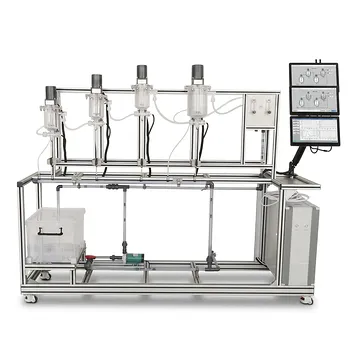
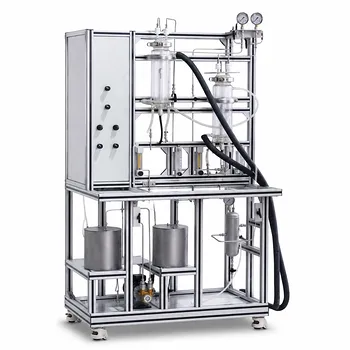
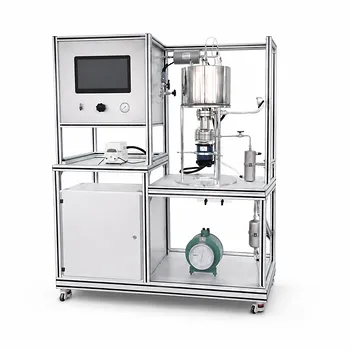
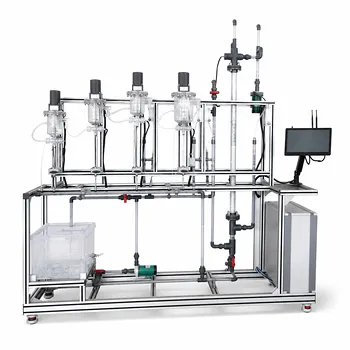
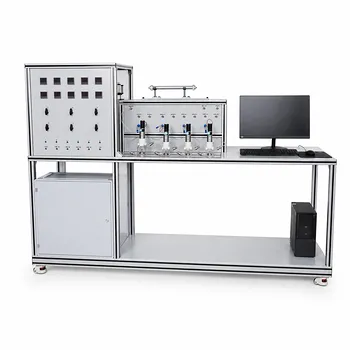
The integration of microchannel reactor technology and parallel screening arrays into chemical engineering laboratories is a direct, high-impact upgrade over traditional batch-scale systems. These tools provide unmatched precision in controlling heat and mass transfer, dramatically reduce the risks associated with hazardous reactions, and enable rapid catalyst screening. The result is a safer, faster, and more industrially relevant platform for both educating students and accelerating research.
The core advantage is a paradigm shift from teaching "big batch" thinking to mastering continuous process intensification. You gain the ability to safely study explosive or exothermic reactions at ambient conditions, screen catalyst formulations in hours instead of weeks, and teach the modular, data-driven workflow that defines modern pharmaceutical and energy research—all while using less space, less material, and less energy.
A New Era for Unit Operations Labs
Traditional chemical engineering education is built around large-scale batch reactors and distillation columns. While these are foundational, they fail to teach the mindset needed for modern industry.
Microchannel reactors and parallel arrays close that gap. They embody process intensification, the discipline of making chemical processes dramatically smaller, safer, cleaner, and more efficient. By integrating them into educational and research labs, you equip students and researchers with the exact skills demanded by sectors like pharmaceuticals, fine chemicals, and green energy.
Bridging the Gap Between Theory and Industrial Practice
The reference point for a chemical engineer has shifted from the stirred-tank batch reactor to the continuous flow microreactor. This shift is driven by physics: at the microscale, the surface-area-to-volume ratio increases by orders of magnitude, leading to extremely efficient heat and mass transfer. Students can observe this principle in real-time, moving from abstract textbook equations to tangible experiments.
A pilot plant with modular microcomponents—reactors, separators, sensors—teaches the logic of a fluidic circuit board. Students learn to isolate unit operations, adjust residence times with surgical precision, and acquire data automatically. This is the vocational skill set for continuous manufacturing.
The Power of Microchannel Reactors: Precision and Safety
The primary advantage of a microchannel reactor is its ability to tame reactions that are dangerous or impossible to run in a flask.
Exquisite Thermal Control for Endothermic and Exothermic Reactions
The high surface-area-to-volume ratio allows for near-instantaneous heat removal or addition. For highly exothermic reactions, this means you can eliminate the need for cryogenic cooling. A reaction that might traditionally require cooling to -60°C to prevent a runaway can be run safely at room temperature in a microreactor. For endothermic reactions like steam reforming, the superior thermal transfer achieves thermal efficiencies up to 85%, directly improving reaction yield and selectivity.
This precise thermal management also narrows the residence time distribution. You move from the chaotic mixing of a batch reactor to the near-perfect plug flow of a microchannel, giving you an ideal kinetic platform to measure true reaction rates without mass transfer artifacts.
Inherent Safety Through Minimal Inventory
Safety in a microreactor is not a bolt-on feature; it is a physical consequence of its geometry. The narrow channels and thin walls hold a tiny volume of potentially hazardous material at any given moment. This minimized reactant inventory suppresses gas-phase free-radical chain reactions and prevents explosions from propagating. Students and researchers can safely investigate the chemistry of syngas conversion to alkanes or the oxidation of CO with zero exposure risk.
Advanced Catalyst Architecture
The use of a silica sol-gel coating as a catalyst support inside the channels creates a uniform, high-surface-area matrix. When you then disperse an active catalyst like platinum, you achieve remarkable conversion and selectivity for model reactions like CO oxidation. This serves as an ideal teaching platform for concepts like Washcoat kinetics, mass transport limitations, and catalyst deactivation, all within a single lab session.
The Power of Parallel Screening Arrays: Speed and Insight
While a single microreactor provides fundamental kinetic data, a parallel array of reactors provides the power of high-throughput experimentation.
From Weeks to Hours: Systematic Catalyst Screening
The most critical bottleneck in chemical research is often the discovery and optimization of a catalyst. Parallel arrays allow you to test multiple catalyst formulations, temperatures, and feed compositions simultaneously under identical operational conditions. This directly addresses the deep need for rapid innovation. A screening that once took a month can be completed in an afternoon, teaching students the systematic, data-driven logic of modern R&D.
Low-Cost, Data-Rich Operation
These arrays are designed for automated data acquisition and flexible operation, but at a fraction of the maintenance and operational cost of pilot-scale test rigs. This makes them uniquely suited for academic budgets. The "circuit board" modularity means you can quickly reconfigure the array for a new project, shifting from syngas conversion to hydrocarbon isomerization without rebuilding the entire plant.
Understanding the Trade-offs
This technology is not a universal solution. An objective technical advisor must highlight its limitations.
- Solids Handling: Microchannels are prone to clogging if reactions produce precipitates or if solid catalysts slough off. This can make them unsuitable for certain gas-liquid-solid multiphase reactions.
- Throughput vs. Scale: A single microreactor produces grams, not kilograms. While you scale out by numbering up parallel channels, this comes with challenges in flow distribution and fabrication cost. For true scale-up, you must still transition to larger equipment; the microreactor teaches the principles but does not replace the pilot plant for tonnage production.
- Material Compatibility: The aggressive use of solvents or corrosive reactants can degrade the reactor materials (often glass, silicon, or stainless steel) over time, and replacing a clogged microchannel can be more expensive than cleaning a glass beaker.
- Educational Overspecialization: There is a risk of focusing too narrowly on microfluidics at the expense of teaching large-scale troubleshooting, such as the operation of distillation columns or large heat exchangers, which remain critical.
Making the Right Choice for Your Goal
Integrating these technologies is a strategic decision. Your implementation should be guided by your specific educational or research objective.
After a careful analysis of your needs, here’s how to proceed:
-
If your primary focus is teaching fundamental process intensification and kinetic principles: Use a single microreactor module with integrated sensors. The visual, quantitative demonstration of heat transfer and residence time control will solidify core concepts more effectively than any textbook.
-
If your primary focus is industrial research and rapid catalyst development: Prioritize the parallel screening array with automated liquid handling. The speed of data generation and the ability to run DoE (Design of Experiments) campaigns will directly translate to R&D productivity and patent filings.
-
If your primary focus is advancing green chemistry and laboratory safety: Implement microreactors to replace batch processes for hazardous reactions. You will actively demonstrate how process intensification reduces waste, energy use (by eliminating cryogenic cooling), and the inherent risk to researchers.
-
If your primary focus is vocational training for the pharmaceutical industry: Build a modular, integrated pilot plant that combines a microreactor with continuous purification and PAT (Process Analytical Technology) sensors. This teaches the end-to-end continuous manufacturing workflow that regulatory agencies are now championing.
By choosing the configuration that matches your core mission, you transform your laboratory from a museum of 20th-century unit operations into a vibrant, risk-friendly environment that pioneers the future of chemical engineering.
Summary Table:
| Technology | Key Advantages | Trade-offs & Limitations |
|---|---|---|
| Microchannel Reactors | Superior heat/mass transfer, minimal reactant inventory (high safety), precise residence time control. | Susceptible to clogging from solids, high fabrication/replacement costs, scaling up requires numbering up. |
| Parallel Screening Arrays | High-throughput catalyst screening (hours vs. weeks), low operational costs, automated data acquisition. | Designed for small-scale testing; does not replace large-scale pilot equipment for tonnage production. |
Elevate Your Chemical Engineering Lab with LABPARK
Ready to transition from traditional batch processes to modern process intensification? LABPARK provides state-of-the-art Educational and Vocational Unit Operations Pilot Plants in chemical engineering, bioprocess & biotech, and environmental & water treatment.
We help universities, research institutes, and enterprises implement safe, modular, and high-throughput systems that accelerate research and prepare students for modern industry standards.
Contact LABPARK today to find the perfect pilot plant configuration for your lab!
Related Products
- Micro-Scale Gas-Solid Catalytic Reaction Educational Pilot Plant
- Multi-Stage Stirred Tanks in Series Residence Time Distribution and Mixing Performance Determination Educational Pilot Plant
- Photocatalytic Membrane Separation and Degradation Unit Operations Pilot Plant
- Methane Cracking Educational Unit Operations Pilot Plant
- Internal Circulation Gradient Free Catalytic Reaction Educational Pilot Plant
People Also Ask
- Fluidized vs. Fixed Bed Reactors: Comparing Heat & Complexity in Pilot Plants
- Why is a multibed configuration necessary for exothermic reactions? Optimize your pilot plant trajectory.
- Why is thermal management a major challenge in methane oxidative coupling? Reactor Solutions for Pilot Plants
- How does the Mears criterion evaluate transport resistance? Key Guide to Intrinsic Kinetics
- How do reactor pilot plants safely study gas-solid reactions? Master kinetics with thermal & flow control.