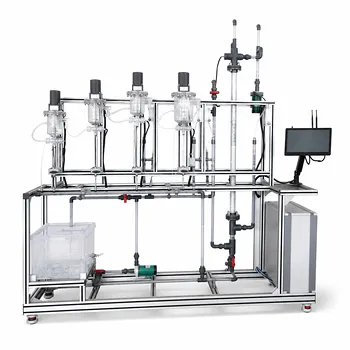
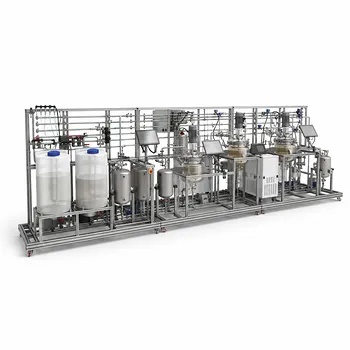
Immobilized microbial technology represents a fundamental upgrade over conventional activated sludge. It delivers dramatically higher cell densities—up to 37 times greater—along with superior shock resistance against pH and organic loading swings, and far simpler solid‑liquid separation. Bioprocess pilot plants transform these inherent advantages into actionable knowledge, giving researchers and technicians the controlled environment needed to optimize carrier selection, fluid dynamics, and reactor design for both deep academic inquiry and hands‑on vocational training.
Traditional activated sludge relies on fragile suspended flocs, whereas immobilization traps or binds microbes onto stable carriers, creating a robust, high‑density biocatalyst. Bioprocess pilot plants then allow systematic exploration of how carrier properties, oxygen mass transfer, and hydrodynamics interact—turning promising lab‑scale concepts into scalable, practical technologies.
Why Immobilized Systems Outperform Activated Sludge
Superior Biomass Concentration
Immobilized cells can achieve cell densities up to 37 times higher than those in a conventional aeration tank. This leap means a much smaller reactor footprint can handle the same organic load, reducing capital and land costs. High cell density also naturally translates to faster reaction rates and the ability to degrade recalcitrant compounds more efficiently.
Built‑in Process Resilience
The carrier matrix shields microorganisms from sudden environmental stress. Immobilized systems show markedly greater tolerance to pH drops, toxic shocks, and organic load surges that would wash out or poison a conventional floc. This self‑stabilizing behavior makes the process far more forgiving during operational upsets—a critical advantage in industrial wastewater treatment or variable feedstock scenarios.
Effortless Solid‑Liquid Separation
In activated sludge, separating biomass from treated water demands large, energy‑intensive clarifiers and careful settling control. Immobilized beads or structured carriers settle rapidly or can be retained by simple screens. The result is drastically simplified downstream separation, lower energy consumption, and the ability to decouple hydraulic retention time from solids retention time—granting process engineers unprecedented flexibility.
How Bioprocess Pilot Plants Unlock Immobilized Technology
Bridging the Scale‑Up Gap
A beaker‑scale immobilization experiment cannot reveal how carrier particles will behave in a column or fluidized bed at scale. Pilot plants provide the realistic flow conditions, mixing patterns, and carrier attrition data needed to validate hydrodynamic models. They are the essential bridge that identifies dead zones, channeling, or unexpected pressure drops before committing millions to full‑scale construction.
Precision Control for Mechanistic Studies
Bioprocess pilot units are equipped with precise pH, temperature, and dissolved oxygen controls—the same infrastructure used in advanced enzymatic hydrolysis or biocatalysis research. For immobilized microbial systems, this allows academic researchers to meticulously study oxygen‑limited biofilm kinetics, substrate diffusion into porous beads, and effective reaction rates under mass‑transfer constraints. The ability to maintain constant conditions while varying flow rates or carrier sizes yields the rigorous data needed for kinetic modeling and reactor design correlations.
Vocational Relevance: Hands‑On Process Training
For workforce development, pilot plants simulate industrial reality in a safe, instructive environment. Trainees learn to load and fluidize carriers, monitor biofilm health, respond to shock loads, and troubleshoot backwashing procedures. These concrete operational skills—built on observing real pressure drops, pH rebounds, and effluent clarity changes—cannot be taught through theory alone, making pilot‑scale work indispensable for vocational programming.
Understanding the Trade‑offs
Mass‑Transfer Limitations
Immobilization inherently introduces diffusion barriers that can starve the innermost cells of oxygen or substrate. Bead size, porosity, and flow velocity must be balanced to avoid a sharp drop in effective reaction rate. Pilot‑scale studies are the only reliable way to quantify these mass‑transfer resistances and optimize carrier geometry before full deployment.
Carrier Fouling and Longevity
Over time, excessive biofilm growth can clog pore spaces, leading to channelling and loss of active surface area. Carriers can also abrade or degrade with prolonged fluidization. Pilot plants reveal realistic carrier lifecycles and maintenance requirements—information that directly shapes operational costs and replacement schedules.
Higher Initial Complexity and Cost
Immobilization requires additional unit operations: carrier synthesis or procurement, immobilization reactors, and potentially carrier regeneration. This raises upfront capital and operational complexity compared to a simple activated sludge basin. The economic viability can only be assessed when pilot‑scale data on throughput, energy use, and carrier replacement are factored into a whole‑life cost model.
Making the Right Choice for Your Research or Training Goal
Pilot‑plant capability should be aligned with your primary objective. Use the following guide to focus your resources:
- If your primary focus is academic research into microbial kinetics: Use a pilot‑scale immobilized‑cell reactor to decouple hydraulic and solids residence times, enabling precise measurement of intrinsic reaction rates and diffusion limitations under well‑controlled mass‑transfer conditions.
- If your primary focus is vocational and operational training: Leverage the pilot plant to stage realistic scenarios—organic overloads, pH excursions, carrier loss—so trainees can observe how immobilized systems self‑stabilize and practice effective corrective actions.
- If your primary focus is process scale‑up and economic viability: Prioritize pilot runs that yield carrier durability data, oxygen transfer efficiency curves, and energy consumption profiles, as these will underpin the design and cost models for a full‑scale fluidized or packed‑bed installation.
By coupling the intrinsic robustness of immobilized microbial systems with the investigative power of bioprocess pilot plants, you turn a compelling biological concept into a reliable, scalable technology ready for real‑world deployment.
Summary Table:
| Feature | Traditional Activated Sludge | Immobilized Microbial Tech | Pilot Plant Role |
|---|---|---|---|
| Biomass Density | Low (suspended flocs) | High (up to 37x higher) | Optimizes carrier loading & density |
| Shock Resilience | Low (vulnerable to pH/toxic shocks) | High (carrier matrix shields cells) | Simulates operational shock scenarios |
| Separation Ease | Complex (requires clarifiers) | Effortless (rapid settling/screens) | Validates downstream hydrodynamics |
| Process Control | Basic aeration controls | Precise DO, pH & temp control | Models diffusion & kinetic barriers |
Accelerate Your Bioprocess Innovation with LABPARK
Transitioning from lab-scale microbial technology to reliable industrial operations requires hands-on validation. LABPARK provides advanced Educational and Vocational Unit Operations Pilot Plants in chemical engineering, bioprocess & biotech, and environmental & water treatment.
Designed specifically for universities, research institutes, and enterprises, our pilot plants empower you to:
- Optimize Fluid Dynamics: Test carrier durability and mass-transfer limits under realistic conditions.
- Enhance Training: Provide students and technicians with hands-on experience in advanced process controls.
- Bridge the Scale-Up Gap: Acquire the reliable, repeatable data needed to project full-scale performance.
Ready to elevate your research and vocational training? Contact LABPARK today to discover the ideal pilot plant solution for your facility.
Related Products
- Bio-fermentation Ethanol Production Practical Training Unit Operations Pilot Plant
- High-Gravity Emulsification and Mass Transfer Educational Pilot Plant
- Natural Product Extraction Unit Operations Training Pilot Plant
- Educational Unit Operations Pilot Plant for Intraparticle Diffusion Effective Factor Measurement
- Absorption and Desorption Educational Unit Operations Pilot Plant
People Also Ask
- Why Use PTFE & Hastelloy in Chemical Pilot Plants? Prevent Corrosion & Ensure Safety
- Why Compare Predicted and Experimental Excess Enthalpy? Key to Accurate Pilot Plant Scale-up
- Why is the chemical plant startup schedule crucial? De-risk scale-up with pilot plants.
- When to transition from PID to adaptive control in pilot plants? Key process indicators.
- Why must batch and fed-batch fermentation pilot plants be designed to accommodate changing rheological conditions?