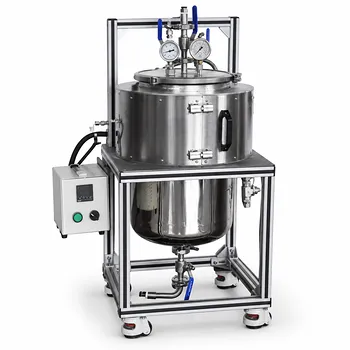
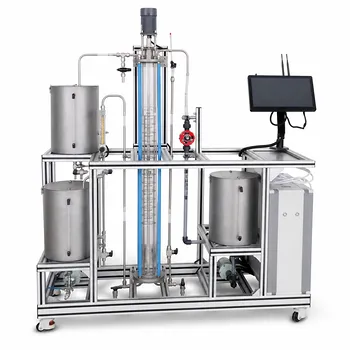
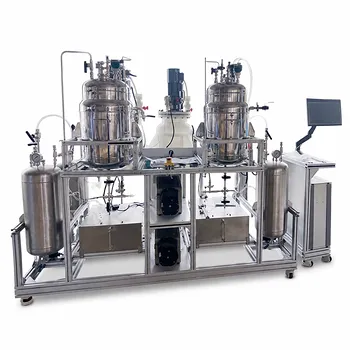
When relative volatility plummets, azeotropes form, or heat destroys your product, conventional rectification columns fail completely. Special distillation systems — extractive and azeotropic units — become the only viable path forward. You select them when a standard fractionating column would demand infinite reflux, an impossible number of stages, or would thermally degrade your target molecule. In research and pilot plant environments, these systems also offer unmatched flexibility to study mass transfer under non-ideal conditions.
The core trigger is thermodynamic limitation. Special distillation introduces a carefully chosen third component — a solvent, entrainer, or salt — to manipulate the relative volatility of the key mixture, breaking azeotropes and enabling separation that ordinary rectification cannot achieve. The choice then pivots on operating mode (batch vs. continuous), thermal sensitivity, and energy economics.
Recognizing Where Conventional Columns Hit a Wall
Any laboratory or pilot plant engineer learns to spot the three red flags that make standard rectification pointless. Ignoring these conditions leads to columns that are meters tall, consume enormous energy, and still fail to deliver pure fractions.
The Relative Volatility Barrier
Conventional distillation relies on a meaningful difference in vapor pressures. When the relative volatility (α) between two components drops below 1.1–1.2, the required number of equilibrium stages explodes. A mixture with α close to 1.0 essentially demands an infinitely tall column.
This is where special distillation takes over. By introducing a mass-separating agent, you chemically alter the liquid-phase activity coefficients, effectively “stretching” the volatility apart. The same column can then hit target purities at practical reflux ratios.
The Azeotropic Trap
An azeotrope is a mixture that boils at a constant temperature and maintains a fixed composition in both liquid and vapor phases. No amount of boiling in a conventional column will split it further. You hit a composition ceiling — for ethanol-water, 95.6 wt% ethanol at 1 atm — and you cannot climb over it.
Azeotropic and extractive distillation are designed explicitly to break this ceiling. The added entrainer or solvent interacts preferentially with one component, forming a new, lower-boiling azeotrope or suppressing activity, pulling the target product past the original pinch point.
Protecting Heat-Sensitive Molecules
In bioprocessing, pharmaceuticals, and fine chemicals, your product can degrade at its normal boiling point. Cranking up the reboiler temperature to drive a conventional separation risks destroying what you’re trying to recover. Vacuum distillation can help lower boiling points, but it adds capital cost and complexity.
Extractive distillation often operates at lower temperatures because the heavy solvent stays in the liquid phase, and you don’t vaporize the entire thermal load. Steam distillation presents another cost-effective alternative for water-immiscible, high-boiling compounds by reducing the partial pressure of volatiles. Both avoid the thermal abuse of a hot reboiler.
How Extractive and Azeotropic Systems Solve These Problems
The fundamental similarity between the two techniques is that both exploit a third component to change relative volatility. Their operational differences, however, determine which fits your pilot plant’s mission.
Extractive Distillation: The Continuous, Low-Temperature Workhorse
A high-boiling, non-volatile solvent is fed continuously near the top of the column. It flows downward, scrubbing one of the feed components and altering the vapor-liquid equilibrium along the column. Because the solvent remains liquid, its boiling point never comes into play inside the column, so reboiler temperatures stay low.
This makes extractive distillation ideal for heat-sensitive materials and continuous operations. In a pilot plant, you can test different solvent-to-feed ratios, recovery methods, and mass transfer efficiency. However, extractive distillation is poorly suited for batch mode, because the continual solvent addition and withdrawal are hard to replicate in a single charge, a critical point for academic labs that run multiple small-scale experiments.
Azeotropic Distillation: The Batch-Friendly, Flexible Tool
Here, the entrainer is volatile and forms a new azeotrope — often a minimum-boiling one — with one or more feed components. This new azeotrope is taken overhead, leaving the purified product behind. The entrainer must be vaporized, which typically consumes more energy than extractive distillation.
The big advantage is batch compatibility. Because you can simply charge the entrainer along with the feed, azeotropic distillation adapts seamlessly to multi-purpose pilot studies and teaching labs where you flip between different mixtures frequently. It also runs at lower temperatures than an extractive column at the same operating pressure, an extra safeguard for delicate compounds.
Understanding the Trade-offs and Context
No system is a silver bullet. The decision to deploy special distillation instead of conventional rectification, and which variant to use, involves hard economic and operational trade-offs that your laboratory’s procurement must acknowledge.
Energy Consumption and Throughput
Azeotropic distillation demands vaporizing the entrainer, so reboiler duty jumps. Extractive distillation, while often gentler on energy, requires a separate solvent recovery column downstream, adding overall plant complexity. For a pilot plant demonstrating unit operations, this dual-column setup is an educational goldmine but demands more floor space.
Solvent Selection and Recovery
Extractive distillation offers a wider solvent choice, since it doesn’t require forming an azeotrope. You can pick based on selectivity, toxicity, and boiling point. Azeotropic distillation’s entrainer must form a specific azeotrope, limiting your options and potentially introducing more difficult recovery steps. Contamination risk is real: poor solvent recovery can ruin the economic case and mar research data.
Operation Mode Flexibility
If your plant’s purpose is academic research with small, frequent batches, azeotropic distillation’s batch capability is priceless. For process development and continuous pilot campaigns, extractive distillation’s steady-state operation and lower thermal footprint win. Mixer-settler or centrifugal extractors might even become contenders when density differences are tiny or contact time must be minimal, though these fall outside the special distillation family.
Making the Right Choice for Your Goal
Your selection should flow directly from your pilot plant’s core mission and the properties of the mixture you need to separate. Start by asking if conventional rectification can work at all; if the answer is no, then evaluate the thermal and operational landscape.
- If your primary focus is azeotropic mixtures or ultra-close-boiling solvents: Select a special distillation system. Choose azeotropic distillation if you need batch flexibility; choose extractive distillation for continuous, high-throughput campaigns.
- If your primary focus is protecting highly heat-sensitive biological or pharmaceutical compounds: Lean heavily toward extractive distillation or even liquid-liquid extraction at room temperature. The lower reboiler temperatures and non-volatile solvent are your product’s best defense.
- If your primary focus is an educational multi-purpose lab: Favor an azeotropic distillation skid with a packed or plate column that allows visual observation of hydrodynamics and easy switching between entrainers, while also teaching reflux ratio management and HETP concepts.
- If your primary focus is minimizing capital cost for demonstrating high-boiling, water-immiscible separations: Evaluate steam distillation. It simplifies column construction and drastically reduces thermal degradation without the complexity of entrainer recovery loops.
The moment a mixture defies simple boiling-point differences, special distillation stops being a luxury and becomes a necessity. Align the system’s mode of operation with your research cadence, and you will turn a thermodynamic dead end into a reproducible, teachable separation.
Summary Table:
| Distillation Type | Core Mechanism | Best Suited For | Key Limitation |
|---|---|---|---|
| Conventional | Vapor pressure differences | Mixtures with high relative volatility ($\alpha > 1.2$) | Fails at azeotropes and close-boiling points |
| Extractive | Non-volatile solvent alters liquid-phase activity | Continuous, heat-sensitive separation campaigns | Requires a separate solvent recovery column |
| Azeotropic | Volatile entrainer forms a new minimum-boiling azeotrope | Batch operations, multi-purpose research labs | High energy usage to vaporize the entrainer |
Scale Up Your Chemical Engineering & Bioprocess Research with LABPARK
Are you looking to equip your facility with advanced separation systems? LABPARK provides state-of-the-art Educational and Vocational Unit Operations Pilot Plants in chemical engineering, bioprocess & biotech, and environmental & water treatment.
Designed specifically for universities, research institutes, and enterprises, our pilot plants bridge the gap between theory and industrial reality—allowing you to safely study mass transfer, test solvents, and optimize complex separations.
Ready to elevate your laboratory capability? Contact LABPARK today to discuss your custom pilot plant specifications.
Related Products
- Multi-Functional Special Distillation Educational Pilot Plant
- Electrolyte Distillation Purification and Formulation Educational Pilot Plant
- Continuous Batch Extractive Distillation Educational Pilot Plant
- Green Anhydrous Ethanol Purification Extractive Distillation Unit Operations Training Pilot Plant
- Multi-Modal Distillation Unit Operations Training Pilot Plant
People Also Ask
- Why does simple distillation yield higher efficiency than flash distillation? Key thermodynamic differences.
- How does double temperature difference control improve distillation pilot plants? Stabilize purity.
- How to Integrate Spectroscopy in Distillation Pilot Plants for Advanced Process Control
- How to Verify Distillation Boundary Lines & Composition Regions with Pilot Plants
- Why is the acentric factor important in pilot plants? Fluid property prediction.