Swelling and erosion-controlled release kinetics guide bioprocess unit operation design by defining the exact hydrodynamic, thermal, and residence-time conditions required to achieve the desired polymer degradation and active-ingredient release profile. These mathematical models quantify how solvent penetration, polymer dissolution, and matrix degradation respond to environmental factors, turning qualitative material behavior into engineering specifications for mixing intensity, tank geometry, and flow configuration.
The core insight is that kinetic models are not just academic descriptions—they are the translation layer between polymer chemistry and process engineering. For surface-eroding polymers, the unit operation must control mass transfer at the fluid–solid boundary; for bulk-eroding systems, it must manage water ingress and local pH; for swelling-controlled matrices, it must precisely time solvent exposure. Pilot-scale unit operations then become the proving ground where these model-based designs are validated under realistic hydrodynamic conditions before commercial scale-up.
The Kinetic Models as Design Tools
Kinetic equations for erosion and swelling directly translate into process engineering requirements. The analytical solutions for surface erosion, such as (M_t/M_\infty = 1 – (1 – k_0 t / a C_0)^n), and concentration-dependent swelling diffusion models reveal which process variables critically influence performance. This allows engineers to select and size unit operations that provide the necessary level of control.
Surface Erosion Kinetics and Unit Operation Demands
Surface erosion releases mass from the outer layer at a rate governed by a dissolution rate constant ((k_0)), polymer solubility ((C_0)), and characteristic dimension ((a)). Crucially, (k_0) is not an intrinsic constant—it depends strongly on fluid velocity and shear stress at the particle surface. Therefore, for a surface-eroding biodegradable polymer, the unit operation must maintain a consistent boundary-layer thickness across all particles.
This informs the choice of a well-mixed stirred tank with high shear, such as a Rushton turbine or paddle impeller, to strip away dissolved polymer chains and prevent the buildup of a gel layer. It also dictates the tank’s geometry: baffles are essential to prevent solid-body rotation and ensure uniform energy dissipation. Without such design, differences in local shear would create a wide distribution of erosion rates, losing the zero-order release profile these polymers promise.
Bulk Erosion and Water-Uptake Control
Bulk erosion occurs when water penetrates the entire matrix, causing homogeneous hydrolytic degradation. Here, the rate-limiting step is often water ingress or the local autocatalytic effect of acidic degradation products. The unit operation design shifts focus from external shear to internal mass transfer and pH management.
To avoid autocatalytic acceleration in large devices, the system may require continuous buffer circulation through the polymer bed or an agitated tank that ensures homogeneous pH. The water-uptake kinetics inform the required residence time before downstream processing. For example, if the model indicates that equilibrium swelling is reached in 30 minutes at process temperature, the holding tank must provide that residence time distribution. Plug-flow or multiple continuous stirred tanks in series might be selected over a single batch vessel to tighten this distribution and prevent under- or over-degraded fractions.
Swelling-Controlled Systems and Solvent Management
Swelling-controlled release relies on solvent diffusion into the polymer and subsequent chain relaxation, creating a swollen gel layer through which the active agent diffuses. This dual mechanism produces time-dependent diffusion coefficients that must be matched with process timing. The unit operation that handles solvent exposure—such as a pre-swelling tank or solvent-exchange column—must be sized based on the diffusion time scale.
For a continuous process, the swelling kinetics dictate the flow rate through the tank to achieve the desired penetration depth. Temperature control becomes critical because both diffusion and relaxation are thermally activated. A jacketed vessel with precise temperature control and an agitation rate that does not mechanically disrupt the forming gel layer is a direct consequence of the swelling model’s predictions.
Hydrodynamic Validation in Pilot-Scale Unit Operations
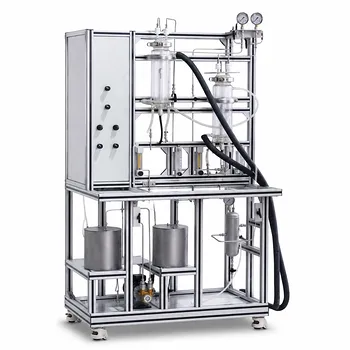
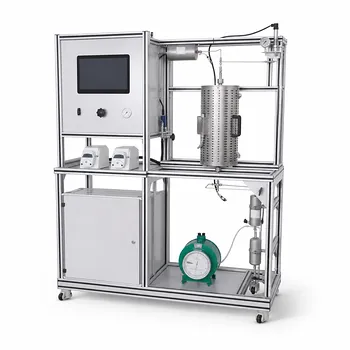
The design principles derived from kinetic models must be validated under conditions that replicate commercial reality. This is where pilot-scale unit operations, equipped with controlled stirred tanks or fluid flow loops, become indispensable. They allow the accurate characterization of erosion type—heterogeneous versus homogeneous—under realistic fluid flow, mixing, and temperature.
Replicating Flow and Shear to Characterize (k_0)
Measuring the dissolution rate constant (k_0) at the pilot scale requires a known and uniform flow field. A flow loop with a test section of defined pipe diameter and flow rate can provide well-characterized shear stress, enabling a direct correlation between shear and erosion rate. Alternatively, a controlled stirred tank with a calibrated torque sensor allows the average energy dissipation rate to be related to the measured (k_0). This data then feeds back into the design of the full-scale unit operation, ensuring that the mixing specification (e.g., tip speed, power per volume) has a validated mathematical basis rather than an empirical guess.
The Role of Controlled Stirred Tanks and Flow Loops
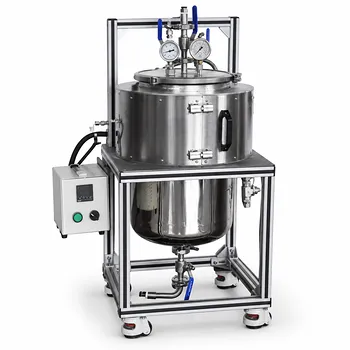
Pilot plants equipped with these unit operations enable researchers to observe how different polymer shapes—microspheres, films, or irregular particles—respond to stirring rates and shear stress. This reveals whether the chosen shape and size distribution will erode uniformly in a large tank or settle in dead zones. The validated models then inform the design of the commercial unit operation’s impeller type, bottom clearance, and sparger placement. For swelling systems, pilot-scale testing in a stirred tank confirms that the agitation is gentle enough not to erode the gel layer prematurely, preserving the release profile.
Understanding the Trade-offs
Applying kinetic models to design is not without conflict. The optimal conditions for one parameter often compromise another, and overlooking these trade-offs can lead to a pilot-plant failure that scales into a commercial disaster.
Balancing Shear Sensitivity and Mass Transfer
For surface-eroding polymers, high shear promotes a thin boundary layer and rapid erosion—desirable for achieving fast release. However, if the polymer matrix is soft or the encapsulated active ingredient is shear-sensitive (e.g., an enzyme), that same high shear can mechanically degrade the product. The design must then balance mass transfer enhancement against product integrity, perhaps by using a lower-shear axial-flow impeller and accepting a slightly slower erosion rate, or by adding a protective coating that shifts the erosion kinetics to a slower regime but preserves activity.
Avoiding Scale-Down Mismatches
A common pitfall is using a lab-scale shaker flask to determine kinetic parameters and then directly designing a pilot-scale stirred tank. Shaker flasks provide uncontrolled and uncharacterized shear, often leading to an overestimated (k_0) compared to the milder, more uniform mixing in a large vessel. Pilot-scale unit operations with well-characterized power inputs prevent this scale-down mismatch by providing the true relationship between impeller speed, shear rate, and erosion kinetics. Skipping this step means the commercial unit operation will be designed on flawed data, resulting in a release profile that is either too slow (undermixing) or impossibly fast to control.
Making the Right Choice for Your Bioprocess Goal
The swelling and erosion kinetics models are a toolbox that guides every major equipment decision. The specific translation from model to machine depends entirely on your process objective.
- If your primary focus is achieving a zero-order release profile: Select a surface-eroding polymer and design a unit operation with a high-shear, baffled stirred tank that maintains a constant fluid boundary layer, as described by the surface-erosion kinetic equation.
- If your primary focus is processing shear-sensitive biomolecules: Choose a bulk-eroding or swelling-controlled matrix and design a gentle, well-buffered mixing vessel that prioritizes pH homogeneity over high shear to prevent autocatalytic degradation hotspots.
- If your primary focus is precise, real-time release control: Integrate a flow loop or controlled-pump-around system that allows you to modulate the shear stress (and thus the erosion rate (k_0)) in response to in-line analytics, directly leveraging the erosion model as a process control loop.
- If your primary focus is rapid process scale-up: Use geometrically similar pilot-scale stirred tanks to validate the kinetic parameters under scalable fluid dynamics, directly de-risking the commercial design by anchoring it in measurable power-per-volume and shear-rate data.
Ultimately, the quantitative language of swelling and erosion kinetics transforms an artisanal polymer process into a predictable, scalable engineering sequence—and the unit operation is the instrument through which that mathematical promise is fulfilled.
Summary Table:
| Release Mechanism | Critical Kinetic Parameter | Unit Operation Design Requirements |
|---|---|---|
| Surface Erosion | Dissolution rate ($k_0$), boundary layer thickness | Baffled, high-shear stirred tank (e.g., Rushton turbine) to maintain uniform shear. |
| Bulk Erosion | Water ingress rate, local autocatalytic pH drop | Temperature-controlled holding tanks (plug-flow/CSTR in series), buffer circulation. |
| Swelling-Controlled | Solvent diffusion, polymer chain relaxation | Jacketed vessel for precise temperature control, low-shear agitation to protect gel layer. |
Optimize Your Bioprocess Scale-Up with LABPARK
Bridging the gap between theoretical kinetic models and commercial production requires rigorous physical validation. LABPARK provides premium Educational and Vocational Unit Operations Pilot Plants in chemical engineering, bioprocess & biotech, and environmental & water treatment.
Tailored for universities, research institutes, and enterprises, our pilot-scale stirred tanks and flow loops allow researchers and students to validate polymer degradation profiles under realistic hydrodynamic conditions.
Ready to elevate your research and engineering training? Contact LABPARK today to find the ideal pilot plant solution for your lab!
Related Products
- Polymerization Granulation and Pellet Processing Educational Unit Operations Pilot Plant
- Bio-fermentation Ethanol Production Practical Training Unit Operations Pilot Plant
- Natural Product Extraction Unit Operations Training Pilot Plant
- Absorption and Desorption Educational Unit Operations Pilot Plant
- Multimodal Absorption and Desorption Pilot Plant for Unit Operations Training
People Also Ask
- How do educational unit operations pilot plants bridge theory and design? Bridge the Engineering Gap
- How do educational unit operations pilot plants address safety and waste management when scaling up?
- Why Compare Predicted and Experimental Excess Enthalpy? Key to Accurate Pilot Plant Scale-up
- When to transition from PID to adaptive control in pilot plants? Key process indicators.
- Why is the chemical plant startup schedule crucial? De-risk scale-up with pilot plants.