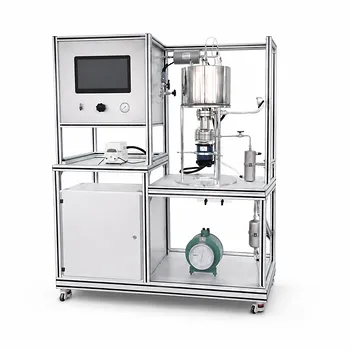
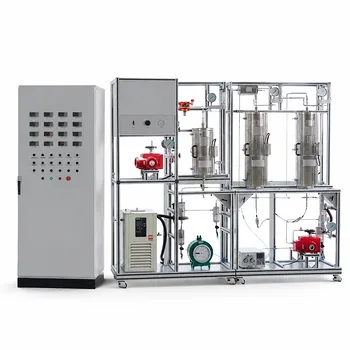
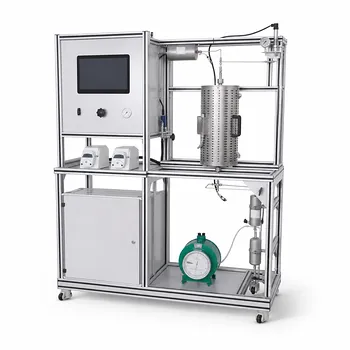
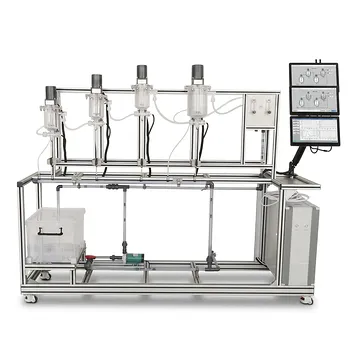
A single vessel, a universe of unit operations. Educational pilot plant batch reactors do far more than just mix chemicals; they are deliberately designed to replicate a range of separation, heat transfer, and phase-change processes. Students routinely reconfigure the same jacketed stirred tank to function as a heater or cooler, a decanter, an extractor-settler, a crystallizer or precipitator, and even a batch distillation kettle. This intentional multi-functionality transforms a compact pilot system into the laboratory equivalent of a Swiss Army knife for unit operations training.
The core insight is that in fine chemical and pharmaceutical production, a single batch vessel often serves multiple process steps. Educational pilot plants mirror this industrial reality, using the reactor's inherent design—jacketed heat transfer, bottom/side ports, overhead condenser connections—to teach a remarkably broad curriculum of separation and reaction fundamentals within a single, space-efficient system.
The Jacketed Batch Reactor as a Thermal Unit
Before any reaction begins, raw materials often need to be brought to a precise temperature. The same vessel then removes heat of reaction or cools the product before the next step.
Operating the Vessel as a Heater and Cooler
The reactor jacket, internal coils, or external heat exchangers allow students to circulate steam or a thermal fluid for heating, and cooling water or brine for cooling. By tracking jacket inlet/outlet temperatures and internal thermocouples, students calculate overall heat transfer coefficients and study transient thermal behavior. This mirrors the heating/cooling phases that dominate cycle times in industrial fine chemical production.
Demonstrating Heat Integration Principles
When the same vessel is used both for the reaction and the subsequent thermal conditioning, students directly observe process intensification. Integrating the reaction with recuperative heat exchange eliminates the need for separate heat exchangers, reducing equipment footprint—a lesson reinforced when they compare space and energy requirements with a hypothetical multi-unit train.
Leveraging the Vessel for Liquid-Liquid Separations
Many post-reaction mixtures contain immiscible liquids that must be separated before further purification. The batch reactor’s geometry and nozzles are perfect for demonstrating gravity-driven separation.
The Reactor as a Simple Decanter
After a liquid-liquid reaction or a washing step, students stop the agitation and allow the phases to settle. By opening the bottom valve, they can drain the denser phase while monitoring the interface through a sight glass. This hands-on exercise teaches settling kinetics, the effect of droplet size, and the importance of designing vessels with sufficient residence time for phase disengagement.
Transitioning to an Extractor-Settler
Adding an immiscible solvent directly into the same vessel transforms it into a mixer-settler. Students agitate to transfer a solute from one phase to another, then decant. They learn practical aspects of extraction: solvent ratio optimization, mixing intensity versus emulsion formation, and the number of theoretical stages achievable in a single contact. This demonstrates how a single unit operation can overcome thermodynamic limitations—like azeotropes or low volatility—without a dedicated extraction column.
Controlled Solid Formation: Crystallization and Precipitation
When a product must be isolated as a solid, the reactor becomes the birthplace of crystals. The precise temperature control afforded by the jacket is critical here.
Teaching Crystallization Fundamentals
By programming a cooling ramp, students cause the solute solubility to drop in a controlled manner. They observe nucleation points, monitor particle size via probes, and see how cooling rate influences crystal habit and purity. This turns the reactor into a crystallizer, demonstrating the unit operation of solid-liquid separation right at the point of production, and teaching the principles of supersaturation and metastable zone width.
Precipitator Operation
For products that form an amorphous solid or a fine precipitate, a different agitation and batch recipe is used. Students learn to control the supersaturation burst by carefully adding a precipitating agent through a dosing line. The same vessel that earlier heated raw materials now generates a slurry, reinforcing the message that a multipurpose plant assets must handle fluid mechanics from low-viscosity liquids to dense suspensions.
Transforming the Reactor into a Batch Distillation Kettle
Perhaps the most visually striking demonstration of multifunctionality is when the vessel is connected to an overhead condenser and reflux divider to perform a batch distillation.
Installing Distillation Ancillaries
By bolting a packed or tray column onto the reactor’s top flange, students convert the vessel into the reboiler of a batch distillation unit. They charge the reactor with a mixture, apply heat through the jacket, and begin fractionating. This setup is used to teach Rayleigh distillation theory, the effect of reflux ratio on separation efficiency, and the concept of batch time versus product purity.
Linking Reaction and Immediate Purification
When a reaction mixture is distilled right in the reactor, students grasp the power of integrating reaction and separation. They see first-hand how removing a product or by-product drives equilibrium-limited reactions to higher conversion, a core principle of reactive distillation. This configuration eliminates the need to transfer sensitive intermediates, reducing both losses and contamination risks.
Understanding the Trade-offs and Limitations
While the educational value is immense, using a batch reactor as a universal process vessel is not without compromises. Discussing these openly builds credibility and deeper understanding.
Deviation from Specialized Equipment Design
A true commercial decanter or crystallizer is hydraulically optimized for its specific task—with features like lamella packs or baffles to enhance separation, scraping devices, or specific agitator types. The pilot reactor’s “demonstration” of these operations is a simplified model. Students must learn to distinguish between a conceptual demonstration and the engineering details required for production-scale implementation.
Potential for Cross-Contamination and Scheduling Bottlenecks
In an educational setting, running multiple steps in a single vessel means the vessel must be thoroughly cleaned between uses. The flexibility that saves capital cost can become a source of scheduling inefficiency. Instructors use this as a teachable moment: in a real multipurpose plant, longer cleaning times can make the reactor the bottleneck stage in an overlapping campaign schedule.
Safety and Scale-up Considerations
Exothermic reactions followed by distillation in the same vessel demand careful control of heat release and pressure. The pilot plant includes interlocks and relief systems that students must evaluate. This demonstrates that multifunctionality increases process complexity and requires a more sophisticated recipe-based control strategy to prevent runaway scenarios.
Making the Right Choice for Your Training Goals
When selecting experiments or designing a curriculum around a multifunctional batch reactor, align its operation with specific learning outcomes.
- If your primary focus is heat and mass transfer fundamentals: Use the heating/cooling and decanter experiments. Have students measure U-values and settling times, comparing them to theoretical models.
- If your primary focus is process synthesis and intensification: Run the integrated extraction-reaction and reactive distillation experiments. Challenge students to quantify how combining steps reduces unit count and processing time.
- If your primary focus is plant operations and scheduling: Sequence multiple product runs (reaction, crystallization, drying) in the same vessel. Build Gantt charts and identify how cleaning times affect the overall makespan and equipment utilization.
- If your primary focus is control and safety: Implement automated temperature ramps for crystallization or distillation cut changes, and use the pilot plant’s DCS to teach the logic of interlock systems when the vessel operates in different modes.
A single, thoughtfully configured batch reactor vessel is not a compromise in education—it is a deliberate, powerful tool that mirrors the flexibility demanded by the modern fine chemicals industry. It teaches future engineers to think of equipment not as fixed-function boxes, but as adaptable assets that can be orchestrated to solve a series of chemical engineering challenges.
Summary Table:
| Configuration | Unit Operation | Key Learning Outcome |
|---|---|---|
| Jacketed Tank | Heat Transfer | Calculate overall heat transfer coefficients (U-values) and transient thermal kinetics. |
| Decanter / Extractor | Liquid-Liquid Separation | Analyze gravity settling kinetics, phase boundary separation, and extraction stages. |
| Crystallizer | Solid-Liquid Separation | Manage cooling ramp profiles, study supersaturation, and control crystal growth. |
| Distillation Kettle | Fractionation / Distillation | Master Rayleigh batch distillation, reflux ratio adjustment, and reactive distillation. |
Elevate Your Unit Operations Training with LABPARK
Maximize your laboratory space and training potential with versatile, industrial-grade systems. LABPARK provides state-of-the-art Educational and Vocational Unit Operations Pilot Plants in chemical engineering, bioprocess & biotech, and environmental & water treatment designed specifically for universities, research institutes, and enterprises.
Our systems help you:
- Deliver comprehensive, hands-on training on a single, space-efficient footprint.
- Transition seamlessly between heating, extraction, crystallization, and distillation operations.
- Teach industry-relevant DCS automation, process control, and safety protocols.
Empower the next generation of engineers with real-world process experience. Contact LABPARK today to request a quote or customize your pilot plant setup!
Related Products
- Multi-Reactor Educational Pilot Plant for Reaction Engineering Unit Operations
- Fixed-Bed Chemical Reaction and Gas Dust Tar Removal Unit Operations Pilot Plant
- Continuous Batch Extractive Distillation Educational Pilot Plant
- 100L Continuous Loop Hydrogenation Educational Unit Operations Pilot Plant
- Fluidized Bed Gas Solid Catalytic Reaction Educational Pilot Plant
People Also Ask
- How do educational unit operations pilot plants address safety and waste management when scaling up?
- How do educational unit operations pilot plants bridge theory and design? Bridge the Engineering Gap
- Why Compare Predicted and Experimental Excess Enthalpy? Key to Accurate Pilot Plant Scale-up
- How to study gasification in pilot plants? Compare exit gas composition & efficiency
- Why Use PTFE & Hastelloy in Chemical Pilot Plants? Prevent Corrosion & Ensure Safety