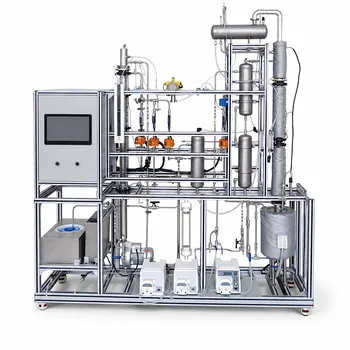
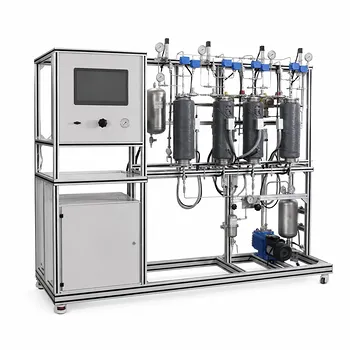
The core answer is a controlled, accelerated cycle of simulation, analytics, and optimization. A chemical engineering reaction pilot plant serves as the definitive bridge between catalyst chemistry in a lab and performance in a real exhaust pipe. It allows researchers to precisely create a synthetic, yet highly realistic, exhaust cocktail of CO, NOx, and hydrocarbons to rigorously test catalytic materials under industrial conditions. The true power isn't just seeing if a catalyst works, but understanding exactly why and when it works by manipulating temperature, flow, and reactant ratios in a safe, instrumented environment.
A reaction pilot plant provides a risk-free, high-precision environment to deconstruct the complex chemistry of catalytic emission reduction. It moves beyond simple pass/fail testing to enable deep kinetic mapping and process optimization, answering critical questions about catalyst activity, stability, and selectivity under dynamic, real-world conditions.
Core Capabilities: A Multi-Faceted Research Tool
The pilot plant's value lies not in a single function, but in its integrated suite of capabilities that address the multifaceted problem of vehicular and industrial emissions. Each function allows you to peel back a layer of complexity.
Replicating Reality Through Advanced Simulation
The first challenge in studying a car's exhaust is that its composition constantly changes. A pilot plant overcomes this by letting you build a dynamic, synthetic exhaust stream from the ground up.
The Art of Gas Blending
By precisely controlling mass flow controllers for individual gases—CO, NO, NO2, propene (as a surrogate hydrocarbon), O2, and N2—you can simulate everything from a cold-start rich-burn condition to a steady-state lean cruise. This deterministic control allows you to isolate the effect of a single variable, like oxygen concentration, on the catalytic reduction of NOx, a feat impossible with a real engine's chaotic output.
The Critical Ammonia Delivery System
For studying Selective Catalytic Reduction (SCR), the pilot plant is indispensable for handling the reducing agent. The setup can demonstrate the complete two-stage process: first, injecting a liquid urea-water solution into a hot carrier gas stream where it thermally decomposes into ammonia (NH3) and CO2. Second, precisely metering this fresh ammonia into the main NOx-laden gas stream just before the catalytic reactor. This teaches the crucial engineering reality that uniform ammonia distribution is as important as catalyst formulation for high NOx conversion efficiency.
The Heart of the System: Engineering the Catalytic Reaction
Once the synthetic exhaust is created, the pilot plant's reactor becomes the central theater of investigation. This is where catalyst chemistry meets reaction engineering.
Deconstructing the Three-Way Catalyst (TWC)
Using a reactor loaded with a TWC monolith (typically featuring noble metals like platinum, palladium, and rhodium on an alumina carrier modified with ceria for oxygen storage), you can study the simultaneous conversion of CO and NOx. The pilot plant allows you to measure conversion efficiency as a function of temperature, constructing the iconic "light-off" curve. Critically, you can quantify the oxygen storage capacity of the ceria promoter by observing the catalyst's performance during transient swings between rich and lean conditions, a key durability metric.
Mapping the SCR Landscape
For NOx reduction in oxygen-rich (lean-burn) exhaust, the pilot plant becomes an SCR optimization platform. You can systematically vary the critical NH3-to-NOx ratio, gas hourly space velocity, and temperature to map the reaction network. This reveals the competition between the desired "standard SCR" reaction (NO + NH3 + O2 → N2 + H2O) and the "fast SCR" reaction (NO + NO2 + NH3 → N2 + H2O), showing you exactly how to engineer the upstream NO:NO2 ratio for maximum throughput.
Comparing Catalyst Formulations: A Case in Point
The pilot plant is the ideal referee for head-to-head catalyst comparisons. For the catalytic reduction of CO specifically, data shows how different noble metal catalysts perform under identical conditions. For example, a 2.5 wt% Ru/Al2O3 catalyst, a 5 wt% Rh/Al2O3 catalyst, and a bimetallic 2.5 wt% Pt/2.5 wt% Rh/Al2O3 catalyst can all reduce a 12,000 ppm CO stream to less than 4 ppm. However, the pilot plant reveals their distinct "personalities":
- Activity: Ru/Al2O3 achieves this at the lowest active temperature (~126°C), followed by Rh/Al2O3 (~140°C) and Pt-Rh/Al2O3 (~144°C).
- Stability: The Pt-Rh/Al2O3 formulation demonstrates the highest stability over time, a critical factor for real-world durability.
- Selectivity: This stability comes with a trade-off, as the Pt-Rh catalyst's hydrogen selectivity drops to about 88% at 140°C due to competing reactions.
This multi-dimensional data—activity, stability, selectivity—is what turns a material into a viable technology, and it's the pilot plant that delivers it.
From Data to Insight: The Analytical Advantage
Generating reactions is only half the battle; a pilot plant's key role is to provide rigorous, time-resolved analytical data that reveals the underlying kinetics.
Kinetic Mapping and Real-Time Analysis
The core scientific output is the kinetic model. By integrating online analytical tools like gas chromatographs (GCs) or, more effectively, fast-response analyzers (FTIR or mass spectrometers), the system moves beyond endpoint analysis. A bypass UV-Vis spectrophotometer or inline optical sensor, for example, can track concentration changes continuously under perfectly controlled temperature and agitation. This automation directly constructs concentration-time curves, allowing you to calculate rate constants and determine activation energies, effectively simulating an industrial process control loop for a critical environmental reaction.
Understanding the Trade-Offs and Hidden Realities
A pragmatic researcher must recognize that a pilot plant is a model, and models have limitations. Its true value emerges when you understand these constraints.
The Purity Pitfall vs. Real-World Poisons
Your synthetic gas blend is pristine. Real vehicular exhaust contains trace poisons from lubricant oils (phosphorous, zinc) and sulfur from fuel that slowly degrade catalysts. A pilot plant study of fresh catalyst activity will always paint an overly optimistic picture of long-term durability unless you purposefully design accelerated poisoning experiments into your protocol.
The Challenge of Adiabatic Scale-Down
A 2-centimeter diameter bench-scale reactor is far from an adiabatic full-scale monolith. The pilot plant excels at measuring intrinsic kinetics, but it struggles to replicate the massive, self-sustaining thermal waves and radial heat loss profiles of an industrial converter. You must apply engineering heat transfer models to bridge these pilot-scale rate data to commercial-size predictions.
Calculating More Than Just Carbon
The analytical system dictates the depth of your insight. If you only measure CO and NOx disappearance, you're getting half the story. A complete mass balance, including N2O and NH3 slip, is essential to confirm you haven't fixed one regulated pollutant by creating another. Applying green chemistry metrics, like atom economy, in your analysis can reveal the true environmental efficiency of the process. For instance, a catalytic emission control approach that is 99% efficient but generates a toxic byproduct and un-recycled waste salts has a fundamentally different sustainability profile than one that converts reactants exclusively to benign N2, CO2, and water.
Making the Right Choice for Your Goal
Your specific research objective dictates how you should configure and operate the pilot plant. Its flexibility is its greatest strength.
- If your primary focus is catalyst screening and rapid activity ranking: Prioritize a high-throughput setup with a rapid-response analytical suite (like a mass spec) to quickly generate light-off curves and test dozens of formulations under a standard, simplified gas mix.
- If your primary focus is developing a robust kinetic model for a specific emission catalyst: Design a long-term, systematic campaign using a single catalyst monolith. Vary temperature, space velocity, and reactant concentrations one at a time to isolate rate dependencies, and use transient cut-off experiments to validate your model's predictive power for the deep reduction of CO and NOx.
- If your primary focus is optimizing real-world process parameters like urea dosing for an SCR system: Focus your pilot plant on steady-state mapping across the full operating window. Your primary measured outputs should be NOx conversion, NH3 slip, and N2O formation, explicitly charting the performance trade-off as you push towards complete NOx conversion.
- If your primary focus is sustainability and lifecycle analysis: Use the pilot plant to run extended durability tests with contaminated gas streams and then calculate the E-factor for the entire catalytic process, accounting for catalyst deactivation, regeneration, and ultimate precious metal recovery, thereby moving your study far beyond simple reaction chemistry.
The pilot plant is an engine for generating deep, mechanistic understanding, and that understanding is the only true path to designing a better, more durable, and more effective emission control system.
Summary Table:
| Catalyst Formulation | Active Temp for CO (~12,000 ppm) | Key Advantage | Key Trade-off / Limitation |
|---|---|---|---|
| 2.5 wt% Ru/Al2O3 | ~126°C | Highest activity (lowest activation temperature) | Lower long-term stability |
| 5 wt% Rh/Al2O3 | ~140°C | Balanced initial activity | Moderate overall durability |
| 2.5 wt% Pt / 2.5 wt% Rh/Al2O3 | ~144°C | Highest durability and stability over time | Reduced hydrogen selectivity (88% at 140°C) |
Accelerate Your Emission Control Research with LABPARK
Bridging the gap between lab-scale catalyst chemistry and real-world industrial performance requires robust, highly controllable systems. LABPARK provides state-of-the-art Educational and Vocational Unit Operations Pilot Plants in chemical engineering, bioprocess & biotech, and environmental & water treatment.
Tailored for universities, research institutes, and enterprises, our pilot plants deliver the precise gas blending, reactor control, and real-time analytical capabilities you need to master catalytic reduction processes.
Ready to elevate your research or training programs? Contact LABPARK today to request a quote or discuss your custom pilot plant specifications.
Related Products
- Fixed-Bed Chemical Reaction and Gas Dust Tar Removal Unit Operations Pilot Plant
- Fixed Bed Gas Solid Catalytic Reaction Educational Pilot Plant
- Micro-Scale Gas-Solid Catalytic Reaction Educational Pilot Plant
- Multi Functional Catalytic Reaction and Reactor Evaluation Educational Unit Operations Pilot Plant
- Methane Cracking Educational Unit Operations Pilot Plant
People Also Ask
- When to transition from PID to adaptive control in pilot plants? Key process indicators.
- How do deviations in estimating latent heat impact pilot plant thermal systems? Avoid hardware mis-sizing.
- Why Compare Predicted and Experimental Excess Enthalpy? Key to Accurate Pilot Plant Scale-up
- Why are particle density, bulk density & voidage critical in pilot plants? Master Bed Fluid Dynamics
- How to study gasification in pilot plants? Compare exit gas composition & efficiency