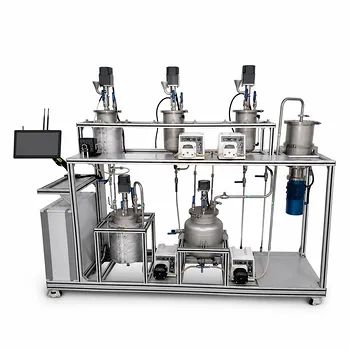
Direct measurement over abstract equations. Reactor pilot plants allow students to physically execute chemical reactions—like the water-gas shift reaction ((CO + H_2O \rightleftharpoons CO_2 + H_2))—under variable feed rates, ratios, and temperatures. By analyzing the actual composition of inlet and outlet streams, they directly calculate the conversion rate of the limiting reactant. This turns a textbook formula into a tangible, numbers-driven result that they can see change in real time.
Textbooks present conversion as a solved equation; pilot plants present it as a dynamic output of interdependent variables. The core takeaway is that manually tuning process conditions and immediately observing their impact on conversion builds the deep, intuitive grasp of reactor optimization that no simulation can replicate.
From Theory to Tangible Data: The Pilot Plant Advantage
Closing the Gap Between Equations and Reality
In a classroom, students solve conversion problems using idealized stoichiometry and given numbers. On a pilot plant, the numbers are not given—they must be measured.
They set a feed rate, adjust a temperature, and then sample the output. The resulting composition tells them whether their assumptions about kinetics and equilibrium were correct. This direct feedback loop is where theory becomes skill.
The Water-Gas Shift as a Learning Catalyst
Take the water-gas shift reaction. A pilot unit lets students vary the steam-to-CO ratio and the reactor temperature. They then measure the outlet gas composition (CO, (CO_2), (H_2), (H_2O)).
The conversion of CO becomes a calculated value that changes with every manual adjustment. They see Le Chatelier’s principle not as a rule in a book, but as a lever they can pull—adding excess steam shifts the equilibrium toward products, visibly boosting conversion.
Real-Time Composition Analysis and Material Balances
Running a reaction like benzene alkylation with ethylene provides a more complex case. Students analyze reactor output for ethylbenzene (target) and diethylbenzene (byproduct).
They use the measured flow rates and concentrations to close the material balance. The conversion of benzene is no longer an assumption—it’s a number they derive from the difference between inlet and outlet. When selectivity drops, they immediately see more byproduct and understand the cost.
Unlocking Reaction Kinetics Through Hands-On Instrumentation
Monitoring Concentration Changes via Physical Properties
In educational pilot plants, students don’t always have to wait for lab analysis. Many setups include inline sensors—conductivity meters, pressure transmitters, spectrophotometers—that track reaction progress continuously.
For a reaction that generates gas, a pressure transmitter captures the rate of pressure rise. For an acid-metal reaction, a conductivity meter reveals how ion concentration changes. Students connect a physical signal to a reaction rate, directly calculating (\Delta c / \Delta t) without a stopwatch and a titration.
Determining Rate Laws and Order with Integrated Sensors
A batch reactor with an inline spectrophotometer transforms kinetics into a live plot. Students monitor absorbance (proportional to concentration) over time under isothermal conditions.
They then apply integrated rate equations: a linear plot of (\ln(A)) vs. (t) signals a first-order reaction (slope = (-k)); a linear plot of (1/(B)) vs. (t) signals second-order. The pilot plant delivers the raw data; the student discovers the order and rate constant. This bridges the gap between differential equations and the reality of a stirred vessel.
Seeing the Big Picture: Selectivity, Byproducts, and Process Economics
The Cost of Low Selectivity: From Reactor to Separation
Conversion alone is a hollow metric if selectivity is poor. A pilot plant makes this obvious. When students run an alkylation and get high conversion but low selectivity to ethylbenzene, they see a reactor outlet rich in unwanted diethylbenzene.
Immediately, they understand that downstream distillation columns will now have to work harder. The pilot plant teaches that process yield is the product of reactor selectivity and separation efficiency—a core lesson in process economics that equations alone cannot convey.
Le Chatelier’s Principle in Action
A pilot reactor is the best tool to internalize equilibrium shifts. Students manipulate temperature and the concentration of one reactant, then sample the outlet.
They watch conversion rise when they add excess steam or when they remove a product in a reactive distillation setup. What was once a theoretical prediction becomes a measured, repeatable trend, cementing the principle in their engineering judgment.
Understanding the Trade-offs of Pilot-Scale Experimentation
Scale Limitations and Extrapolation Risks
Pilot plants are scaled-down, not miniature, replicas. Heat transfer and mixing patterns differ from industrial reactors. Students must learn that a conversion of 85% at pilot scale doesn’t automatically translate to 85% at full scale. The real lesson is in understanding the trend and the underlying kinetics, not in taking the pilot number as absolute.
Sensor Accuracy and Data Interpretation
Inline probes are powerful but can introduce artifacts. A conductivity meter may drift with temperature; a spectrophotometer may suffer from bubble interference. Students learn that raw sensor data must be validated—a “perfect” kinetic plot could be hiding a calibration error. This cultivates a critical mindset toward automation and measurement.
Time and Resource Constraints
Running a pilot plant takes time. Equilibrium reactions may need hours to stabilize. Finding the optimal feed ratio for maximum conversion requires multiple runs. The trade-off is between depth and breadth: you may learn one reaction system profoundly, rather than covering ten superficially. This deep dive is precisely what builds genuine competence.
Making the Right Choice for Your Educational Goal
Depending on your training objective, you can focus your pilot-plant sessions on a specific facet of conversion understanding.
- If your primary focus is fundamental kinetics: Use a batch reactor with integrated absorbance or conductivity probes. Directly apply integrated rate equations to determine reaction order and rate constant from the live concentration-time data.
- If your primary focus is industrial optimization: Run a continuous stirred-tank or fixed-bed reactor. Vary the feed rate, ratio, and temperature, and calculate conversion at steady state for each set of conditions to map the operating envelope.
- If your primary focus is process integration: Choose a reaction with significant byproduct formation. Measure both conversion and selectivity, then trace how the product quality impacts a downstream separation unit. This connects reactor design to overall plant economics.
The ultimate power of a reactor pilot plant is that it transforms conversion from a calculation you memorize into a phenomenon you can control, measure, and optimize with your own hands.
Summary Table:
| Training Focus | Recommended Setup | Key Learning Outcome |
|---|---|---|
| %Fundamental Kinetics% | Batch reactor with inline probes | Determine reaction order and rate constants from live data. |
| %Industrial Optimization% | Continuous (CSTR / Fixed-bed) | Calculate steady-state conversion and map the operating envelope. |
| %Process Integration% | Multi-unit setups with byproduct separation | Connect reactor selectivity directly to downstream separation economics. |
Elevate Your Engineering Programs with LABPARK
Bridge the gap between textbook theory and practical expertise. LABPARK designs and supplies premium Educational and Vocational Unit Operations Pilot Plants in chemical engineering, bioprocess & biotech, and environmental & water treatment.
Our custom-built solutions enable universities, research institutes, and enterprises to:
- Provide hands-on experience in calculating conversion rates, selectivity, and kinetics.
- Train students on industrial-grade instrumentation and data acquisition systems.
- Prepare future engineers with realistic troubleshooting and process optimization skills.
Ready to transform your laboratory training? Contact LABPARK today to discuss your project requirements!
Related Products
- Fixed-Bed Chemical Reaction and Gas Dust Tar Removal Unit Operations Pilot Plant
- Multi-Reactor Educational Pilot Plant for Reaction Engineering Unit Operations
- Fixed Bed Gas Solid Catalytic Reaction Educational Pilot Plant
- 100L Continuous Loop Hydrogenation Educational Unit Operations Pilot Plant
- Internal Circulation Gradient Free Catalytic Reaction Educational Pilot Plant
People Also Ask
- When to transition from PID to adaptive control in pilot plants? Key process indicators.
- How do deviations in estimating latent heat impact pilot plant thermal systems? Avoid hardware mis-sizing.
- Why Compare Predicted and Experimental Excess Enthalpy? Key to Accurate Pilot Plant Scale-up
- How to study gasification in pilot plants? Compare exit gas composition & efficiency
- Why Use PTFE & Hastelloy in Chemical Pilot Plants? Prevent Corrosion & Ensure Safety