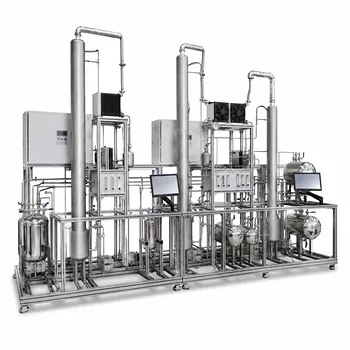
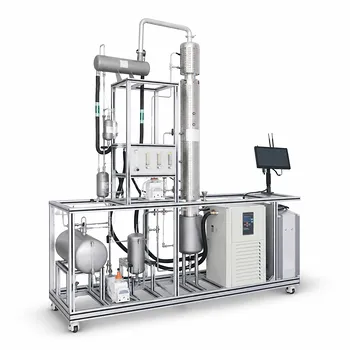
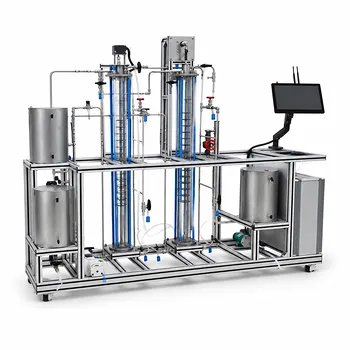
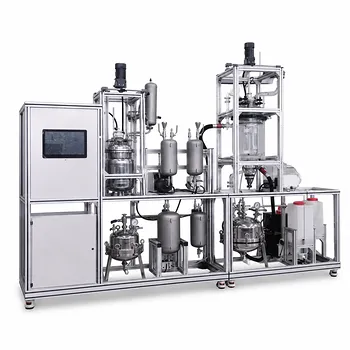
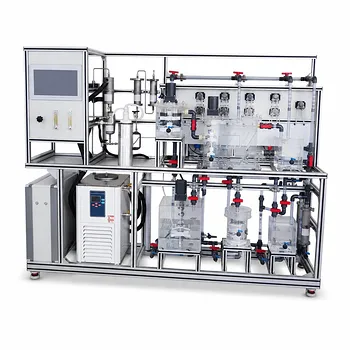
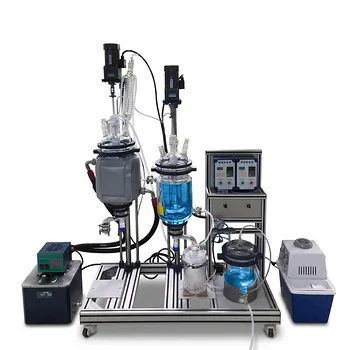
Knowledge Vocational Chemical Engineering Education How does an extractive distillation pilot plant demonstrate azeotropic separation and solvent recycling?
Author avatar

Tech Team · LABPARK

Updated 1 month ago

How does an extractive distillation pilot plant demonstrate azeotropic separation and solvent recycling?


The short answer: An extractive distillation pilot plant physically demonstrates the separation of azeotropic mixtures by using a two-column system. The first column introduces a high-boiling solvent that alters the relative volatilities of the feed components, allowing one pure compound to be drawn off at the top. The bottom stream—a mix of solvent and the second component—is sent to a second column where the second component is distilled overhead and the now-clean solvent is recycled back to the first column, closing the loop.

An extractive distillation pilot plant turns a textbook impossibility into a tangible, operable process. It shows how a carefully chosen solvent can “break” an azeotrope, enabling complete component separation while continuously recycling the solvent—teaching the core industrial strategy for handling hard-to-separate mixtures.

Why Standard Distillation Fails with Azeotropes

The Vapor-Liquid Equilibrium Wall

In a simple distillation, separation is governed by the vapor-liquid equilibrium curve. When a mixture forms an azeotrope, the vapor and liquid phases have the same composition—the boiling point becomes constant and further enrichment by mere boiling is impossible.

The Educational Bottleneck

Students often learn that azeotropes are “unbreakable” without truly grasping how industry overcomes them. A pilot plant bridges that gap, showing that adding a third component (a solvent) can shift the equilibrium and unlock the separation.

The Core Principle: How Extractive Dissilation Breaks the Azeotrope

Solvent as a Volatility Shifter

Extractive distillation adds a high-boiling, non-volatile solvent near the top of the column but below the condenser. As the solvent flows downward, it interacts preferentially with one of the feed components, significantly altering its vapor pressure.

Making One Component “Heavier”

The solvent increases the relative volatility of the other, unbound component. The result: one component becomes far more volatile and exits at the top as a pure distillate, while the solvent-bound component remains in the liquid phase and is carried to the bottom.

The Two-Column Pilot Plant in Action

Column 1: The Extractive Distillation Column

The feed (the azeotropic mixture) enters a middle point, while the extraction solvent enters near the top. As the solvent cascades down, it selectively retains one component. A pure product leaves the top condenser. The heavy bottom stream—mainly solvent plus the second component—flows to the second column.

Column 2: The Solvent Recovery Column

Here, the simpler binary mixture (second component + solvent) is subjected to ordinary distillation. The second component, now purified, is taken as the top product. The high-boiling solvent remains at the bottom and is pumped back, reheated, and re-injected into the first column.

Real-Time Observation Under Glass

Educational pilot plants often use transparent glass columns and precision temperature sensors. This allows students to visually trace liquid loading, bubbling, and reflux flow—observations that turn abstract mass balances into concrete understanding.

Solvent Recovery: Closing the Loop

The Recycling Circuit

The recovered solvent is not discarded; it is continuously recycled to the first column. This closed-loop operation exemplifies industrial solvent management—minimizing waste, reducing cost, and maintaining steady-state conditions for reliable data collection.

Parameters Students Can Investigate

With a pilot plant, learners can adjust the solvent-to-feed ratio, monitor column temperature profiles at multiple stages, and measure recycling efficiency over time. These hands-on experiments reveal how solvent purity affects separation performance and how heat integration influences overall energy use.

What Students Can Learn: From Theory to Hands-On Insight

Bridging Thermodynamics and Operation

Students start with theoretical concepts (activity coefficients, residue curve maps) but the pilot plant forces them to confront practical realities: what happens if the solvent enters too cold? How does flooding affect the separation? Real data from temperature and pressure sensors grounds simulation in reality.

Mapping Azeotropic Boundaries

By operating at different initial compositions and solvent rates, learners can “move” the distillation path across residue curve boundaries. They can see how adding a solvent makes it possible to obtain product compositions that were previously trapped by azeotropic points.

Mass and Energy Balance in Action

Collecting samples from feed, distillate, bottoms, and recycle streams and performing analytical checks teaches full mass balance closure. Energy balances can be tied to reboiler duty and condenser cooling—critical for later process design tasks.

Trade-offs and Limitations of Extractive Distillation

Energy Intensity and Operating Cost

The solvent recovery column requires additional heating and cooling, making the process more energy-intensive than a theoretical one-column separation. For a solvent with a very high boiling point, reboiler temperatures can become challenging.

Solvent Selection Challenges

The solvent must be thermally stable, non-reactive, non-toxic, and easy to separate. Finding the perfect solvent for a given azeotrope is a research problem in itself, and pilot studies often involve testing multiple candidates.

Potential for Cross-Contamination

If the recycled solvent slowly accumulates impurities or degradation products, separation efficiency degrades. A pilot plant can demonstrate this gradual loss of performance, highlighting the need for occasional solvent purge or regeneration—a real-world operational headache.

Complexity Versus Simpler Alternatives

For some mixtures, other methods (membrane separation, pressure-swing distillation, or azeotropic distillation with an entrainer that forms a heterogeneous azeotrope) may be simpler or less energy-intensive. The pilot plant helps students compare these options economically.

Making the Right Choice for Your Training Goals

  • If your primary focus is teaching the fundamentals of azeotrope breaking: An extractive distillation pilot plant is unmatched. It visually and operatively demonstrates how a third component can alter volatility and close the solvent loop.
  • If your primary focus is minimizing energy consumption or exploring cutting-edge separations: Consider pairing the unit with a membrane pervaporation module or a pressure-swing setup to contrast energy profiles and show when alternative technologies become attractive.
  • If your primary focus is hands-on system integration and real-world troubleshooting: Opt for a plant with multiple sample ports, precise PID temperature control, and a transparent decanter to give students the full picture of closed-loop operation and fault diagnosis.

The extractive distillation pilot plant remains the gold standard for turning the impossible azeotrope into a teachable, scalable, and recyclable reality.

Summary Table:

Column Primary Function Input Stream Key Output
Column 1: Extractive Distillation Breaks the azeotrope by altering relative volatility Azeotropic feed + high-boiling solvent Pure Component A (distillate); Solvent + Component B (bottoms)
Column 2: Solvent Recovery Separates and purifies the solvent for reuse Solvent + Component B mixture Pure Component B (distillate); Clean solvent recycled to Column 1 (bottoms)

Bring Hands-On Process Engineering to Life with LABPARK

Bridge the gap between textbook theory and real-world industrial practice. LABPARK provides state-of-the-art Educational and Vocational Unit Operations Pilot Plants designed specifically for universities, research institutes, and enterprises.

Our advanced systems cover:

  • Chemical Engineering (including distillation, extraction, and evaporation units)
  • Bioprocess & Biotech
  • Environmental & Water Treatment

Equip your students and researchers with the tools to master complex thermodynamic separations and closed-loop operations. Contact us today to discuss your laboratory training goals and receive a custom proposal!

Related Products

People Also Ask

Related Products

Green Anhydrous Ethanol Purification Extractive Distillation Unit Operations Training Pilot Plant

Green Anhydrous Ethanol Purification Extractive Distillation Unit Operations Training Pilot Plant

Modular pilot plant produces high-purity anhydrous ethanol from crude ethanol via extractive distillation in a zero-emission closed-loop process providing hands-on training in unit operations with PLC-based control SCADA software and digitalized process management focusing on green engineering principles

Continuous Batch Extractive Distillation Educational Pilot Plant

Continuous Batch Extractive Distillation Educational Pilot Plant

Versatile pilot plant for continuous, batch, and extractive distillation training. High-borosilicate glass column for visualizing hydraulics, 15.6-inch touchscreen with data logging, precise reflux ratio control 1-99, and durable corrosion-resistant frame. Ideal for chemical engineering education and process research.

Multi-Functional Special Distillation Educational Pilot Plant

Multi-Functional Special Distillation Educational Pilot Plant

Versatile multi-functional special distillation pilot plant for chemical engineering education. Supports continuous, vacuum, azeotropic, reactive, extractive distillation. Transparent glass columns enable real-time visual observation of hydrodynamics and separation processes.

Green Anhydrous Ethanol Refining Practical Training Pilot Plant

Green Anhydrous Ethanol Refining Practical Training Pilot Plant

Advanced integrated pilot plant for university labs demonstrating extractive distillation to produce high-purity absolute ethanol from crude feedstock, featuring multi-column continuous operation, closed-loop solvent recycling, and customizable controls for hands-on engineering education, ideal for chemical engineering training and research.

Continuous Sieve-Plate Distillation Pilot Plant for Unit Operations Laboratory Education

Continuous Sieve-Plate Distillation Pilot Plant for Unit Operations Laboratory Education

Integrated pilot-scale teaching system for continuous sieve-plate distillation studies. Visual demonstration of tray hydraulics, flexible feed positions, and automatic reflux control for hands-on unit operations education in engineering labs. Designed for higher education engineering laboratories.

Electrolyte Distillation Purification and Formulation Educational Pilot Plant

Electrolyte Distillation Purification and Formulation Educational Pilot Plant

Integrated bench-to-pilot scale educational pilot plant for electrolyte distillation, purification, and formulation with borosilicate glass construction, PLC automation, touchscreen HMI, and advanced industrial safety features for hands-on chemical process training, ideal for chemical engineering and materials science curricula.

Natural Product Extraction Unit Operations Training Pilot Plant

Natural Product Extraction Unit Operations Training Pilot Plant

Integrated natural product extraction pilot plant for chemical engineering training bridges theory and industrial practice with modular extraction and evaporation/concentration units, hybrid touchscreen and manual control, realistic process simulation, and self-contained softened water and vacuum utilities.

Multi-Modal Distillation Unit Operations Training Pilot Plant

Multi-Modal Distillation Unit Operations Training Pilot Plant

Multi-modal distillation pilot plant for practical unit operations training in chemical engineering education. Features real, analog, and semi-physical simulation modes, industrial construction, customizable for university labs. Hands-on fractionation columns, SCADA control, safety systems. Includes sight glasses, sampling ports, closed-loop recycling.

Comprehensive Liquid-Liquid Extraction Pilot Plant for Engineering Education

Comprehensive Liquid-Liquid Extraction Pilot Plant for Engineering Education

Comprehensive liquid-liquid extraction pilot plant for engineering education, integrating rotary and vibratory columns for hands-on observation of phase behavior, flooding limits, and mass transfer efficiency, enabling precise HTU and mass transfer coefficient calculations.

Ethyl Acetate Synthesis Unit Operations Pilot Plant for Practical Training

Ethyl Acetate Synthesis Unit Operations Pilot Plant for Practical Training

Modular and customizable pilot plant for ethyl acetate synthesis practical training. Integrates esterification reaction, liquid-liquid extraction, neutralization, and sieve-plate distillation unit operations. Bridging theory and real-world industrial processes. Designed for university chemical engineering labs

Gallium and Indium Selective Extraction Educational Pilot Plant

Gallium and Indium Selective Extraction Educational Pilot Plant

Integrated pilot-scale laboratory system for engineering education bridging theoretical concepts with industrial practice enabling hands-on study of liquid liquid extraction reaction kinetics and mass transfer for selective gallium and indium separation featuring real-time IoT connectivity with integrated safety

Dual-Mode Rectification Pilot Plant for Practical Training Unit Operations

Dual-Mode Rectification Pilot Plant for Practical Training Unit Operations

Industrial-scale dual-mode rectification pilot plant for chemical engineering practical training. Features real-material and simulated-material operation modes, sieve-plate column with sight glasses for visual observation of hydrodynamics, and customizable SCADA control for safe, hands-on learning of unit operations and mass transfer.

Multi Functional Membrane Crystallization Educational Unit Operations Pilot Plant

Multi Functional Membrane Crystallization Educational Unit Operations Pilot Plant

Integrated bench-scale membrane crystallization pilot plant for engineering education. Provides hands-on training in advanced separation technologies, combining membrane distillation crystallization and process intensification. Features variable scaling vessels, industrial-grade flow control, and interactive digital data acquisition. Customizable for university labs.

Bio-fermentation Ethanol Production Practical Training Unit Operations Pilot Plant

Bio-fermentation Ethanol Production Practical Training Unit Operations Pilot Plant

Bio-fermentation ethanol production pilot plant for hands-on training in unit operations: fermentation, solid-liquid filtration, membrane separation, and distillation. Bridges theory with industrial practice using industrial-grade components, customizable for university labs. Hybrid automated and manual control for comprehensive learning.

Methanol Synthesis and Catalyst Performance Evaluation Educational Unit Operations Pilot Plant

Methanol Synthesis and Catalyst Performance Evaluation Educational Unit Operations Pilot Plant

Bench-scale methanol synthesis and catalyst evaluation educational pilot plant for chemical engineering labs to study catalytic kinetics, high-pressure operations, process control, and unit operations under realistic conditions with industrial safety features, precision gas delivery, data acquisition, and intelligent monitoring.

Electrolytic Hydrogen Production Educational Unit Operations Pilot Plant

Electrolytic Hydrogen Production Educational Unit Operations Pilot Plant

Bench-scale electrolytic hydrogen production pilot plant designed for university engineering labs. Provides hands-on training in water electrolysis, gas-liquid separation, and process safety. Fully customizable system with digital PID control, corrosion-resistant components, and hydrogen gas detector. Ideal for chemical engineering curricula.

Absorption and Desorption Educational Unit Operations Pilot Plant

Absorption and Desorption Educational Unit Operations Pilot Plant

Dual packed column absorption and desorption pilot plant for chemical engineering education, offering real-time mass transfer coefficient measurement, durable mobile frame, industrial touch-screen interface, and customizable design for varied laboratory curricula, enabling hands-on study of gas absorption and stripping.

Carbon Dioxide Hydrogen Methanol Synthesis Educational Unit Operations Pilot Plant

Carbon Dioxide Hydrogen Methanol Synthesis Educational Unit Operations Pilot Plant

Hands-on educational pilot plant for methanol synthesis from carbon dioxide and hydrogen. Enables practical study of high-pressure catalysis, unit operations, and process control. Features real-time data acquisition, safety systems, and customizable experiment modules for undergraduate and graduate chemical engineering laboratories.

Thermal Desorption Exhaust Gas and Tail Water Treatment Educational Pilot Plant

Thermal Desorption Exhaust Gas and Tail Water Treatment Educational Pilot Plant

Bench-scale educational pilot plant for treating thermal desorption exhaust gas and tail water integrates condensation, Fenton oxidation, precipitation, filtration, and carbon adsorption. Ideal for chemical engineering and environmental labs, teaching unit operations, process control, and real-time data analysis.

Potassium Salt Thermal Dissolution and Crystallization Separation Educational Unit Operations Pilot Plant

Potassium Salt Thermal Dissolution and Crystallization Separation Educational Unit Operations Pilot Plant

This educational pilot plant allows chemical engineering students to perform potassium salt thermal dissolution and cooling crystallization experiments, integrating solubility studies, supersaturation control, and solid-liquid separation in a safe, compact, and customizable laboratory system for hands-on unit operations learning.


Leave Your Message