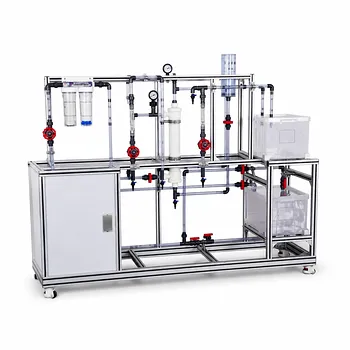
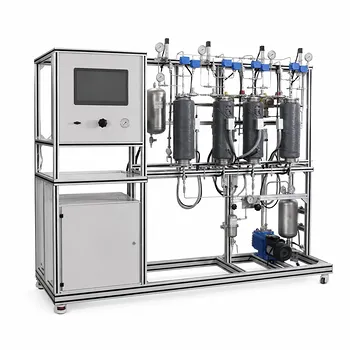
The most direct answer: To train students on purifying synthesized metal complexes, a pilot plant should be configured with a vacuum filtration unit followed by a temperature-controlled drying oven (typically set at 90 °C for stable thermochromic compounds like nickel complexes). This sequential setup allows learners to separate the insoluble target product from soluble impurities and then remove residual solvent under controlled thermal conditions, turning a benchtop synthesis into a scalable unit operation.
A simple vacuum filtration–drying sequence creates a powerful learning platform. The real educational value lies not in the hardware alone, but in how you guide students to manipulate process variables, analyze cake properties, and apply Quality by Design thinking to achieve a pure, consistent product — bridging the gap between glassware chemistry and industrial chemical engineering.
The Pedagogical Blueprint: From Synthesis to Purified Product
Your laboratory configuration must transform a chemical synthesis into a tangible, analyzable process flow. The purification of metal complexes often hinges on a single critical step: isolating a solid product from a liquid mother liquor that holds unreacted species and by‑products.
Why Start with a Vacuum Filtration Pilot Unit?
Vacuum filtration is the workhorse for insoluble products. It uses reduced pressure to pull the liquid through a filter medium, leaving the desired solid cake behind. At pilot scale, this demonstrates industrial-scale solid‑liquid separation.
Students can immediately see how the washing step determines purity. Each solvent wash removes adsorbed impurities, but the volume and number of washes must be balanced against product loss and solvent consumption. Operating the unit forces them to design a washing protocol, not just follow a recipe.
This also introduces the concept of filtration resistance. As they observe flow rates decline, they appreciate how cake thickness, particle size, and applied vacuum interact — core principles that scale to pressure filtration, filter presses, and centrifugal filters in industry.
The Drying Step: More Than Just Removing Solvent
After filtration, the wet cake still contains interstitial solvent. The controlled drying oven at 90 °C (as used for nickel‑based thermochromic complexes) serves a dual purpose. First, it finalizes purification by evaporating remaining volatiles. Second, it becomes a data‑generating unit operation.
Students can plot drying curves by recording mass loss over time. They learn to identify constant‑rate and falling‑rate periods, connecting heat and mass transfer theory to a real product. For thermally sensitive metal complexes, the set temperature is itself a critical parameter: too high, and you risk decomposition; too low, and drying times become impractical. This teaches the engineering judgment behind process specification.
Bridging the Scale: From Benchtop to Industrial Unit Operations
The pilot plant mirrors the same unit operations used in kilo‑lab and ton‑scale production — crystallization, filtration, washing, and drying — but in a safe, observable format. Even if the upstream crystallization occurs in a jacketed vessel on the same rig, the filtration and drying steps become the focal point for downstream purification training.
By physically connecting these units, students see that material leaving the reactor must be immediately processed. This nurtures a holistic thinking about process flow and scheduling, a key competency missing when steps are performed independently at a bench.
Embedding Quality by Design into the Laboratory
A modern engineering curriculum demands more than operational familiarity. The pilot plant is the ideal setting to apply systematic risk‑based thinking.
Categorizing Process Variables (C, N, X)
Instructors can frame each purification run using Cause‑and‑Effect (C&E) risk assessment. Students identify:
- Controllable parameters (C): Drying oven setpoint, vacuum level, wash solvent volume.
- Noise factors (N): Ambient humidity, feed cake consistency from a previous synthesis batch.
- Experimental variables (X): Agitation speed during washing (if using an agitated filter), drying tray load, or filter membrane type.
By deliberately varying these X‑factors, students move from “getting the product” to mapping how each unit operation affects critical quality attributes — purity, polymorphic form, residual moisture. This mimics the QbD approach used in pharmaceutical and fine chemical manufacture.
Designing Your Own Washing and Drying Experiments
The pilot plant becomes a testbed for Design of Experiments (DoE). For example, a student team might investigate wash frequency (one large wash versus three small washes) against wash ratio (mL of solvent per gram of cake). The drying oven then allows them to measure residual impurity levels or final colour change (for a thermochromic complex) as a function of the upstream washing strategy.
Such exercises teach that purification is a system, not a sequence of disconnected steps. An optimized wash in the filter can dramatically shorten drying time and improve final product quality, a lesson far more powerful when physically performed than when simulated.
Understanding the Trade-offs and Hidden Complexities
No configuration is perfect. An honest advisor will highlight where the educational setup must be complemented by discussion, rather than relying on perfect replication of industry.
The Reality of Cake Behavior
Not all metal complex cakes filter easily. The primary reference’s configuration works well for relatively non‑compressible, coarse solids. But students must also learn about cake compressibility: fine, compressible cakes can blind the filter medium under high vacuum, causing sharply decreased flow rates. In an industrial setting, this would call for a pressure filter or an agitated filter dryer to keep the cake porous.
Similarly, cracking of the wet cake during washing can cause channelling, where solvent bypasses the cake entirely and leaves impurities untouched. This is a common problem with non‑agitated filters. Students who witness cracking firsthand come to understand why industrial processes may use an agitated filter dryer or a centrifuge that maintains a uniform cake structure.
When Simplicity Clashes with Industrial Reality
A vacuum filtration unit and a static oven are easy to operate, clean, and maintain — ideal for a teaching lab. But for highly toxic metal complexes (e.g., those containing mercury or certain radioactive metals), this open‑type equipment is inadequate. The supplementary references highlight that contained agitated filter dryers are preferred for toxic compounds, eliminating manual cake handling and reducing personal protective equipment needs.
It is essential to address this gap explicitly. Frame the simple configuration as the deliberate starting point for mastering fundamentals, while using case studies or virtual tours of contained facilities to introduce advanced EHS‑driven design. This prevents students from erroneously assuming that a Buchner funnel on a vacuum flask scales directly to every industrial environment.
How to Configure Your Pilot Plant for Maximum Learning
The equipment you choose will shape the curriculum. Match your investment to the core competencies you intend to build.
- If your primary focus is solid–liquid separation fundamentals: Prioritize a robust vacuum filtration pilot unit with interchangeable filter media. Add a vacuum gauge and a filtrate collection vessel that allows for quantitative washing studies. Keep the design simple and glass‑rich for visibility.
- If your primary focus is thermal process optimization: Select a forced‑convection drying oven with precise temperature control and data logging. Include sample ports that allow students to withdraw material for time‑point analysis without disrupting the thermal profile. Expand the exercise to different temperature setpoints to map compound stability.
- If your primary focus is QbD and experimental design: Ensure the configuration allows easy variation of multiple parameters. A filter unit that can switch between vacuum and low‑pressure operation, coupled with adjustable wash nozzle angles, gives students more factors to explore. Integrate this with a structured C&E matrix exercise at the start of the lab.
- If your primary focus is industrial realism with safety constraints: Supplement the basic hardware with demonstrations of a non‑agitated versus agitated filter dryer system (even as benchtop mock‑ups). Use the contained system example to introduce EHS risk assessment and the cost–benefit analysis of containment.
The ultimate goal is a configuration that forces students to think like process engineers. When they can explain why a 90 °C drying step works for one metal complex but would decompose another, or why a wash ratio above 3:1 gives diminishing purity returns, you have moved them far beyond a recipe — and that is what a well‑configured pilot plant delivers.
Summary Table:
| Unit Operation | Key Parameters & Equipment | Primary Educational Value |
|---|---|---|
| Vacuum Filtration | Vacuum level, wash solvent volume, filter media | Solid-liquid separation, cake resistance, washing protocol design |
| Thermal Drying | Forced-convection oven, temperature control (e.g., 90 °C) | Heat & mass transfer, drying curves, thermal stability evaluation |
| Process Integration | Interconnected rig flow, scale-up modeling | Process scheduling, flow management, industrial emulation |
| Quality by Design (QbD) | Controllable (C), Noise (N), and Experimental (X) variables | Cause-and-Effect risk assessment, Design of Experiments (DoE) |
Modernize Your Engineering Labs with LABPARK
Bridge the gap between benchtop chemistry and industrial reality. LABPARK provides state-of-the-art Educational and Vocational Unit Operations Pilot Plants in chemical engineering, bioprocess & biotech, and environmental & water treatment for universities, research institutes, and enterprises.
Our custom-configured pilot plants empower educators to teach critical industrial concepts—from solid-liquid separation to Quality by Design (QbD) parameters—in a safe, interactive, and highly visual environment.
Ready to upgrade your laboratory training capabilities? Contact us today to request a custom pilot plant configuration!
Related Products
- Multi-Functional Drying Educational Unit Operations Pilot Plant
- Constant Pressure Filtration Educational Unit Operations Pilot Plant
- Hot Filtration Educational Unit Operations Pilot Plant Laboratory System
- Electrolyte Distillation Purification and Formulation Educational Pilot Plant
- Fixed-Bed Chemical Reaction and Gas Dust Tar Removal Unit Operations Pilot Plant
People Also Ask
- Vacuum vs. Atmospheric Drying: How to Choose the Right Pilot Plant Configuration for Your Lab
- Why is dry-basis moisture content preferred over wet-basis? Simplify your drying pilot plant balances.
- How do seasonal changes affect drying pilot plant blower requirements? Key sizing tips.
- Why is the chemical plant startup schedule crucial? De-risk scale-up with pilot plants.
- Why Does a Pilot Plant Solver Return a Singular Matrix Error, and How Can You Resolve It?