A narrower roller gap is a direct lever for tightening the distribution of your tablet hardness. In dry granulation, the gap between the compaction rollers fundamentally shapes the resulting granulate’s physical properties, especially its fines content. By reducing the amount of fragile, over-milled particles, you create a more uniformly compactable blend. This directly shrinks the standard deviation of tablet hardness, driving the process capability index (Cp) higher—with a target Cp of 2.0 becoming achievable.
The core challenge in solid dosage pilot plants is not just hitting a hardness spec, but doing it with minimal variability. Adjusting the roller gap addresses this deep need by controlling the granulate’s compactability profile, making it the single most impactful parameter for elevating the hardness-based Cp.
The Link Between Roller Gap and Granulate Quality
The roller compactor does more than compress powder—it defines the “history” of every particle that eventually forms a tablet. Understanding this mechanism reveals why gap adjustment is so powerful for process capability.
Understanding the Roller Gap as a Control Parameter
Roller gap is the minimum distance between the two counter-rotating rolls during compaction. It directly governs the peak pressure exerted on the material and the dwell time under that pressure. A smaller gap forces the powder into a denser ribbon, altering the fundamental stress-strain profile of the compacted mass.
How Gap Width Dictates Ribbon Density and Granule Strength
Narrowing the gap increases the compression force and material confinement, yielding a more cohesive, higher-density ribbon. Upon milling, these denser ribbons produce stronger, less friable granules. Conversely, a wider gap creates a weaker ribbon that fractures easily, generating an excess of fine particles.
The Fines Factor: Why Less Is More for Consistency
The critical output is the proportion of fines in the milled blend. Fines possess different flow and compaction properties than intact granules. A blend with excessive fines will fill dies inconsistently and compact unpredictably under tablet press pressure. Reducing the fines fraction through a narrower gap is the primary mechanism that stabilizes the tableting step.
Translating Granule Consistency into Tablet Hardness Cp
Process capability for hardness is a direct reflection of blend uniformity. The journey from roller gap to a high Cp follows a clear, logical chain of events.
The Direct Effect on Compactability Variance
Granules from a narrower gap consolidate more uniformly under the tablet press’s main compression. Because their particle size distribution is tighter and less weight-variable, the force transfer during compression is more predictable. This narrows the range of resulting tablet densities and, consequently, the spread of hardness values.
Calculating the Impact on the Cp Statistic
Cp is defined as (USL – LSL) / 6σ, where σ is the process standard deviation. By shrinking σ through reduced compactability variance, you directly increase the ratio. A process that was barely capable (Cp < 1.0) due to hardness scatter can be shifted to a robust state (Cp ≥ 1.33, ideally 2.0) simply by optimizing the roller gap and thereby lowering the fines-related noise in the system.
Understanding the Trade-offs and Hidden Pitfalls
While narrowing the roller gap is a potent optimization strategy, it is not a single-minded solution. Over-optimization can create new problems that undermine the very capability you seek to improve.
The Risk of Over-compaction and Poor Disintegration
Excessively dense ribbons can produce granules that are too hard. While this might superficially improve hardness Cp, the resulting tablets may exhibit unacceptably slow disintegration and dissolution. The goal is a balanced gap that minimizes fines without producing a granulate that resists timely breakup.
Machine Stress and Formulation Sensitivity
A continuously narrow gap imposes high mechanical stress on the roller surfaces and drive system, accelerating wear. Additionally, certain brittle or lubricant-sensitive formulations may suffer from “blinding” of the ribbon surface or inhomogeneous lubrication distribution, leading to new sources of hardness variability that offset the fines benefit.
Actionable Steps for the Pilot Plant Scientist
Applying this knowledge requires a systematic, data-driven approach. The following roadmap turns the theory into a practical program for achieving a hardness-based Cp of 2.0.
Designing a Gap-Optimization Study
Start by mapping ribbon density as a function of roller gap at a fixed feed screw speed. For each gap setting, measure the resulting granulate’s particle size distribution (with a focus on the fines fraction) and then compress tablets while recording hardness data. Calculate Cp for each setting to identify the gap that minimizes σ without neglecting other CQAs.
Integrating with a Control Strategy
Once the optimal gap is identified, treat it as a critical process parameter (CPP) with established control limits. Use real-time monitoring of roller gap and tie it to periodic hardness checks. This transforms a static study into a dynamic control loop that maintains high Cp across production runs.
Making the Right Choice for Your Development Goal
The “best” roller gap depends entirely on your development priorities. Use these goal-oriented strategies to guide your next pilot study.
- If your primary focus is maximizing hardness Cp for regulatory filing: Tighten the roller gap just enough to reduce fines to a near-optimal level, then validate that the resulting σ allows a Cp comfortably above 1.33, targeting 2.0. Confirm that no other attributes are out of specification.
- If your primary focus is balancing hardness capability with dissolution performance: Optimize the gap incrementally, selecting the setting that delivers the highest Cp without pushing the dissolution profile outside acceptable therapeutic limits.
- If your primary focus is establishing a robust, tech-transferable range: Identify the upper and lower gap limits where Cp remains acceptable, then choose a midpoint that offers operational flexibility and insensitivity to minor raw material variability.
Mastering the roller gap is the most elegant way to turn a variable tablet hardness process into a truly capable one.
Summary Table:
| Roller Gap Setting | Ribbon Density | Fines Content | Hardness Variance (\sigma) | Tablet Hardness Cp | Potential Risks |
|---|---|---|---|---|---|
| Narrower | High | Low | Low (Tight distribution) | High (Target ≥ 1.33 - 2.0) | Over-compaction, slow dissolution, machine wear |
| Wider | Low | High | High (Wide distribution) | Low (Cp < 1.0) | Fragile granules, inconsistent tablet weights |
Scale Up Your Pilot Plant Operations with LABPARK
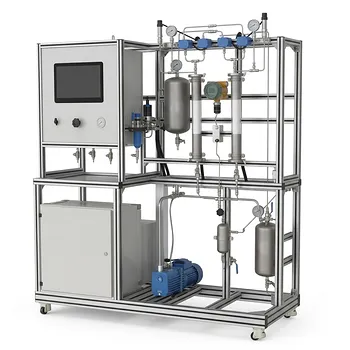
Achieving precise control over critical parameters like roller compaction requires reliable, scalable equipment. LABPARK provides premium Educational and Vocational Unit Operations Pilot Plants designed for universities, research institutes, and enterprises.
Whether your focus is chemical engineering, bioprocess & biotech, or environmental & water treatment, our pilot systems empower you to:
- Bridge the Gap: Transition seamlessly from laboratory research to industrial-scale production.
- Optimize Processes: Accurately control and analyze variables to maximize process capability (Cp).
- Enhance Training: Deliver hands-on, vocational experience with industry-grade pilot systems.
Ready to elevate your research and training capabilities? Contact LABPARK today to discover the ideal pilot plant solution for your facility!
Related Products
- Quantitative Dosing and Liquid Flow Control Educational Unit Operations Pilot Plant
- Solid Waste Pyrolysis and Refining Educational Pilot Plant for Unit Operations
- Micro-Scale Gas-Solid Catalytic Reaction Educational Pilot Plant
- Fixed-Bed Chemical Reaction and Gas Dust Tar Removal Unit Operations Pilot Plant
- Pressure Swing Adsorption Educational Unit Operations Pilot Plant
People Also Ask
- How do educational unit operations pilot plants bridge theory and industrial process development? Hands-On Learning
- How do educational unit operations pilot plants bridge theory and design? Bridge the Engineering Gap
- How do educational unit operations pilot plants address safety and waste management when scaling up?
- How do unit operation requirements differ between traditional chemical processes and bioprocesses? Build Better Pilot Plant Curricula
- What are the barriers to process intensification & how do pilot plants help?