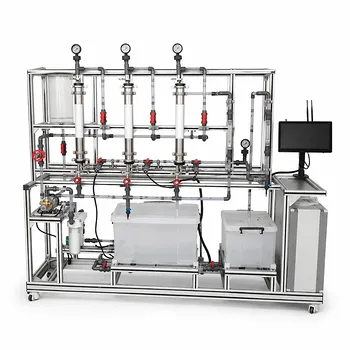
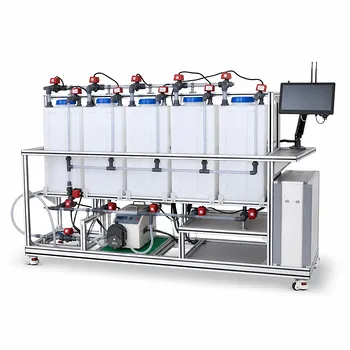
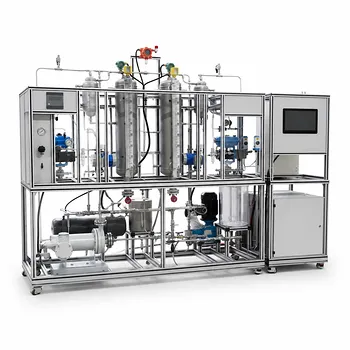
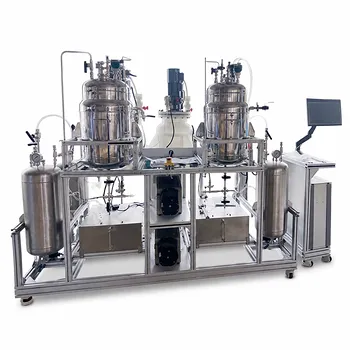
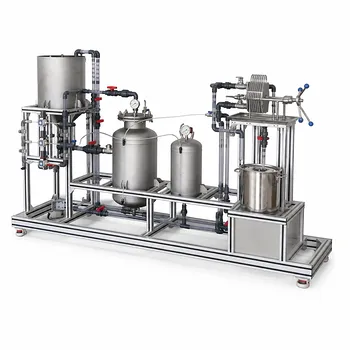
The critical difference between electrodialysis and reverse osmosis isn’t just what they remove, but how they remove it. Reverse osmosis acts as a physical, pressure-driven barrier that strains nearly everything except water molecules. Electrodialysis, conversely, is an electrically-driven process that selectively pulls charged ions through specialized membranes, leaving uncharged contaminants and the water itself to pass through untouched. Your choice between them in a pilot plant hinges on one core question: are you trying to make ultra-pure water, or are you trying to selectively separate and concentrate salts?
Understanding the fundamental driving force—pressure versus electrical potential—is the key to avoiding pilot plant failure. The deep need isn't simply to desalinate water, but to select the separation principle that matches your specific feed water chemistry and research goal. Reverse osmosis offers a universal barrier for all solutes, while electrodialysis provides a selective scalpel for ionic species.
Dissecting the Core Driving Forces
The most fundamental distinction lies not in the membranes themselves, but in the physics that move molecules. RO fights nature’s osmotic flow with brute mechanical force, while ED manipulates ionic charges with an electric field.
Pressure vs. Voltage
Reverse osmosis uses a high-pressure pump to overcome the natural osmotic pressure of a solution. In a pilot plant, you apply pressure significantly higher than the solution’s osmotic potential to the concentrated side, physically forcing pure water molecules through a dense semipermeable membrane. This process rejects virtually everything else—salts, organics, and colloids.
Electrodialysis relies on a direct current (DC) electric field to drive ion migration. Rather than forcing water through a dense film, ED uses a stack of ion-exchange membranes that are permeable to ions, not water flow. Cations migrate toward the cathode and pass through cation-exchange membranes, while anions migrate toward the anode through anion-exchange membranes, effectively removing salts without a high-pressure feed stream.
The Analogy of a Sieve vs. a Sorting Gate
To visualize the difference in a pilot plant setting, consider these mechanisms:
- Reverse Osmosis is like a molecular sieve. The dense membrane acts as a hyper-fine filter. Water molecules are small enough to pass through the polymer matrix under extreme pressure, but all other dissolved and suspended matter is too large and is physically rejected in the concentrate stream.
- Electrodialysis is like a sorting gate at a stadium. The field is the event that makes people (ions) move. The gates (ion-exchange membranes) are chemically tuned to allow only specific ticket holders (cations or anions) to leave. Water molecules and neutral organic substances are unaffected spectators that don’t respond to the electric field and stay put.
Operational Consequences in a Pilot Plant
This mechanistic difference creates starkly different operational realities when you run these units. The separation method dictates energy consumption patterns, the nature of fouling, and what passes through to the product stream.
The Final Product Profile
RO produces water that is theoretically free of nearly all contaminants. Because the mechanism is physical size-exclusion at near-molecular scale, the "permeate" is highly demineralized. This makes it ideal for applications requiring ultra-pure water or stringent removal of uncharged micropollutants.
ED leaves non-ionic components in the product water. The electric field only acts on charged species. Silica, uncharged organic molecules, and biological matter remain in the diluate stream. If your pilot plant research involves separating a valuable charged protein from a neutral sugar, ED is your tool. If you need to remove a neutral pesticide, RO is the mandatory choice.
Scaling and Fouling Behavior
RO membranes are highly susceptible to fouling and scaling. The "dead-end" filtration style concentrates all rejected substances—including scalants like calcium carbonate, silica, and microbes—directly on the membrane surface. This necessitates intensive pretreatment like chemical dosing and media filtration to prevent rapid performance loss.
Electrodialysis units demonstrate superior resistance to organic fouling. Because water does not flow through the membranes and the electric field is applied tangentially, organic colloids are less likely to be forced into the membrane matrix. The process experiences concentration polarization, but the ion-exchange membranes are chemically optimized to selectively pass small ions while repelling large, charged organic molecules, offering more robust operation with challenging feedstocks in a teaching lab.
Application Scenarios: Choosing the Right Tool
While both are used for desalination, their divergent strengths define their niche in pilot-scale research and environmental engineering. Selecting the wrong technology will lead to inefficient mass transfer or complete project failure.
Where ED Excels: Selective Desalting and Bioprocessing
Electrodialysis pilot units are the standard for specific ionic separations. In food and pharmaceutical industries, ED is used to demineralize whey, remove tartrates from wine, or recover valuable electrolytes—all without denaturing heat-sensitive proteins or removing desirable uncharged sugars.
It is the superior tool for teaching mass transfer kinetics. Because students can independently vary electrical current density, flow velocity, and ion-specific membrane selectivity, an ED pilot plant provides a rich experimental matrix for studying electrode reactions and ion transport under stable, low-fouling conditions.
Where RO Excels: Universal Removal and Barrier Applications
Reverse osmosis is the paradigm for producing drinking water from seawater. In environmental engineering, it provides the ultimate barrier against pathogens, dissolved salts, and emerging contaminants of concern (like PFAS) in a single step. Its energy efficiency relative to thermal distillation is unmatched for brackish and seawater feeds.
It is critical for proving membrane durability. Pilot plant studies use RO to test the compaction resistance and chemical stability of new membrane materials under high operating pressures. The efficiency is defined by the membrane’s ability to maintain high rejection rates mechanically, not by electrical current optimization.
Understanding the Trade-offs
No separation technology is a panacea. A significant pitfall is assuming ED’s selectivity is always superior. It fails completely against non-electrolytes. Similarly, assuming RO’s universality defines its purity often ignores its operational fragility.
The Blind Spot of ED: Uncharged Molecules
Electrodialysis cannot remove dissolved silica, bacteria, or neutral organic pollutants. If your pilot plant’s goal is to treat a stream where these are the primary concern, ED provides zero rejection. A hybrid system or an RO guard polish is required, negating the ED system’s simpler pretreatment advantage.
The Energy Crossover Point
ED power consumption is proportional to the amount of salt removed. It is highly energy-efficient for low-salinity brackish water (below 3,000 mg/L TDS) where the solution’s electrical resistance is high enough to prevent current leakage. RO power consumption is largely independent of salinity. The pump must always overcome a fixed osmotic pressure. For seawater (~35,000 mg/L TDS), the osmotic pressure dominates energy needs, making RO more efficient than ED. Using ED for seawater desalination in a pilot plant would lead to exorbitant resistive heating and energy waste.
Membrane Longevity vs. Pretreatment Complexity
RO systems require chemical-intensive pretreatment to protect the physical structure of the membrane. The high-pressure environment makes chlorine damage and physical compaction major risks, demanding activated carbon and antiscalant dosing. ED systems trade pretreatment simplicity for a risk of chemical corrosion. While less prone to colloidal fouling, the electrodes and ion-exchange membranes can degrade if exposed to oxidants or incorrect pH extremes. The durability concern shifts from mechanical pressure resistance to electrochemical stability.
Making the Technology Choice in Your Pilot Plant
The decision is never about which technology is globally superior, but which separation physics aligns with your research or treatment goal. Base your selection on the nature of your solute and the final product specification.
- If your primary focus is demonstrating selective solute recovery or food/bio-processing: Choose electrodialysis. Its ability to separate ionic salts from neutral organics without a phase change or high pressure makes it the only viable choice for maintaining product integrity while demineralizing.
- If your primary focus is achieving a total contaminant barrier or producing sterile, ultra-pure water: Choose reverse osmosis. The pressure-driven, dense membrane is your only guarantee of rejecting everything from viruses to sodium ions in a single unit operation.
- If your primary focus is research into membrane fouling with minimal chemical pretreatment: Start with electrodialysis. Its higher tolerance for organic matter and low-pressure operation provides a more stable platform for isolating and studying fouling mechanism variables before moving to the more sensitive RO system.
Ultimately, treating these as competing technologies misses the point of a pilot plant—they are complementary tools for resolving the molecular components of water, one using pressure and the other using potential.
Summary Table:
| Feature | Electrodialysis (ED) | Reverse Osmosis (RO) |
|---|---|---|
| Driving Force | Electrical potential (DC voltage) | Mechanical pressure |
| Mechanism | Ion migration through membranes | Size-exclusion physical barrier |
| Target Solute | Charged ions (leaves neutral molecules) | Universal solute rejection (pure water) |
| Fouling Risk | High resistance to organic fouling | Highly susceptible to scaling/fouling |
| Energy Factor | Proportional to salt removed | Proportional to feed osmotic pressure |
Accelerate your research and training with LABPARK's advanced Educational and Vocational Unit Operations Pilot Plants. We provide tailored systems in chemical engineering, bioprocess & biotech, and environmental & water treatment for universities, research institutes, and enterprises. Explore how our custom solutions can enhance your educational capabilities—contact us today to get started!
Related Products
- Multifunctional Membrane Separation Educational Pilot Plant with Ultrafiltration, Nanofiltration, Reverse Osmosis
- Electrolyte Distillation Purification and Formulation Educational Pilot Plant
- Electrolytic Hydrogen Production Educational Unit Operations Pilot Plant
- Electrochemical Water Treatment Educational Unit Operations Pilot Plant
- Multi-Functional Membrane Separation Educational Pilot Plant for Unit Operations Lab
People Also Ask
- Pervaporation vs. Vapor Permeation: Handling Suspended Solids in Membrane Pilot Plants
- How do PEI, PVDF, and PSU membranes compare in pilot plants? Find the best fit.
- What are the trade-offs of polymer vs inorganic membranes in teaching pilot plants? Key laboratory comparison.
- How can operators optimize operating conditions and cleaning protocols in membrane separation pilot plants to mitigate fouling?
- What are the advantages of membrane separation in pilot plants? Efficient Organic Vapor Recovery