Knowledge Chemical Engineering Education When can students simplify calculations by using the arithmetic mean radius instead of the log-mean radius? (r₂/r₁ ≤ 2)
Author avatar

Tech Team · LABPARK

Updated 1 month ago

When can students simplify calculations by using the arithmetic mean radius instead of the log-mean radius? (r₂/r₁ ≤ 2)


When the ratio of the pipe’s outer radius to its inner radius is 2 or less, you can confidently replace the log-mean radius with the simple arithmetic mean. In a pilot plant laboratory, this shortcut introduces an error of only about 4%—a deviation so small that it falls well within acceptable reporting tolerances for thermal unit operations experiments.

The logarithmic mean radius is the mathematically exact way to account for a cylindrical wall’s changing area, but its arithmetic cousin becomes an eminently practical substitute the moment r₂/r₁ ≤ 2. The resulting 4% error is a negligible trade‑off for faster, clearer calculations that still faithfully represent the physics students are meant to observe.

The Mathematical Foundation of Cylindrical Heat Conduction

Before reaching for a shortcut, it helps to see why the exact formula exists in the first place. Cylindrical walls are not like flat plates—the surface area available for heat flow expands as the radius increases.

Why the Log-Mean Radius Matters

In a flat wall, the area perpendicular to heat flow stays constant. In a cylinder, that area changes continuously from the inner surface to the outer surface.

The heat transfer rate therefore depends on a single representative area: the logarithmic mean area, (S_m = \frac{S_2 – S_1}{\ln(S_2/S_1)}). From that area, the log-mean radius (r_m) is derived. Using it ensures your calculated (Q) matches what the actual temperature gradient would produce.

The Arithmetic Mean Shortcut

The arithmetic mean radius simply averages the inner and outer values: (\frac{r_1 + r_2}{2}). It flattens the exponential curvature of the cylinder into a straight line.

For thick‑walled pipes, that straight‑line assumption breaks down. But for many pilot‑plant setups, the walls are thin enough that the curvature is barely noticeable—and that is where the simplification lives.

When the Simplification Is Valid

Pilot plant experiments often involve small‑diameter pipes and modest wall thicknesses. These dimensions naturally push the geometry into a safe zone where the arithmetic mean performs surprisingly well.

The Critical Ratio: r₂/r₁ ≤ 2

All the complexity boils down to a single geometric test. If the outer radius is no more than twice the inner radius, the arithmetic mean radius is acceptable. This condition is equivalent to saying the outer‑to‑inner surface area ratio (S₂/S₁) is 2 or less.

Most teaching‑scale heat exchangers and insulated pipes fall comfortably within this limit, making it a rule students can apply almost instinctively.

Quantifying the 4% Error Threshold

When (r₂/r₁ = 2), the exact log‑mean radius and the arithmetic mean diverge by roughly 4%. Below that ratio the error shrinks further. In a pilot plant, where other uncertainties—flow measurement noise, thermocouple accuracy, minor fouling—easily exceed 4%, this mathematical simplification does not obscure the physical truth. It simply removes a tedious calculation step without meaningful loss of fidelity.

Understanding the Trade‑offs

Every engineering shortcut has a boundary. Students build real judgment when they learn not just the rule, but the moment the rule stops working.

When the Error Becomes Unacceptable

Push (r₂/r₁) much beyond 2—say, to 3 or 4—and the 4% error quickly balloons. For thick‑walled cylinders, the arithmetic mean systematically over‑predicts the effective radius, leading to an overestimated heat transfer rate. In a research‑grade experiment where a precise energy balance is critical, such an error could mask real phenomena or mislead the data analysis. The log‑mean formula then becomes non‑negotiable.

The Broader Lesson: Logarithmic vs. Arithmetic Means in Unit Operations

This radius shortcut is not an isolated trick; it mirrors a wider rule‑of‑thumb in thermal and mass transfer unit operations. The logarithmic mean temperature difference (LMTD) can be approximated by the arithmetic mean when the end temperature differences satisfy (\Delta t₂/\Delta t₁ \le 2). Similarly, gas absorption pilot plants allow an arithmetic mean driving force when the concentration ratio (\Delta Y_1/\Delta Y_2) stays between 0.5 and 2.

All these cases share the same mathematical heart: when the two boundary values are within a factor of two of each other, the system’s driving force or geometry is uniform enough that a simple linear average does the job. Understanding one helps you understand them all.

Making the Right Choice for Your Lab Report

Your decision boils down to a quick check of the pipe dimensions and a clear awareness of what you are trying to demonstrate.

  • If your primary focus is report accuracy and your measured r₂/r₁ exceeds 2: Use the log-mean radius. The point of the experiment is to trace the physics precisely, and the extra calculation is worth the integrity it brings.
  • If your primary focus is lab efficiency and your pipe’s r₂/r₁ is ≤ 2: Adopt the arithmetic mean radius. It saves time, reduces algebraic errors, and still yields a result that matches the measured data within experimental scatter.
  • If your primary focus is developing engineering judgment: Use the arithmetic mean shortcut and explicitly state the ratio and the estimated 4% error in your report. This transforms a simple calculation into a deliberate, justified simplification—exactly what seasoned engineers do.

The arithmetic mean radius is not a crutch; it is a legitimate tool whose use proves you know when a calculation can be simplified without losing the lesson the experiment is designed to teach.

Summary Table:

Feature Log-Mean Radius ($r_m$) Arithmetic Mean Radius ($r_a$)
Formula $(r_2 - r_1) / \ln(r_2/r_1)$ $(r_1 + r_2) / 2$
Geometric Limit Any $r_2/r_1$ ratio $r_2/r_1 \le 2$
Error Margin Exact (0% error) $\le 4%$ error
Best Use Case Thick-walled pipes & precise research Thin-walled pipes & fast student labs

Upgrade Your Chemical Engineering Lab with LABPARK

Teaching thermal unit operations effectively requires reliable, industrial-grade equipment where students can verify mathematical models and shortcut rules in real time.

LABPARK provides high-quality Educational and Vocational Unit Operations Pilot Plants in chemical engineering, bioprocess & biotech, and environmental & water treatment. Designed specifically for universities, research institutes, and vocational enterprises, our pilot plants deliver the accuracy and durability needed for rigorous engineering coursework.

👉 Contact LABPARK today to request a catalog or custom pilot plant solution!

Related Products

People Also Ask

Related Products

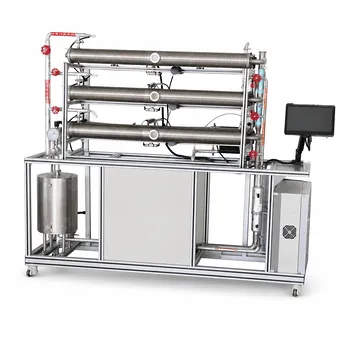
Dual Mode Heat Transfer Pilot Plant for Unit Operations Training

Dual Mode Heat Transfer Pilot Plant for Unit Operations Training

Engineering-scale dual-mode heat transfer pilot plant for hands-on unit operations training in chemical engineering. Features real and simulated modes, multiple heat exchanger types, comprehensive coefficient determination, and advanced process control with data acquisition for engineering students and researchers.

Three-Tube Heat Transfer Educational Pilot Plant for Unit Operations Training

Three-Tube Heat Transfer Educational Pilot Plant for Unit Operations Training

Three-tube heat transfer pilot plant for studying convective heat transfer enhancement and condensation. Allows comparison of smooth, corrugated, turbulent tubes, verifying empirical correlations. Ideal for chemical engineering education with safety and closed-loop steam recovery.

Comprehensive Multi-Modal Heat Transfer Unit Operations Pilot Plant for Engineering Training

Comprehensive Multi-Modal Heat Transfer Unit Operations Pilot Plant for Engineering Training

Comprehensive multi-modal heat transfer unit operations pilot plant for engineering training. Features four heat exchanger types, multi-media switching, and three operating modes. Hands-on experience in safety, optimization, and process control. Industrial-grade design with real-time data acquisition for chemical engineering labs.

Shell and Tube Heat Exchanger Heat Transfer Coefficient Determination Educational Pilot Plant

Shell and Tube Heat Exchanger Heat Transfer Coefficient Determination Educational Pilot Plant

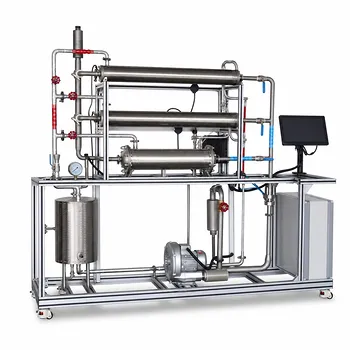
LABPARK's shell and tube heat exchanger pilot plant enables students to investigate heat transfer coefficients, LMTD, co-current vs counter-current flow, bridging theory and industrial practice. Customizable for chemical, mechanical, environmental engineering curricula. Ideal for unit operations and process engineering labs.

Comprehensive Heat Transfer Coefficient Determination Educational Unit Operations Pilot Plant

Comprehensive Heat Transfer Coefficient Determination Educational Unit Operations Pilot Plant

Advanced industrial-grade educational pilot plant for comprehensive heat transfer coefficient determination. Enables quantitative convective heat transfer analysis, evaluates double-pipe and shell-and-tube exchanger configurations, and includes digital data acquisition. Customizable for engineering curriculum. Ideal for engineering unit operations labs.

Hot Filtration Educational Unit Operations Pilot Plant Laboratory System

Hot Filtration Educational Unit Operations Pilot Plant Laboratory System

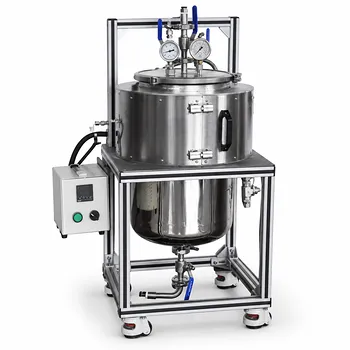
This integrated laboratory bench-scale hot filtration pilot plant enables students to study solid-liquid separation under thermal conditions, featuring a stainless steel vessel, removable heating jacket, and multi-layer filter plates for unit operations education, ideal for chemical engineering laboratory curriculum.

Potassium Salt Thermal Dissolution and Crystallization Separation Educational Unit Operations Pilot Plant

Potassium Salt Thermal Dissolution and Crystallization Separation Educational Unit Operations Pilot Plant

This educational pilot plant allows chemical engineering students to perform potassium salt thermal dissolution and cooling crystallization experiments, integrating solubility studies, supersaturation control, and solid-liquid separation in a safe, compact, and customizable laboratory system for hands-on unit operations learning.

Throttling Effect Determination Educational Unit Operations Pilot Plant

Throttling Effect Determination Educational Unit Operations Pilot Plant

Investigate the Joule-Thomson throttling effect with this educational unit operations pilot plant. Designed for engineering students, it enables hands-on comparative analysis of adiabatic gas expansion using precise process control, interactive digital interface, and eco-friendly operation, ensuring safe repeatable thermodynamic experiments.

Solid Spherical Heat Transfer Coefficient Determination Educational Chemical Engineering Pilot Plant

Solid Spherical Heat Transfer Coefficient Determination Educational Chemical Engineering Pilot Plant

This educational chemical engineering pilot plant enables students to determine convective heat transfer coefficients and observe transient thermal behavior of solid spheres under natural convection, forced convection, fixed beds, and fluidized bed regimes.

Rising and Falling Film Evaporation Educational Unit Operations Pilot Plant

Rising and Falling Film Evaporation Educational Unit Operations Pilot Plant

Hands-on educational pilot plant for studying rising and falling film evaporation, flow regimes, and heat transfer. Customizable for university labs with industrial instrumentation and data acquisition. Enables comparative evaluation of evaporation modes and energy efficiency.

Multi-Reactor Educational Pilot Plant for Reaction Engineering Unit Operations

Multi-Reactor Educational Pilot Plant for Reaction Engineering Unit Operations

Integrated bench-scale educational pilot plant for chemical engineering teaching featuring fixed bed fluidized bed and stirred tank reactors with web-based digital twin controls and safety interlocks for hands-on unit operations and reaction engineering comparative studies in one compact system.

Circulating Wind Tunnel Drying and Convective Heat Transfer Coefficient Determination Educational Pilot Plant

Circulating Wind Tunnel Drying and Convective Heat Transfer Coefficient Determination Educational Pilot Plant

This educational pilot plant enables engineering students to study convective drying, air-water vapor systems, and heat transfer by determining drying curves, drying rate curves, and convective heat transfer coefficients under variable conditions.

Thermal Desorption Exhaust Gas and Tail Water Treatment Educational Pilot Plant

Thermal Desorption Exhaust Gas and Tail Water Treatment Educational Pilot Plant

Bench-scale educational pilot plant for treating thermal desorption exhaust gas and tail water integrates condensation, Fenton oxidation, precipitation, filtration, and carbon adsorption. Ideal for chemical engineering and environmental labs, teaching unit operations, process control, and real-time data analysis.

Multi Functional Catalytic Reaction and Reactor Evaluation Educational Unit Operations Pilot Plant

Multi Functional Catalytic Reaction and Reactor Evaluation Educational Unit Operations Pilot Plant

Bench-scale educational pilot plant for catalytic reaction and reactor evaluation, integrating fixed bed, fluidized bed, and stirred tank reactors. Students compare reactor designs, evaluate catalysts, and study reaction kinetics and hydrodynamics. Perfect for unit operations labs in chemical engineering curricula.

Polymerization Granulation and Pellet Processing Educational Unit Operations Pilot Plant

Polymerization Granulation and Pellet Processing Educational Unit Operations Pilot Plant

Integrated pilot plant for teaching polymer processing from polymerization to pelletizing. Includes 30L reactor, hydrolyzer, extruder-granulator, vibration dryer, crusher, and sieve. Atmospheric pressure operation for safety, corrosion-resistant SS, customizable for chemical and polymer engineering education. Ideal for university labs.

Tubular Reactor Flow Characteristics Determination Educational Unit Operations Pilot Plant

Tubular Reactor Flow Characteristics Determination Educational Unit Operations Pilot Plant

Educational pilot plant for investigating tubular reactor flow characteristics and residence time distribution Features adjustable recycle for plug flow and backmixing studies industrial touchscreen interface and real-time data acquisition Ideal for chemical engineering unit operations laboratory training and education

Supercritical High-Gravity Flash Evaporation Educational Unit Operations Pilot Plant

Supercritical High-Gravity Flash Evaporation Educational Unit Operations Pilot Plant

Bench-scale integrated teaching system for advanced separation and mass transfer, combining supercritical high-gravity flash evaporation with heating, chemical reaction, and material collection, featuring modular design, Stainless Steel 316L construction, transparent visualization, touchscreen control, and safety systems for chemical engineering education.

Dual-Mode Rectification Pilot Plant for Practical Training Unit Operations

Dual-Mode Rectification Pilot Plant for Practical Training Unit Operations

Industrial-scale dual-mode rectification pilot plant for chemical engineering practical training. Features real-material and simulated-material operation modes, sieve-plate column with sight glasses for visual observation of hydrodynamics, and customizable SCADA control for safe, hands-on learning of unit operations and mass transfer.

Constant Pressure Filtration Educational Unit Operations Pilot Plant

Constant Pressure Filtration Educational Unit Operations Pilot Plant

Hands-on educational pilot plant for constant pressure filtration. Classic plate and frame filter press allows students to study kinetics, determine specific cake resistance, perform cake washing and evaluate washing rates. Ideal for chemical engineering curriculum. Mobile, customizable, safety-compliant design.

Multi Pump Fluid Transport Process Piping Unit Operations Training Pilot Plant

Multi Pump Fluid Transport Process Piping Unit Operations Training Pilot Plant

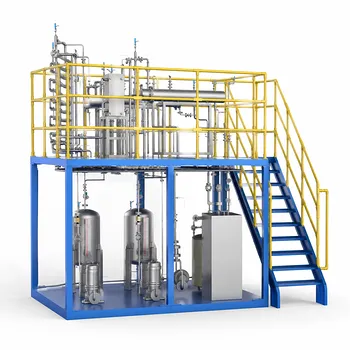
Industrial-scale multi-pump pilot plant for unit operations training in fluid transport and process piping, featuring real-material and semi-physical simulation modes, comprehensive pump and flowmeter calibration, and safety-enhanced two-tier platform, bridging academic theory and industrial practice for chemical engineering education.


Leave Your Message