Knowledge Chemical Engineering Education How does an SMBR simulate TMBR counter-current movement? Master key chemical engineering pilot plant concepts.
Author avatar

Tech Team · LABPARK

Updated 2 months ago

How does an SMBR simulate TMBR counter-current movement? Master key chemical engineering pilot plant concepts.


A clever system of timed valve switches makes the impossible possible in a university lab. A Simulated Moving Bed Reactor (SMBR) replicates the continuous counter‑current contact of a True Moving Bed Reactor (TMBR) not by moving solids, but by periodically rotating the positions where fluid enters and exits a series of fixed‑bed columns. By advancing these inlet and outlet ports one column in the direction of the fluid flow at a high enough frequency, the stationary solid phase appears to move in the opposite direction, establishing the same counter‑current concentration profiles you would measure in a TMBR.

The SMBR turns a sequence of port shifts into a near‑continuous counter‑current contact. Multiple adsorbent or catalyst beds are linked in a ring, and the fluid feed, product, desorbent, and raffinate ports are synchronously stepped forward. This digital mimicry of solid movement delivers the reaction‑separation synergy of a moving bed without a single moving mechanical part, making it ideal for safe, flexible teaching experiments.

The Core Principle: Simulating Movement Without Moving Parts

Why a True Moving Bed Is Impractical for Teaching

A TMBR physically circulates fresh catalyst or adsorbent downward while the liquid phase flows upward. The solid particles exit the top, are regenerated externally, and re‑enter at the bottom. This requires rotary valves, seals, and particle‑handling systems that are expensive, difficult to miniaturize, and prone to clogging. For a university pilot plant, mechanical complexity obscures the fundamental mass‑transfer principles and introduces safety hazards that distract from learning.

The Port Switching Mechanism: A Digital Displacement

In an SMBR, a set of columns – typically 4 to 16 – is arranged in a circular configuration. Each column is a packed bed of stationary catalyst or adsorbent. Instead of physically conveying the solids, the positions of the liquid feed, liquid withdrawal, and any flushing streams are shifted one column at a time in the same direction as the bulk fluid flow. At each switch, the feed port moves to the next column downstream, and the outlet port follows suit.

This switching accomplishes a crucial illusion: the stationary solid bed is conceptually divided into zones that shift upstream against the liquid flow. Imagine a conveyor belt of numbered columns. When you move the point where you pour liquid onto the belt one step forward, the liquid meets a new section of belt. If the belt itself were moving backward, the effect would be identical. Port switching is the digitised equivalent of that backward‑moving belt, allowing the solid phase to “see” the liquid in a progressively changing sequence that matches true counter‑current contact.

From Discontinuous to Continuous: The Role of Switching Frequency

Each port switch creates a step change in the concentration profiles inside the columns. Between switches, the system behaves like a series of fixed beds. The magic happens when the switching period is much shorter than the characteristic time constants of adsorption or reaction. At high switching frequencies, the discrete jumps become indistinguishable from a steady, continuous counter‑current flow. Concentration fronts travel smoothly through the reactor ring, and the separation performance approaches that of a true moving bed. For teaching, adjusting the switching time lets students explore the transition from transient batch‑like operation to a pseudo‑steady‑state regime, directly linking valve timing to reactor performance.

Understanding the Limits of the Simulation

Not Perfectly Continuous

Even with fast switching, an SMBR operates in a periodic, quasi‑steady state. After each port shift, a new set of concentration profiles must re‑establish, leading to slight transient oscillations. These ripples are negligible in well‑designed educational units but remind students that the simulation is an approximation. The system’s performance is inherently more sensitive to dead volumes in connecting lines and to the precision of valve actuation than a true moving bed.

Axial Dispersion and Finite Bed Length

Real columns suffer from axial dispersion, which rounds sharp concentration fronts. In a TMBR, the continuous solid movement can sometimes mitigate this because solids are constantly refreshed. In an SMBR, the fixed beds are longer and the solids never leave their column, so axial dispersion can limit the achievable separation sharpness. Teaching labs benefit from this imperfection, as it becomes a measurable parameter that highlights the differences between ideal and real reactive chromatography.

Zone Configuration Constraints

A classical four‑zone SMB requires careful placement of the feed, extract, raffinate, and desorbent ports to respect the adsorption isotherms. In a teaching reactor, the same column array must host both reaction and separation. If the reaction is faster than the separation, the ideal switching strategy may differ from a pure separation SMB. Students must grapple with the trade‑off: a single set of switching ports cannot simultaneously optimise conversion and purity, illustrating a core design challenge that also exists, albeit differently, in true moving beds.

Making the Right Choice for Your Teaching Goals

The SMBR shines in a university setting because it transforms an abstract counter‑current concept into a programmable experiment. How you use it depends on your learning objectives.

  • If your primary focus is reaction engineering kinetics: Use the SMBR to demonstrate how in‑situ product removal shifts equilibrium and enhances conversion in reversible reactions. Vary the switching time while keeping the feed rate constant to show the impact of solid‑phase “velocity” on yield.
  • If your primary focus is separation process design: Configure the reactor as a classic SMB separation unit first. Let students map the concentration profiles across the ring after each switch and compare the purity of extract and raffinate ports to triangle‑theory predictions.
  • If your primary focus is process control and automation education: Exploit the valve sequencing logic. Task students with programming the port switching, diagnosing timing errors, and implementing a feedback loop to maintain an optimal switching period as feed composition changes.
  • If your primary focus is comparing simulation to reality: Run a few cycles with a slow switching period to visualise discrete steps, then increase the frequency until the concentration profiles appear steady. This directly shows how a sequence of step changes approximates continuous motion, cementing the core principle.

The SMBR’s elegance lies in turning a complex mechanical problem into a simple temporal one. Once students grasp that a well‑timed series of port switches is indistinguishable from solid movement, they possess a design tool that extends far beyond the teaching lab.

Summary Table:

Feature True Moving Bed (TMBR) Simulated Moving Bed (SMBR)
Solid Phase Physically moves and circulates Stationary (fixed-bed columns)
Operation Continuous counter-current Quasi-steady state (periodic port switching)
Complexity High (rotary valves, prone to clogging) Low (no moving mechanical parts)
Suitability Primarily industrial scale Ideal for safe, flexible university teaching

Bring Advanced Chemical Engineering Concepts to Life

Are you looking to equip your lab with state-of-the-art educational systems? LABPARK provides premium Educational and Vocational Unit Operations Pilot Plants in chemical engineering, bioprocess & biotech, and environmental & water treatment. Designed specifically for universities, research institutes, and enterprises, our systems make complex concepts like SMBR easy, safe, and highly interactive for students to explore.

Contact LABPARK today to upgrade your laboratory setup!

Related Products

People Also Ask

Related Products

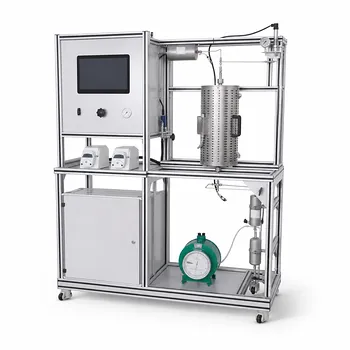
Multi Functional Catalytic Reaction and Reactor Evaluation Educational Unit Operations Pilot Plant

Multi Functional Catalytic Reaction and Reactor Evaluation Educational Unit Operations Pilot Plant

Bench-scale educational pilot plant for catalytic reaction and reactor evaluation, integrating fixed bed, fluidized bed, and stirred tank reactors. Students compare reactor designs, evaluate catalysts, and study reaction kinetics and hydrodynamics. Perfect for unit operations labs in chemical engineering curricula.

Micro-Scale Gas-Solid Catalytic Reaction Educational Pilot Plant

Micro-Scale Gas-Solid Catalytic Reaction Educational Pilot Plant

Explore heterogeneous catalysis with this micro-scale gas-solid catalytic reaction educational pilot plant. Designed for university labs, it enables hands-on study of reaction kinetics and transport phenomena in a benchtop packed bed reactor with high-precision flow control and touchscreen automation.

Multi-Reactor Educational Pilot Plant for Reaction Engineering Unit Operations

Multi-Reactor Educational Pilot Plant for Reaction Engineering Unit Operations

Integrated bench-scale educational pilot plant for chemical engineering teaching featuring fixed bed fluidized bed and stirred tank reactors with web-based digital twin controls and safety interlocks for hands-on unit operations and reaction engineering comparative studies in one compact system.

Fluidized Bed Gas Solid Catalytic Reaction Educational Pilot Plant

Fluidized Bed Gas Solid Catalytic Reaction Educational Pilot Plant

Our educational fluidized bed gas-solid catalytic reaction pilot plant is ideal for chemical engineering labs. Students study fluidization dynamics, catalyst evaluation, and process control hands-on. Features include a customizable reactor, touchscreen HMI, and safety interlocks for safe, curriculum-aligned experiments.

High-Gravity Emulsification and Mass Transfer Educational Pilot Plant

High-Gravity Emulsification and Mass Transfer Educational Pilot Plant

This integrated educational pilot plant utilizes rotating packed bed technology to demonstrate high-gravity emulsification and mass transfer, providing engineering students with hands-on experience in process intensification and unit operations through a modular, customizable design with digital monitoring.

Fixed Bed Gas Solid Catalytic Reaction Educational Pilot Plant

Fixed Bed Gas Solid Catalytic Reaction Educational Pilot Plant

Fixed-bed gas-solid catalytic reaction unit operations pilot plant for chemical engineering education. Features split-furnace, mass flow controllers, PID control, safety interlocks. Ideal for heterogeneous catalysis, reactor dynamics, catalyst evaluation studies. Fully customizable configurations for university laboratories and academic research.

Fixed-Bed Chemical Reaction and Gas Dust Tar Removal Unit Operations Pilot Plant

Fixed-Bed Chemical Reaction and Gas Dust Tar Removal Unit Operations Pilot Plant

Integrated educational pilot plant for studying catalytic gas-solid reactions and downstream gas purification. Features dual fixed-bed reactor, three-stage heating, and touchscreen control for hands-on engineering training. Ideal for chemical and environmental engineering curricula.

Ethylbenzene Dehydrogenation Educational Unit Operations Pilot Plant

Ethylbenzene Dehydrogenation Educational Unit Operations Pilot Plant

Ethylbenzene dehydrogenation educational pilot plant replicates industrial styrene production, offering hands-on experience with fixed-bed reactors, catalyst activation, regeneration, automated process control. Designed for university chemical engineering labs, it enables study of gas-solid catalysis, catalyst deactivation, steam regeneration, and safety interlocks.

Educational Unit Operations Pilot Plant for Intraparticle Diffusion Effective Factor Measurement

Educational Unit Operations Pilot Plant for Intraparticle Diffusion Effective Factor Measurement

Designed for chemical engineering university labs, this pilot plant allows hands-on determination of catalyst particle intraparticle diffusion effective factors and gas-solid reaction kinetics using a fixed-bed tubular reactor with industrial touchscreen control, bridging theory and practical reactor design.

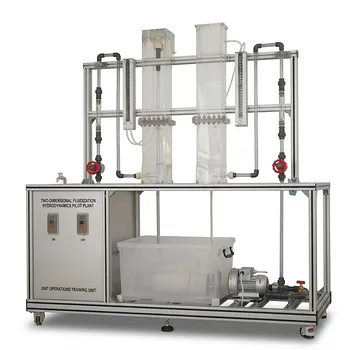
Two-Dimensional Fluidization Hydrodynamics Educational Pilot Plant for Unit Operations Training

Two-Dimensional Fluidization Hydrodynamics Educational Pilot Plant for Unit Operations Training

Explore gas-solid and liquid-solid fluidization hydrodynamics with our transparent 2D educational pilot plant. Ideal for chemical engineering unit operations labs, it demonstrates fixed to fluidized bed regimes, measures pressure drop, and integrates QR-code digital learning for enhanced student training.

Photocatalytic Membrane Separation and Degradation Unit Operations Pilot Plant

Photocatalytic Membrane Separation and Degradation Unit Operations Pilot Plant

Bench-scale pilot plant integrating photocatalytic degradation with membrane separation for engineering education. Study advanced oxidation, microfiltration, and hybrid processes using industrial sensors. Features safety light-blocking curtain, low-noise compressor, and durable stainless-steel construction.

Residence Time Distribution and Reactor Flow Characteristics Determination Educational Pilot Plant

Residence Time Distribution and Reactor Flow Characteristics Determination Educational Pilot Plant

This versatile educational pilot plant is designed for comprehensive study of residence time distribution and reactor flow characteristics, featuring multiple CSTRs in series, a tubular reactor, variable recycle loop, and automated real-time data acquisition, perfect for hands-on chemical engineering education.

Supercritical High-Gravity Flash Evaporation Educational Unit Operations Pilot Plant

Supercritical High-Gravity Flash Evaporation Educational Unit Operations Pilot Plant

Bench-scale integrated teaching system for advanced separation and mass transfer, combining supercritical high-gravity flash evaporation with heating, chemical reaction, and material collection, featuring modular design, Stainless Steel 316L construction, transparent visualization, touchscreen control, and safety systems for chemical engineering education.

Multi-Stage Stirred Tanks in Series Residence Time Distribution and Mixing Performance Determination Educational Pilot Plant

Multi-Stage Stirred Tanks in Series Residence Time Distribution and Mixing Performance Determination Educational Pilot Plant

Explore residence time distribution and mixing performance in series stirred tanks with this educational pilot plant. Real-time conductivity sensors, interactive 3D simulation, and industrial-grade PC for chemical engineering lab training. Customizable to curricula.

Methanol Synthesis and Catalyst Performance Evaluation Educational Unit Operations Pilot Plant
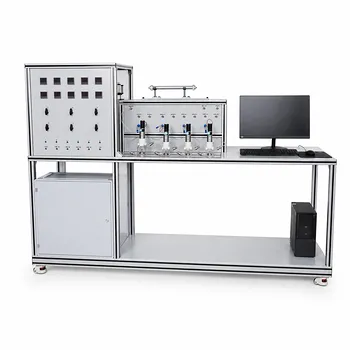
Methanol Synthesis and Catalyst Performance Evaluation Educational Unit Operations Pilot Plant

Bench-scale methanol synthesis and catalyst evaluation educational pilot plant for chemical engineering labs to study catalytic kinetics, high-pressure operations, process control, and unit operations under realistic conditions with industrial safety features, precision gas delivery, data acquisition, and intelligent monitoring.

Packed Bed Absorption Educational Unit Operations Pilot Plant

Packed Bed Absorption Educational Unit Operations Pilot Plant

Study gas-liquid absorption, pressure drop, flooding, and mass transfer coefficients with this pilot plant. Transparent packed column, industrial touchscreen, real-time sensor data, automated analysis. Investigate two-phase flow, loading points, column efficiency. Comprehensive data logging and assessment software included.

Internal Circulation Gradient Free Catalytic Reaction Educational Pilot Plant

Internal Circulation Gradient Free Catalytic Reaction Educational Pilot Plant

Internal circulation gradient free catalytic reaction educational pilot plant for chemical engineering unit operations. Provides isothermal gradient free operation and hands on study of heterogeneous catalysis kinetics and mass transfer with precise control. Ideal for academic labs.

100L Continuous Loop Hydrogenation Educational Unit Operations Pilot Plant

100L Continuous Loop Hydrogenation Educational Unit Operations Pilot Plant

This 100L continuous loop hydrogenation pilot plant is designed for chemical engineering education, featuring 316 stainless steel construction, advanced gas-liquid mass transfer components, explosion-proof safety systems, and a 15.6-inch touchscreen with 5G connectivity, cloud data logging, bridging theory and industry.

Gas Phase Mixing and Residence Time Distribution Determination Educational Unit Operations Pilot Plant

Gas Phase Mixing and Residence Time Distribution Determination Educational Unit Operations Pilot Plant

Integrated lab system for gas-phase mixing and RTD determination. Supports pulse and step tracer methods with dual CSTR and PFR reactors, industrial components, and PC data logging. Provides hands-on study of non-ideal flow and reactor behavior for university students.

Multi Functional Membrane Crystallization Educational Unit Operations Pilot Plant

Multi Functional Membrane Crystallization Educational Unit Operations Pilot Plant

Integrated bench-scale membrane crystallization pilot plant for engineering education. Provides hands-on training in advanced separation technologies, combining membrane distillation crystallization and process intensification. Features variable scaling vessels, industrial-grade flow control, and interactive digital data acquisition. Customizable for university labs.


Leave Your Message