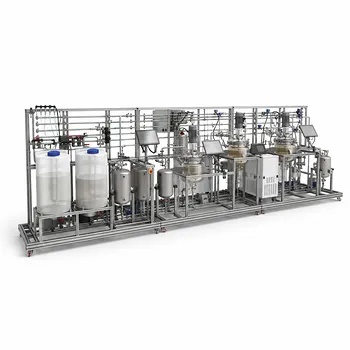
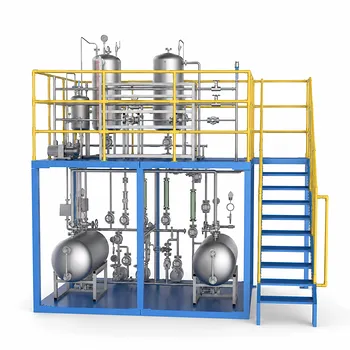
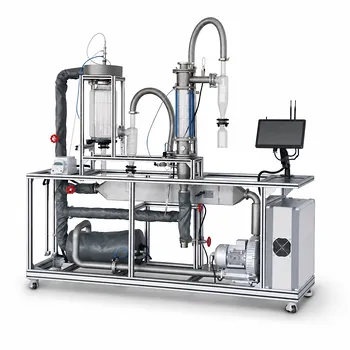
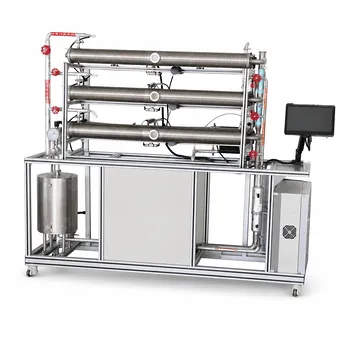
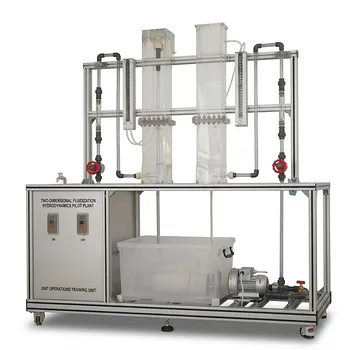
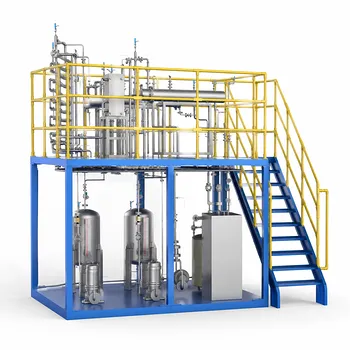
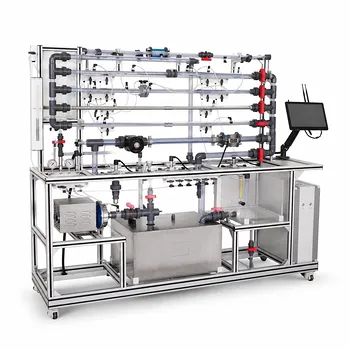
The answer to your surface-level question is that pilot plants transform economic feasibility from a theoretical exercise into an empirical science. Unit operations pilot plants provide the validated mass and energy balance data—specifically raw material conversion rates, utility consumption, and achievable product purity—that define a project’s annual operating costs and revenue potential. Without this physical data, any calculation of Net Present Value (NPV) or Discounted Cash Flow Rate of Return (DCFROR/IRR) is merely a guess masked as a spreadsheet.
A sophisticated discounted cash flow model is worthless if its inputs are based on unvalidated assumptions. The deep purpose of a pilot plant is to eliminate the single biggest risk in process economics: the gap between theoretical design yields and real-world, physics-constrained performance. It de-risks the financial model by replacing optimistic approximations with measured, repeatable reality, thereby giving decision-makers the confidence that the calculated NPV and DCFROR are achievable.
From Benchtop Theory to Bankable Cash Flows
The financial viability of any chemical process hinges on annual cash flow, which is simply revenue minus operating costs minus capital depreciation. The pilot plant’s role is to provide the non-negotiable physical constants for that equation.
How Pilot Plants Define Operating Costs (OPEX)
Variable operating costs are dominated by raw materials and utilities. A computer simulation might assume a 95% yield and a fixed steam-to-product ratio, but reality is often messier.
A pilot plant allows you to measure, not just model. By running physical trials, engineers obtain precise consumption rates for feedstock, water, steam, and electricity per unit of product. This empirical data directly translates to the variable cost line item in the cash flow analysis. For a large-scale commodity chemical plant, a 5% error in raw material yield—moving from a simulated 75% to a measured 70%—can be the difference between a highly profitable NPV and a financial disaster.
Validating Revenue Through Product Quality
Revenue is not just about production volume; it is about producing a material that meets a marketable specification at a certain purity.
Physical testing validates the revenue side of the ledger. Pilot plants produce actual physical product samples that can be analyzed and, crucially, provided to potential customers for qualification. This confirms that the projected market price is realizable. Without this, the price assumption in the revenue projection remains speculative, fundamentally undermining the credibility of the calculated DCFROR.
The Bridge Between Simulation and Economic Reality
The primary reason pilot plants are essential for rigorous economic evaluation is that they expose the hidden physics that computer models simplify or ignore. These hidden physics have direct and often punitive economic consequences.
Uncovering the Hidden Costs of Physics
Pure mathematical process models often treat reactors and pipes as idealized environments. They might neglect fouling factors, heat losses, or complex fluid dynamics that create inefficiencies.
Physical iteration reveals the true operating envelope. Operational data collected from a pilot unit—such as increased pressure drops, lower-than-theoretical heat transfer coefficients, or declining catalyst activity—feeds back into the economic model. For example, a heat exchanger that requires twice the expected cleaning frequency due to fouling introduces additional downtime and maintenance costs, directly reducing the annual cash flow and, subsequently, the NPV.
The Empirical Logic of ROI and Payback
Before calculating the complex time-value of money metrics like DCFROR, you need validated, simple metrics. Pilot plants make these basic calculations meaningful.
Measured savings form the basis of economic justification. When evaluating a cost-reduction project, such as heat integration, a pilot plant measures the actual reduction in steam demand. This delta in utility cost is the annual cash flow benefit. By combining this empirical benefit with the estimated permanent investment, the calculation for Return on Investment (ROI) and Payback Period (PBP) becomes a factual statement rather than a speculative forecast. This validated PBP is the first indicator of whether a project will likely clear the hurdle rate for DCFROR.
Mitigating Capital Risk and Validating Process Economics
A full-scale commercial plant is a massive, irreversible capital investment. The pilot plant’s most critical function is to prevent the construction of a financial black hole.
Reducing the Contingency Factor
Every capital cost estimate for an unproven process includes a significant contingency factor—sometimes 20% to 40%—for unknown unknowns. The data from a pilot plant systematically eliminates these unknowns.
Validation lowers the cost of capital. By proving that the process works end-to-end and identifying any necessary exotic materials of construction, the project’s technical risk profile drops. This allows estimators to shrink the contingency factor, which lowers the initial fixed capital investment. A lower initial investment has a massive positive impact on the calculated NPV, making the project more likely to secure funding.
De-risking By-Product and Waste Stream Economics
Waste treatment is a cost, but a recoverable by-product is a revenue stream. The distinction is rarely clear from a process flow diagram alone.
Pilot-scale separation defines the economic boundary. A physical pilot plant allows you to test if a by-product stream can be upgraded to a saleable purity using an additional separation step. You can then measure the utility consumption and additional capital cost of that step against the net revenue (sales income plus avoided waste treatment cost). This direct empirical validation ensures that a seemingly attractive by-product recovery scheme doesn't destroy the project's overall DCFROR.
Understanding the Trade-offs
The use of pilot plants is not without its own economic considerations. An objective analysis requires acknowledging their limitations and potential pitfalls.
Pilot plants are a significant upfront cost and can delay the project timeline. A poorly designed pilot program that studies the wrong variables or fails to achieve long-term steady-state operation can waste millions of dollars and add years to the development cycle without producing actionable economic data.
A pilot plant cannot perfectly eliminate scale-up risk. Certain phenomena, like macroscopic mixing patterns or large-scale solids handling, behave differently at a commercial scale. The economic grade of the pilot plant data must be critically assessed; it reduces uncertainty but does not eliminate it. The final NPV model must still account for a smaller, but still very real, scale-up uncertainty factor.
The value of a negative result is often undervalued. The ultimate financial trade-off is the cost of a failed pilot plant versus the catastrophic cost of a failed commercial plant. A pilot study that conclusively proves a process is economically unviable—that its DCFROR will never clear the corporate hurdle rate—is one of the highest-return "investments" a company can make. It prevents a much larger capital loss.
Making the Right Choice for Your Feasibility Study
The decision to build a pilot plant and the extent of its use is a strategic financial decision. The goal is not always to scale every pump and pipe; it is to eliminate the specific uncertainties that dominate the project's economic risk profile.
- If your primary focus is proving a new high-value molecule (e.g., a pharma intermediate): Prioritize pilot runs that generate enough product for customer qualification and confirm the feasibility of achieving final product purity, as these factors define your revenue line and market risk premium in the NPV model.
- If your primary focus is commodity chemical production with razor-thin margins: Concentrate the pilot program on multi-week continuous runs to validate catalyst life, raw material yields, and utility consumption. A 1% yield improvement from empirical optimization can be the entire profit margin.
- If your primary focus is validating a complex separation or a novel reactor design: The pilot plant is non-negotiable. The economic model must be underpinned by physical heat and mass balance data, not generalized correlations, to have any credibility with investors evaluating the DCFROR.
- If your primary focus is a first-of-a-kind process with no industry analogue: The pilot plant is the single most important tool for de-risking the initial capital investment. Its data is used to shrink the contingency factor, directly improving the project's NPV and making the final investment decision a defensible one.
The ultimate power of pilot plant data in a feasibility study is that it transforms a financial presentation from a speculative request for money into a defensible, engineering-grounded argument for a calculated return.
Summary Table:
| Financial Metric | How Pilot Plants Validate It | Economic Impact |
|---|---|---|
| OPEX (Operating Costs) | Measures physical utility usage & raw material yields | Prevents margin errors from theoretical simulations |
| Revenue Validation | Generates physical product samples for purity & market qualification | Confirms projected sales price & customer viability |
| CAPEX (Initial Investment) | Resolves process unknowns & material requirements | Lowers contingency margins, directly increasing NPV |
| Waste & By-Product Value | Verifies separation efficiency and by-product purity | Optimizes environmental costs vs. waste-to-revenue gains |
Bridge the Gap Between Theory and Economic Reality with LABPARK
Don't let unvalidated assumptions compromise your process economics. LABPARK provides state-of-the-art Educational and Vocational Unit Operations Pilot Plants in chemical engineering, bioprocess & biotech, and environmental & water treatment for universities, research institutes, and enterprises. Our systems allow you to gather precise empirical data, train the next generation of engineers, and de-risk your scale-up projections.
Ready to elevate your research and process validation? Contact our experts today to find the ideal pilot plant solution for your organization!
Related Products
- General Purpose Cosmetics Production Unit Operations Training Pilot Plant
- Multi Pump Fluid Transport Process Piping Unit Operations Training Pilot Plant
- Multi-Functional Drying Educational Unit Operations Pilot Plant
- Fixed-Bed Chemical Reaction and Gas Dust Tar Removal Unit Operations Pilot Plant
- 100L Continuous Loop Hydrogenation Educational Unit Operations Pilot Plant
People Also Ask
- How do deviations in estimating latent heat impact pilot plant thermal systems? Avoid hardware mis-sizing.
- Why is the chemical plant startup schedule crucial? De-risk scale-up with pilot plants.
- When to transition from PID to adaptive control in pilot plants? Key process indicators.
- Why Compare Predicted and Experimental Excess Enthalpy? Key to Accurate Pilot Plant Scale-up
- Why Use PTFE & Hastelloy in Chemical Pilot Plants? Prevent Corrosion & Ensure Safety