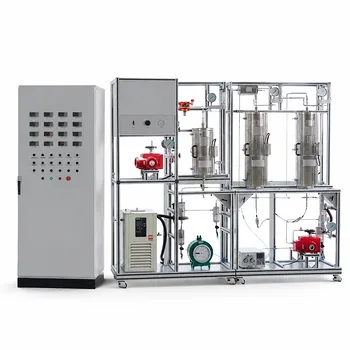
Shorter residence times, engineered through specific tube configurations, directly increase ethylene yield and selectivity by fundamentally altering the reaction pathway. In both industrial and pilot-plant settings, moving from a standard 0.6-second residence time down to a millisecond range (0.05–0.1 seconds) can boost ethylene yield by 1–2% or more. This improvement is achieved by "outrunning" undesirable secondary reactions that would otherwise consume the ethylene you just produced.
The Core Principle: The key to maximizing ethylene is not just applying more heat—it's about precisely controlling how long the hydrocarbon molecules are exposed to that heat. Pilot-scale unit operations demonstrate that specific tube geometries—like split-coil or variable-diameter designs—are the physical levers used to minimize this thermal contact time, suppress side reactions, and directly observe the resulting spike in product selectivity.
The Fundamental Mechanism: Why Shorter is Better for Ethylene
The relationship between residence time and yield isn't just an empirical observation—it's a direct consequence of reaction kinetics. Understanding this is the first learning objective in any pilot-plant study.
The Battle Between Primary and Secondary Reactions
The cracking process is a race. Primary reactions break down large hydrocarbon molecules (like naphtha or ethane) directly into valuable olefins, primarily ethylene.
Once formed, these ethylene molecules are extremely reactive. If they linger too long in the high-temperature zone, they undergo secondary reactions. These unwanted pathways convert ethylene into less valuable byproducts like methane, coke, and heavier aromatics, dramatically reducing your net yield.
The Temperature-Selectivity Trade-off
Higher cracking temperatures accelerate the primary, yield-forming reactions faster than they accelerate the secondary destruction. This creates an opportunity.
By operating at a higher temperature, you can produce ethylene more quickly. The critical requirement is that you then remove the products from the reaction zone immediately. You must balance a higher temperature with a correspondingly shorter residence time to suppress the secondary reactions that the same high temperature would otherwise promote.
- Standard Operation: A residence time of 0.6–0.7 seconds at a lower temperature.
- Optimized Operation: Reducing residence time to 0.2–0.3 seconds while simultaneously raising the outlet temperature.
- Millisecond Operation: Pushing the boundary down to 0.05–0.1 seconds for a significant selectivity gain.
How Tube Configuration Engineers a Shorter Residence Time
Residence time is not an independent variable you can simply set with a dial; it is a consequence of the physical reactor design. For chemical engineering students and researchers, the tube configuration is the independent variable.
The Role of Tube Diameter and Length
A tube with a smaller internal diameter allows for much faster heat transfer from the furnace to the gaseous feed. This heats the hydrocarbons to the target cracking temperature almost instantly, effectively shortening the non-productive heat-up time.
Standard industrial coils might use a diameter of 127 mm, whereas millisecond cracking reactors reduce this drastically, down to 28.6 mm. When combined with a shorter overall tube length, this geometry naturally enforces a residence time in the 0.05–0.10 second range. A pilot plant using micro-tubular reactors with precise flow controllers allows researchers to safely simulate these exact conditions at a small scale.
Split-Coil and Variable-Diameter Configurations
A simple, straight tube of constant diameter faces a physical problem: gas volume expands dramatically during cracking. This expansion increases linear velocity and pressure drop, counteracting the goal of a uniform, short residence time.
Variable-diameter or split-coil designs (e.g., "4-4-2-1" or "2-1" branching) are the physical solution. These configurations start with one or more small-diameter inlets for rapid heating and then transition to larger-diameter tubes downstream. The complex, branched geometry serves three critical functions in a pilot plant:
- Management of Gas Expansion: Prevents a massive pressure drop as volume increases.
- Enhanced Heat Transfer: Accelerates the initial temperature rise in the feed material.
- Controlled Residence Time Distribution: Creates a more uniform "plug-flow" profile, ensuring all molecules spend a nearly identical, minimal time in the reactor.
Simulating Feedstock Flexibility in a Pilot Plant
The ideal configuration is also heavily dependent on the feedstock. Ethane cracking is highly selective, producing a clean profile dominated by ethylene. Naphtha cracking is far more complex, yielding a wide range of co-products (propylene, butenes, pyrolysis gasoline) and more methane.
A well-designed educational pilot plant features flexible feedstock introduction systems and online gas chromatography (GC) analysis. This setup is essential for students to directly compare the "clean" reaction profile of a light gas against the severity-dependent, multi-product yields of a liquid naphtha, all while systematically changing the coil configuration and feed rate.
Understanding the Trade-offs: The Coking Penalty
Every design choice in a cracking furnace carries a trade-off, and tube configuration is no exception. Ignoring this pitfall undermines the educational value of any pilot-plant operation.
The Direct Link Between Diameter and Run-Length
The same physical attribute that improves yield—a small tube diameter—intensifies the reactor's greatest operational problem: coking. The extremely high surface-area-to-volume ratio in a millisecond coil promotes the deposition of coke (carbon) on the tube's inner wall.
This has a direct and severe consequence on maintenance and operational continuity.
- Standard Coil Configuration: A typical decoking cycle (where the plant is taken offline to burn off carbon deposits) might be 40 to 45 days.
- Millisecond Coil Configuration: Under identical cracking severity, this decoking cycle plummets to 7 to 15 days.
For a pilot-plant simulation, this trade-off is not an anomaly; it is a core learning outcome. It demonstrates that maximizing instantaneous ethylene selectivity comes at the direct expense of maximizing continuous operational runtime.
Making the Right Choice for Your Research Goal
When defining the scope of a pilot-plant study or developing an educational module, your objective should dictate your focus on tube configuration.
-
If your primary focus is maximizing instantaneous yield and understanding kinetic selectivity: Prioritize the smallest diameter, millisecond-residence-time coil design. Your study will center on sampling products at the reactor outlet before secondary reactions can occur, directly visualizing the effect of "freezing" primary products.
-
If your primary focus is understanding industrial process economics and operational constraints: Design a comparative study between a standard coil and a split-coil/variable-diameter setup. Measure not only the yield difference but also track the rate of pressure drop increase (a proxy for coking) over the length of the experiment to map the yield/run-length trade-off.
-
If your primary focus is feedstock flexibility and product distribution mapping: Use a system with interchangeable or configurable tube geometries. Couple this with robust online GC analysis to have students systematically switch from ethane to a naphtha analog and observe how the optimal residence time for propylene and ethylene shifts with the feed's molecular complexity.
The physical architecture of the reactor is the curriculum; by changing the tube configuration, you are not just running an experiment—you are directly manipulating the boundary between physics, kinetics, and economic reality.
Summary Table:
| Tube Configuration | Residence Time (s) | Ethylene Yield & Selectivity | Coking Rate & Run-Length |
|---|---|---|---|
| Standard Coil | 0.6 – 0.7 | Baseline yield | Low coking (40–45 days run-length) |
| Optimized / Split-Coil | 0.2 – 0.3 | Moderate increase | Moderate coking |
| Millisecond / Small Diameter | 0.05 – 0.1 | Highest yield & selectivity | High coking (7–15 days run-length) |
Enhance Your Chemical Engineering Curriculum & Research with LABPARK
To help your students and researchers master reactor design and cracking kinetics, LABPARK provides premium Educational and Vocational Unit Operations Pilot Plants in chemical engineering, bioprocess & biotech, and environmental & water treatment. Designed for universities, research institutes, and enterprises, our pilot plants offer the feedstock flexibility and configurable geometries needed to bridge chemical theory and industrial reality.
Ready to upgrade your laboratory? Contact LABPARK today to discuss your custom pilot plant requirements!
Related Products
- Methane Cracking Educational Unit Operations Pilot Plant
- Natural Product Extraction Unit Operations Training Pilot Plant
- Rising and Falling Film Evaporation Educational Unit Operations Pilot Plant
- Multi-Functional Drying Educational Unit Operations Pilot Plant
- Dual-Mode Rectification Pilot Plant for Practical Training Unit Operations
People Also Ask
- How do ethane vs naphtha cracking influence teaching pilot plant analytical configurations? Key Design Guide
- How can flow-NMR be integrated with pilot plant reactors to monitor kinetics? A Complete Guide
- How do cracking temperature and residence time affect olefin yield? Pilot Plant Guide
- How are utility consumption rates integrated into chemical pilot plant economic evaluations?
- How should OSBL investments be estimated? Key Steps to Avoid Budget Overruns in Pilot Plant Projects