The short answer lies in the fundamental direction of flow. In normal flow filtration (NFF), feed stream is driven directly perpendicular into the membrane, forcing all retained particles to crash into the filter in a relentless dead-end assault. Tangential flow filtration (TFF) fundamentally changes the game by pumping the fluid parallel to the membrane surface, creating a self-cleaning sweep that continuously scours away foulants before they can settle and consolidate.
Understanding fouling management in a pilot plant isn't just about defining NFF and TFF—it's about internalizing how fluid dynamics directly control the rate of cake buildup, the resulting resistance to flow, and the thermal stress on your product. The instructor’s real lesson is that TFF shifts the primary fouling mechanism from a near-instantaneous plugging problem to a manageable, steady-state gel layer you can design around.
How Fluid Dynamics Dictate Fouling Mechanisms
Pilot plant instructors illustrate the core difference by making the fluid flow pattern tangible. They demonstrate that fouling is not a single phenomenon but a direct consequence of hydraulic design.
The Dead-End Trap of Normal Flow Filtration
In NFF, the entire feed stream moves directly toward the filter membrane. Every single particle larger than the pore is driven straight into the filter.
This results in two distinct fouling modes: internal pore plugging and the rapid growth of a surface cake. Because there is no force to remove the accumulating solids, the cake layer continuously thickens, acting as a secondary but constantly growing resistance barrier.
Instructors emphasize that this process is inherently transient. The filtrate flux will decline predictably over time, and the only practical way to process more volume is to increase the filter surface area.
The Sweeping Rescue of Tangential Flow Filtration
TFF introduces a cross-flow velocity that runs parallel to the membrane. This sweeping action generates lift forces that carry retained particles away from the filter surface and back into the bulk retentate stream.
Instructors frame this as a dynamic equilibrium. While a thin concentration polarization layer or gel layer (Rg) still forms, the cross-flow prevents it from becoming an infinitely thick cake.
The result is a stable, pseudo-steady-state filtrate flux. This sustained performance is the primary practical advantage of TFF and the first principle students learn to monitor.
The Practical Consequences for Process Design
These microscopic fouling mechanisms have direct, macroscopic consequences on how a process is sized and operated in a pilot plant.
Why NFF Demands More Area
NFF is a surface-area-limited process. Because the resistance from the cake (Rf) and fouling climbs continuously, the only lever to increase throughput is to install a proportionally larger filter.
Instructors demonstrate that scaling up an NFF step is a simple geometry problem: maintain a constant ratio of feed volume to filter area. This makes NFF a linear, but expensive, scaling challenge for large volumes of fouling streams.
How TFF Enables Steady-State Operation
In TFF, operators manage fouling by controlling the cross-flow rate and transmembrane pressure (TMP). Once the gel layer stabilizes, the flux remains relatively constant, allowing for a single system to process large volumes over time.
Pilot plant training highlights that TFF scale-up depends on maintaining key hydraulic parameters constant, not just area. Critical factors include the transmembrane pressure, channel height, and flow path length, which directly affect the sweeping action and fouling resistance.
Monitoring Fouling in Real Time
Instructors use pilot plant instrumentation to transform these theoretical concepts into observable data. The practical lesson is that you never “see” fouling directly; you infer it from pressure and flow.
TMP and Resistance Tell the Story
Students learn to monitor transmembrane pressure (TMP) as a vital sign. A rising TMP under constant flux operation is the indisputable signature of increasing resistance from a growing cake.
Instructors break down the total flow resistance into its core components: membrane resistance (Rm), gel layer resistance (Rg), and fouling resistance (Rf). In TFF, a well-designed process quickly stabilizes Rg and Rf, causing TMP to plateau. In NFF, these resistances climb monotonically until the run is terminated.
A Side Effect: How Fouling Drives Thermal Management
A sophisticated fouling management lesson that instructors connect in the pilot plant is the hidden thermal cost. Fouling directly influences product quality through heat generation.
The Hidden Heat Problem
The recirculation pump in a TFF system must overcome the resistance of the flow path and, critically, the growing viscous resistance of the concentrated retentate. All this energy input is dissipated as heat into the product stream.
This is particularly critical when concentrating labile proteins. The combination of high protein concentration and rising temperature is a perfect recipe for protein denaturation and aggregation, turning a purification step into a product-destroying event.
Pump Selection and Cooling Strategies
Pilot plant instructors use this to teach practical hardware selection. They contrast high-shear centrifugal pumps with low-shear rotary lobe pumps, which minimize the heating input while still providing the necessary cross-flow.
Furthermore, the direct link between fouling management and thermal control is demonstrated by integrating cooling jackets on retentate tanks. This isn't just ancillary equipment; it's a core part of the TFF fouling control strategy, preventing heat-induced product damage that can be misdiagnosed as irreversible membrane fouling.
Understanding the Trade-offs
No filtration technology is universally superior. A critical part of the pilot plant education is an objective look at the limitations that accompany TFF's fouling management benefits.
The Complexity Trade-off. TFF systems require pumps, valves, heat exchangers, and tanks, making them significantly more complex and expensive to operate and clean than a simple NFF capsule holder.
The Shear Sensitivity Risk. The very cross-flow that manages fouling can be destructive. For large, shear-sensitive molecules, the high fluid velocity needed to create the sweeping action can cause product damage, a trade-off that NFF completely avoids.
The Minimum Working Volume. TFF requires a significant hold-up volume to fill the system, making it a poor choice for very small final product pools where high recovery is paramount.
The Validation Burden. Cleaning a TFF system and proving it's free of cross-contamination is a far greater challenge than swapping out a single-use NFF capsule, adding time and cost to multi-product pilot plants.
Making the Right Choice for Your Goal
The instructor’s ultimate lesson is that your filtration choice is a strategic decision about how you want to manage solids. Use the pilot plant data to match the technology to your specific objective.
- If your primary focus is simplicity and validation speed for a product with a low fouling load: A single-use NFF solution will minimize capital cost and eliminate cleaning validation headaches. Its transient fouling is an acceptable trade-off for operational simplicity.
- If your primary focus is processing large volumes of a heavily fouling stream with manageable shear sensitivity: TFF is the only practical solution. Your pilot plant work must focus on defining the cross-flow rate and TMP that achieve a stable, steady-state gel layer without product damage.
- If your primary focus is concentrating a temperature-labile biomolecule: Your evaluation must go beyond flux curves. Directly compare fluid heating under TFF recirculation, and validate that your pump and cooling jacket selection keeps product quality high, turning thermal management into a key part of your fouling control playbook.
Mastering fouling management in the pilot plant is about learning to choose between designing for an inevitable cake build-up and designing a dynamic system that actively prevents it.
Summary Table:
| Feature | Normal Flow Filtration (NFF) | Tangential Flow Filtration (TFF) |
|---|---|---|
| Flow Direction | Perpendicular to membrane | Parallel (cross-flow) to membrane |
| Fouling Control | Cake build-up (transient) | Sweeping action (steady-state gel) |
| Primary Scale-up Key | Filter surface area | Cross-flow rate & TMP control |
| System Complexity | Low (disposable capsules) | High (pumps, valves, heat exchangers) |
| Thermal Impact | Minimal | High (requires cooling strategies) |
Bring Practical Bioprocess Engineering to Life with LABPARK
Are you looking to bridge the gap between theoretical filtration concepts and hands-on industry experience?
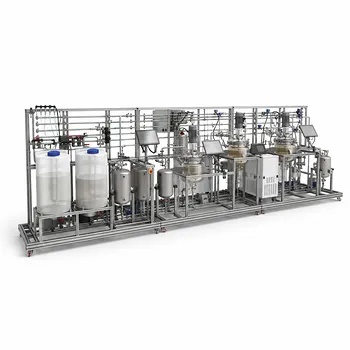
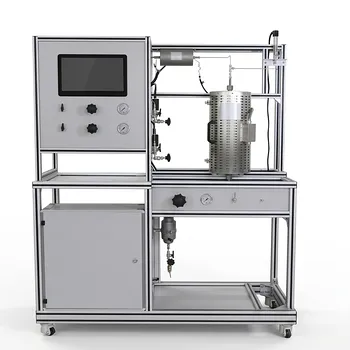
LABPARK provides state-of-the-art Educational and Vocational Unit Operations Pilot Plants in chemical engineering, bioprocess & biotech, and environmental & water treatment. Designed specifically for universities, research institutes, and enterprises, our pilot plants enable students and researchers to master real-world challenges like NFF vs. TFF fouling management, thermal control, and system scaling.
- Robust Instrumentation: Monitor TMP, flow rates, and temperature in real-time.
- Scalable Designs: True-to-industry setups for reliable vocational training and research.
- Comprehensive Support: Tailored layouts and curriculum-aligned system designs.
Equip your lab with the tools to train the next generation of bioprocess engineers. Contact LABPARK today to request a quote or custom consultation!
Related Products
- Bio-fermentation Ethanol Production Practical Training Unit Operations Pilot Plant
- Multimodal Absorption and Desorption Pilot Plant for Unit Operations Training
- Natural Product Extraction Unit Operations Training Pilot Plant
- Multi Pump Fluid Transport Process Piping Unit Operations Training Pilot Plant
- Multi-Functional Drying Educational Unit Operations Pilot Plant
People Also Ask
- Why Use PTFE & Hastelloy in Chemical Pilot Plants? Prevent Corrosion & Ensure Safety
- Why Compare Predicted and Experimental Excess Enthalpy? Key to Accurate Pilot Plant Scale-up
- Why is the chemical plant startup schedule crucial? De-risk scale-up with pilot plants.
- When to transition from PID to adaptive control in pilot plants? Key process indicators.
- Why must batch and fed-batch fermentation pilot plants be designed to accommodate changing rheological conditions?