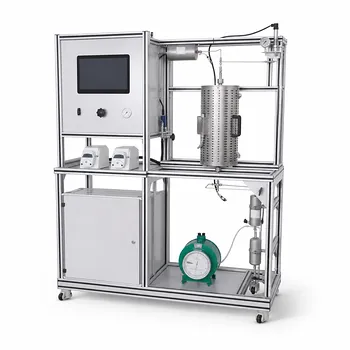
Even the smallest deviation in a batch fermentation can ruin an entire run. The key process control loops for a batch fermentation in a pilot plant are temperature control via the vessel jacket, dissolved oxygen (DO) control through sparging and agitation, and pH control by dosing acid or base. These are supported by critical instrumentation like sterilizable sensors, off-gas analyzers, and foam detection, all tied together with sequential control logic to handle the inoculation, growth, and harvest phases safely and repeatably.
A successful batch fermentation isn't just about hitting setpoints—it's about maintaining the precise abiotic environment that keeps your biological catalyst functional. The core loops of temperature, pH, and DO form the non-negotiable foundation, but true process optimization demands integrating sterile feed preparation, foam control, and real-time respiratory gas analysis to build a complete picture of microbial health.
The Three Non-Negotiable Control Loops
Every batch fermentation unit stands on three tightly integrated control loops. If any one fails, the entire culture is at risk.
Temperature Control: The Thermal Jacket
Microorganisms have narrow optimal temperature ranges. A typical yeast or bacterial fermentation might require a stable 37°C.
The loop works by measuring temperature through a resistance temperature detector (RTD) or thermocouple directly in the broth. The controller then modulates a flow control valve on a cooling/heating water circuit circulating through the vessel’s jacket. You’re not just adding heat; you’re removing the exothermic metabolic heat produced by the growing cells.
pH Control: The Chemical Balancing Act
As cells consume substrates and excrete metabolites, the broth’s pH drifts. Unchecked acidity or alkalinity will denature enzymes and stop growth.
A sterilizable glass reference electrode continuously monitors pH. The controller activates small metering pumps that inject precise doses of acid (e.g., phosphoric acid) or base (e.g., sodium hydroxide) to hold the setpoint. The dosing lines must be kept sterile and the pumps sized appropriately to avoid overshoot in small pilot volumes.
Dissolved Oxygen (DO) Control: The Breath of Aerobic Cultures
For aerobic fermentations, oxygen is often the first limiting nutrient. Cells can starve for oxygen in seconds.
A polarographic or optical DO probe sends a signal to a controller. That controller can cascade to two final control elements: the sterile air sparging flow rate and the agitator speed. You start by increasing the sparge rate; if that’s not enough, the agitator ramps up to shear gas bubbles smaller, improving mass transfer. Both actions work together to maintain the critical DO setpoint.
Instrumentation Essentials for the Core Loops
The loop is only as good as its eyes and ears. Pilot-plant instrumentation must survive repeated sterilization cycles and give reliable data under high humidity and pressure.
Robust Sensing Technology
- Temperature: Pt100 RTDs or T-type thermocouples in stainless-steel thermowells, welded directly into the vessel wall.
- pH: Pre-pressurized, gel-filled combination electrodes with autoclavable connectors. These degrade over time, so regular two-point calibration is mandatory.
- DO: Optical sensors are now preferred over polarographic Clark electrodes because they have no electrolyte and need less maintenance, though both work. They must have an autoclavable form factor.
- Foam: A capacitance or conductance probe mounted above the liquid surface detects rising foam. The control loop then triggers a peristaltic pump to add antifoam agent. This prevents wet foam from entering the exhaust filter, which would block airflow and lose sterility.
Off-Gas Analysis: The Metabolic Window
This is not strictly a control loop in the regulatory sense, but it is vital instrumentation. A paramagnetic oxygen analyzer and an infrared carbon dioxide analyzer sample the exhaust gas continuously.
The data gives you the oxygen uptake rate (OUR) and carbon dioxide evolution rate (CER). The respiratory quotient (RQ) tells you the exact metabolic state of the culture without ever opening the vessel. For a pilot plant, this transforms the fermenter from a black box into a transparent biological reactor.
The Hidden Foundation: Sterilization and Sequence Control
The core loops cannot function in isolation. The entire batch process rides on a foundation of absolute sterility and precise phase management.
Sterile Feed and Media Preparation
All nutrients and water entering the fermenter must be sterile. The feed preparation unit uses a high-temperature, short-time (HTST) heat exchanger: media is heated to 121°C or higher for a holding time, then rapidly cooled back to operating temperature. This must happen immediately before inoculation to avoid re-contamination. Temperature sensors on the heating and cooling legs ensure the sterilization integrity without thermolyzing heat-sensitive media components.
Sequential Control Logic
Batch fermentation is not a steady state. It has distinct phases: sterilize-in-place (SIP), fill, inoculate, grow, induce (if needed), harvest, and clean-in-place (CIP). A programmable logic controller (PLC) or a distributed control system (DCS) executes these sequences. It checks permissive conditions (e.g., “is temperature at 37°C?”) before advancing. Without this sequence manager, an operator could add inoculum into a hot, unsterile vessel or start the harvest pump while the cells are still growing. Data logging of every sensor and actuator moves alongside the sequence, creating the batch record essential for scale-up and GMP compliance.
Understanding the Trade-offs and Common Pitfalls
Blindly applying all these tools without thought leads to poor data and failed batches.
The Agitation-DO-Shear Triangle
Aggressive agitation boosts DO and keeps cells suspended, but it also generates shear stress. For filamentous organisms or sensitive mammalian cells, high tip speeds can rip the cells apart. The control strategy must balance oxygen demand against cell viability, often by limiting the maximum agitator cascade setpoint.
pH Sensor Drift and Dosing Over-Amplification
In small pilot fermenters, the volume is tiny. A pH probe that drifts low will command base to pump in far too much, potentially osmotically shocking the culture with a salt spike. Frequent two-point calibration against a buffer, combined with dosing pump limits in the controller, prevents this cascade failure.
The False Security of Sterilization “Proof”
A thermocouple in the steam line shows 121°C, but that doesn't guarantee every cold spot in the vessel or filter housing reached sterile conditions. Real sterility depends on validated SIP cycles that use multiple temperature probes at the coldest condensate drain points, not just a single line sensor. Skipping this validation is the most common cause of mysterious contaminations in a pilot plant.
Making the Right Choice for Your Pilot Plant
Your instrumentation and control choices must match your goal.
- If your primary focus is fundamental research and strain characterization: Invest heavily in off-gas analysis and precise cascade control loops. You need to see metabolic shifts in real time, even if the equipment cost is higher.
- If your primary focus is process development and scale-down validation: Prioritize robust, industrial-grade pH and DO probes with identical response times to your production plant. The goal is to produce a scalable batch record, so sensor dynamics matter.
- If your primary focus is operator training and educational demonstration: Emphasize reliable sequential control and a clear, intuitive HMI. Data logging should be automatic, and alarms must be visible from across the room to teach good aseptic reaction to process deviations.
Ultimately, a batch fermentation pilot plant is a living system. The best control architecture is one that protects the sterility boundary, respects the biological limits of the cells, and gives you the data you need to understand not just what happened, but why it happened.
Summary Table:
| Control Loop | Key Parameter Measured | Sensor / Instrumentation | Control Mechanism |
|---|---|---|---|
| Temperature Control | Broth Temperature | Pt100 RTD / Thermocouple | Modulates jacket heating/cooling water valves |
| pH Control | Hydrogen Ion Concentration | Autoclavable glass pH electrode | Triggers acid/base dosing pumps |
| Dissolved Oxygen (DO) | Dissolved Oxygen % | Optical or Polarographic DO probe | Cascades to agitator speed & sparging airflow |
| Foam Control | Foam Level Height | Capacitance / Conductance probe | Triggers chemical antifoam dosing pump |
| Off-Gas Analysis | Exhaust O2 & CO2 % | Paramagnetic & Infrared analyzers | Calculates OUR, CER, and Respiratory Quotient (RQ) |
Scale Up Your Bioprocess Training & Research with LABPARK
Achieving precise control in batch fermentation requires robust, industry-grade instrumentation and reliable automation. LABPARK provides state-of-the-art Educational and Vocational Unit Operations Pilot Plants in chemical engineering, bioprocess & biotech, and environmental & water treatment.
Tailored for universities, research institutes, and enterprises, our pilot plants help you bridge the gap between laboratory discovery and industrial-scale production.
Ready to elevate your laboratory's capabilities? Contact LABPARK today to find the perfect pilot plant solution for your institution.
Related Products
- Bio-fermentation Ethanol Production Practical Training Unit Operations Pilot Plant
- Multi-Modal Distillation Unit Operations Training Pilot Plant
- Natural Product Extraction Unit Operations Training Pilot Plant
- Dual-Mode Rectification Pilot Plant for Practical Training Unit Operations
- Multi-Reactor Educational Pilot Plant for Reaction Engineering Unit Operations
People Also Ask
- Why Use PTFE & Hastelloy in Chemical Pilot Plants? Prevent Corrosion & Ensure Safety
- Why Compare Predicted and Experimental Excess Enthalpy? Key to Accurate Pilot Plant Scale-up
- Why is the chemical plant startup schedule crucial? De-risk scale-up with pilot plants.
- When to transition from PID to adaptive control in pilot plants? Key process indicators.
- Why must batch and fed-batch fermentation pilot plants be designed to accommodate changing rheological conditions?