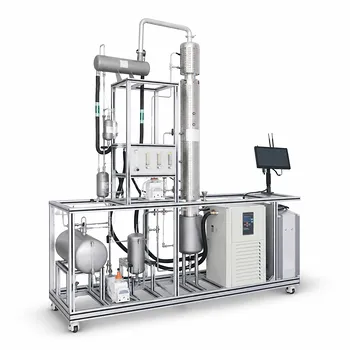
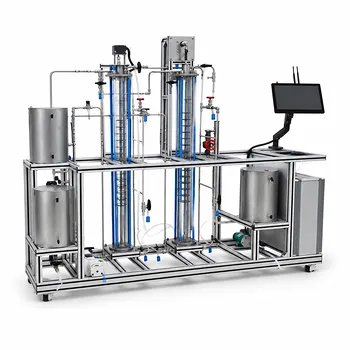
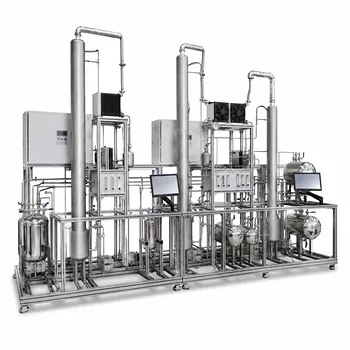
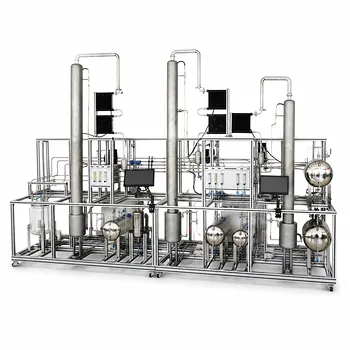
The foundational rule of thumb is simple: separate the easy stuff first and save the hard work for last—but in a pilot plant, you must also protect your hardware from day one. To optimize the separation of a multi-component mixture in a continuous pilot plant, you need to sequence your distillation columns according to five core heuristics. Start with ordinary distillation, isolate corrosive or unstable components as early as possible, remove the highest-volume component to downsize subsequent equipment, push the most difficult (low-relative-volatility) separations to the final columns, and favor splits that divide the feed into roughly equal distillate and bottoms streams. These rules collectively reduce energy consumption, protect expensive pilot-plant components, and maintain stable long-term operation.
Sequencing a multi-column distillation pilot plant is a dual-objective optimization problem: you are balancing thermodynamic efficiency with the very real need to preserve sensitive (and expensive) hardware. The golden rule is to eliminate threats—corrosion, solids, huge throughput—in the first column, then let the laws of vapor-liquid equilibrium dictate the rest of your sequence for minimum utility cost.
Why Sequencing Is the Hidden Lever of a Pilot Plant
In any continuous separation of a mixture with (c) components, you need (c-1) columns to obtain pure products. The order in which you arrange those columns has a dramatic effect on both the capex and opex of the pilot run—far more than most researchers initially assume.
The Thermodynamic Penalty of the Wrong Sequence
The direct sequence—where you remove the most volatile component (A) first, then B, then C—generally requires fewer phase changes for the heavier components. An indirect sequence, where you strip the lightest two components together and then separate them in a second column, forces those molecules to be vaporized and condensed multiple times. That repetition multiplies the total vapor load, which directly drives up the heating and cooling utility demand and demands larger heat exchangers. In a pilot plant where every kilowatt and square meter counts, sequencing becomes a primary cost lever.
Protecting the Pilot Plant’s Integrity
Pilot columns are teaching and research tools, often containing delicate temperature sensors, sight glasses, and precisely machined internals. Allowing a corrosive stream to enter a multi-stage train, or letting solids plug a packing section, turns the plant into a maintenance nightmare. The sequence heuristics that prioritize early removal of these problematic components are not just about process efficiency—they are about keeping the plant operational.
The Five Heuristics for Optimal Sequencing
These rules, grounded in decades of industrial practice, guide you toward an efficient and robust pilot-plant design. They should be applied in order of priority, with the first three often dominating due to safety and operability.
1. Remove the “Troublemakers” First
Before you think about reflux ratios and relative volatilities, isolate anything that can damage the system. This means corrosive components (like organic acids or halides) and any feed that carries entrained solids must be cut away in the very first column. The logic is brutally practical: you do not want to fabricate every downstream column, pump, and sensor from exotic, corrosion-resistant alloys. Instead, you use high-alloy materials or lined equipment only on the first column, and the rest of the plant stays standard. For solids, you employ specialized anti-fouling trays—even if their efficiency is lower—to prevent blockages that would halt the run entirely. This early removal protects the downstream columns and ensures the stable, long-term operation of the entire unit operations training system.
2. Strip the Largest Component Next
After securing the plant, remove the component present in the highest concentration as early as possible. This is a capacity play. The bulk of your vapor and liquid traffic is moving this material. By decanting it out in an early column, you dramatically reduce the vapor-liquid loading in every subsequent column. This allows you to use smaller diameter columns, smaller reboilers, and smaller condensers downstream, slashing both capital cost and utility consumption across the rest of the pilot plant.
3. Favor the “Equal Split”
When you have a choice, select sequences that split the column feed into distillate and bottoms streams of roughly similar molar flow rates. A heavily skewed split where 90% goes overhead and 10% to the bottoms creates a severe imbalance: the rectifying section is overloaded while the stripping section is starving. This forces inefficient use of column internals and drives up the required reflux ratio. Near-equal splits are thermodynamically favored and lead to a more balanced, lower-energy design.
4. Save the Hardest Separation for Last
The components with the closest boiling points (lowest relative volatility) should be separated in the final columns. A low relative volatility demands a high reflux ratio and many trays. Performing this separation late in the sequence means you are handling a smaller total flow, because the bulk components have already been removed. You confine the high energy penalty and the tallest column to a stage where the throughput is at its minimum, rather than forcing a large-volume stream through a difficult, expensive separation.
5. Stick to Ordinary Distillation Unless Forced
Do not introduce chemical solvents or complex mass-transfer agents in your early planning. Azeotropes and extractive distillation should be treated as exceptions. For a standard multi-component pilot plant, you first exhaust the possibility of a simple, heat-driven pressure or temperature swing scheme. Adding an entrainer complicates the plant with solvent recovery columns, creates new azeotropes, and requires precise feeding ports and profile control—all of which add cost and operational complexity. You only turn to this when ordinary distillation is physically impossible.
Understanding the Trade-offs
These heuristics often conflict, and your job is to prioritize. The most common clash is between “remove the corrosive/solids first” and “perform the difficult separation last.” If the heaviest component is also corrosive, you must pull it out in column one despite the fact that it might be a tough, high-boiling separation. In such cases, protecting the plant always wins. Similarly, a high-volume component might also be part of a close-boiling pair. You must decide whether to strip the bulk away first (heuristic 2) or save the difficult split for last (heuristic 4). Here, the guiding principle is to compare the energy penalty: if delaying the difficult separation forces an already large, early column to operate at an extremely high reflux ratio, it may be more economical to perform the bulk removal first, even if it disrupts the ideal “difficult-last” order. Use your pilot plant’s flexibility to test competing sequences and measure actual heat duties before scaling up.
Making the Right Choice for Your Pilot Plant
The optimal sequence depends on what you are trying to achieve with your pilot plant. Use these goal-specific strategies to turn the heuristics into an actionable plan.
- If your primary focus is protecting a shared, multi-user pilot facility: Sequence your columns to eliminate all corrosive components and solids in the very first column—even if that means using a lower-efficiency anti-fouling tray. This single decision saves the entire downstream infrastructure from damage and cross-contamination.
- If your primary focus is minimizing utility consumption for a pilot run: Favor the direct sequence (lightest first), aggressively remove the highest-volume component early, and target equal-split separations wherever possible. Measure the total vapor load across the train to confirm you’ve minimized repetitive phase changes.
- If you are demonstrating azeotropic or thermally sensitive separations: Treat the azeotrope as the exception. Design the ordinary columns first according to the heuristics, then insert the specialty column (with entrainer feed, precise temperature control, and reflux management) only where it is strictly necessary. Use the pilot plant to map the temperature profile and experimentally determine the minimum reflux ratio for that specific tricky cut.
Your pilot plant is both a proving ground and an educational tool. The most valuable thing you can extract from it is not just pure product, but a clear understanding of why that particular sequence of columns made thermodynamic and economic sense.
Summary Table:
| Heuristic | Core Objective | Key Benefit |
|---|---|---|
| 1. Remove Troublemakers First | Isolate corrosives & solids early | Protects downstream hardware from damage |
| 2. Strip Largest Component | Remove bulk concentration first | Reduces downstream column size and load |
| 3. Favor Equal Splits | Divide feed into similar flow rates | Balances internal load and lowers reflux energy |
| 4. Hardest Separation Last | Save low-volatility splits for the end | Confines high reflux penalties to minimal flows |
| 5. Ordinary Distillation First | Avoid chemical solvents/complex agents | Prevents operational complexity and extra costs |
Optimize Your Chemical Engineering Training with LABPARK
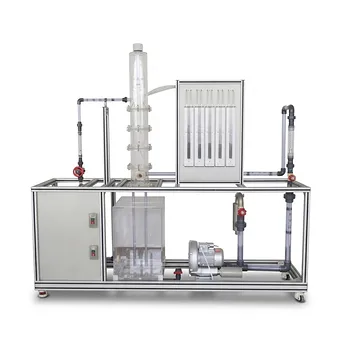
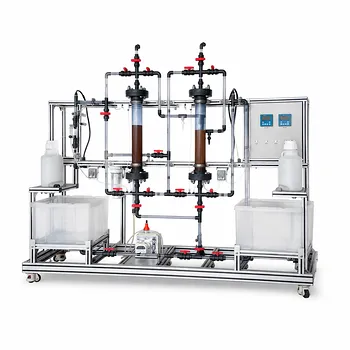
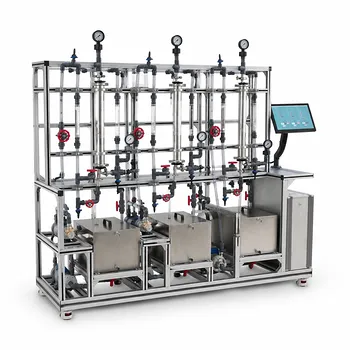
Are you looking to equip your institution with advanced, reliable separation technologies? LABPARK provides state-of-the-art Educational and Vocational Unit Operations Pilot Plants in chemical engineering, bioprocess & biotech, and environmental & water treatment.
Specifically designed for universities, research institutes, and enterprises, our pilot plants help students and researchers master complex processes like multi-column distillation sequencing with hands-on, industry-grade hardware.
Ready to elevate your lab's capabilities? Contact LABPARK Today to explore our customizable pilot plant solutions and request a technical consultation!
Related Products
- Multi-Functional Special Distillation Educational Pilot Plant
- Multi-Modal Distillation Unit Operations Training Pilot Plant
- Continuous Sieve-Plate Distillation Pilot Plant for Unit Operations Laboratory Education
- Continuous Batch Extractive Distillation Educational Pilot Plant
- Dual-Mode Rectification Pilot Plant for Practical Training Unit Operations
People Also Ask
- Why does simple distillation yield higher efficiency than flash distillation? Key thermodynamic differences.
- How to Integrate Spectroscopy in Distillation Pilot Plants for Advanced Process Control
- How does double temperature difference control improve distillation pilot plants? Stabilize purity.
- How to Estimate Distillation Pilot Plant Tray Efficiency? O'Connell's Correlation Guide
- How Batch vs Continuous Configuration Affects Distillation Pilot Plant Versatility & Footprint