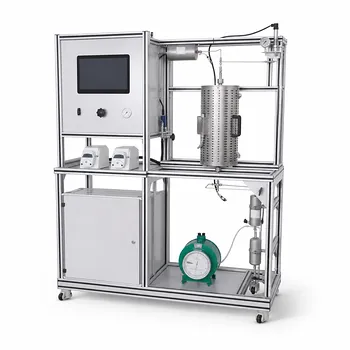
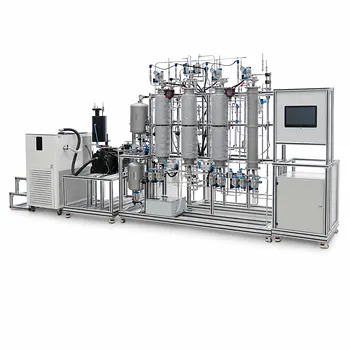
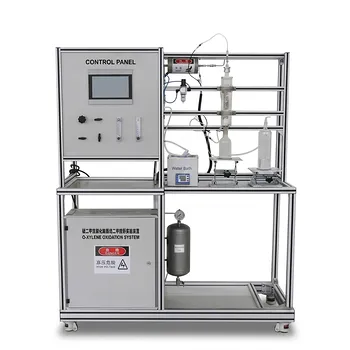
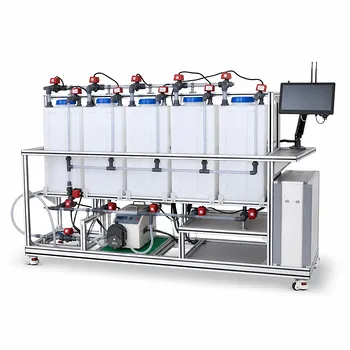
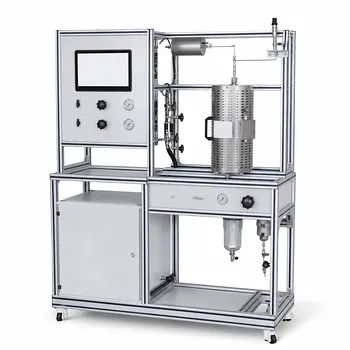
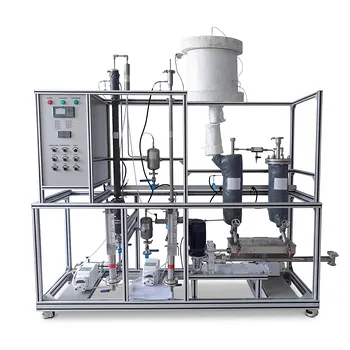
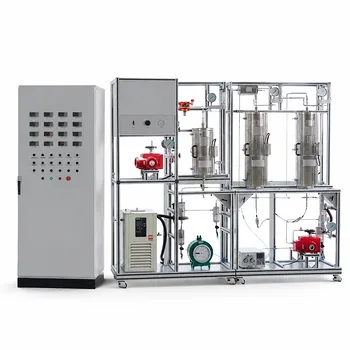
Direct chlorination of ethylene in a pilot plant splits into two distinct thermal paths: a low-temperature, liquid-phase process at ~50°C and a high-temperature, boiling-reactor approach at ~90°C. The low-temperature method prioritizes simplicity and product purity but pays for it with external cooling and downstream energy consumption. The high-temperature method directly exploits the reaction’s exothermic heat to vaporize and purify the product, dramatically improving thermal efficiency while demanding tighter control to avoid unwanted byproducts.
The key difference is where the reaction heat goes. Low-temperature chlorination rejects heat to cooling water and later pays to re-heat the crude EDC for distillation—a net energy loss. High-temperature chlorination captures that same heat immediately to drive vaporization and purification, making it a striking lesson in process integration and energy-saving design.
Low-Temperature Chlorination: Simplicity and Purity at a Cost
How the Low-Temperature Process Operates
The reaction runs in the liquid phase at roughly 50°C, with FeCl₃ as the catalyst. Because the temperature is well below the boiling point of the product mixture, the reactor stays in a single-phase liquid state.
Control Simplicity and Side-Product Profile
This gentle thermal environment makes the process inherently easier to control. Temperature excursions are slow and manageable. Unwanted side reactions—like the formation of 1,1,2-trichloroethane—are suppressed, so the crude EDC is noticeably cleaner right out of the reactor.
The Hidden Energy Cost
The catch is thermal management. The highly exothermic chlorination must be cooled externally by circulating cooling water or chilled brine. Later, to purify the EDC, that same liquid stream must be re-heated to its boiling point in a distillation column. The plant first throws away free energy, then pays to add it back.
High-Temperature Chlorination: Harnessing Reaction Heat
Operating at the Boiling Point
High-temperature chlorination runs near 90°C, at or just above the boiling point of EDC under reaction pressure. The reactor effectively “boils” the product out of the liquid phase as it forms.
Built-in Thermal Efficiency
This is where the configuration shines. No external cooling is needed to remove the bulk of the reaction heat. Instead, that heat provides the latent heat of vaporization to distill the EDC directly from the reactor. The energy that was a disposal problem in the low-temperature case becomes a purification utility, slashing overall steam and cooling-water consumption.
Tighter Control Demands
The trade-off is operational complexity. Running at the boiling curve means temperature, pressure, and reaction rate are tightly coupled. A small deviation can push the reactor into a region where side reactions accelerate or the vapor-liquid equilibrium breaks down, requiring precise instrumentation and automated control strategies.
Thermal Efficiency and Heat Integration: The Core Distinction
Contrasting Energy Flow
In low-temperature chlorination, the reaction exotherm is lost to the environment via cooling utilities. The subsequent distillation column must then be fueled by steam, creating a double energy penalty—removal plus re-addition. In the high-temperature scheme, the exotherm directly substitutes a sizable fraction of the steam demand, achieving a close-coupled, single-step purification.
A Pilot Plant’s Educational Value
Having both configurations side by side lets operators measure actual heat-transfer coefficients, compare utility loads, and calculate the real cost of disposal versus reuse. It transforms an abstract textbook concept—heat integration—into tangible data on steam meters and cooling-water flow rates.
Understanding the Trade-offs
Product Purity vs. Energy Savings
The low-temperature route gives higher initial selectivity and fewer heavy byproducts, simplifying the downstream purification train. The high-temperature route gains energy efficiency but may produce slightly more impurities that require attention in the vapor-phase separation stages.
Control Requirements and Turndown Capability
Low-temperature reactors are more forgiving during start-up, shutdown, or changes in feed rate. High-temperature boiling reactors demand stable pressure and temperature control at all times, which can be a challenge at pilot scale where flows are small and fluctuations are proportionally larger.
Material and Catalyst Longevity
Higher temperatures and aggressive vapor-liquid boiling can accelerate corrosion and catalyst deactivation. While not always the primary factor in a teaching pilot plant, these effects mirror real-world considerations for commercial unit operations.
Making the Right Choice for Your Pilot Plant
The optimal configuration depends on what you intend to demonstrate or study.
- If your primary focus is teaching basic reaction kinetics and safe operation: A low-temperature setup offers simpler control, cleaner product streams, and a clear separation between reaction and distillation steps—ideal for first-time exploration.
- If your primary focus is heat integration and energy-optimized design: The high-temperature boiling reactor becomes a living case study, directly showing how waste heat can be turned into a purification tool and how control strategies must evolve to manage that coupling.
- If your primary focus is comparing real industrial practice: Many commercial plants favor the high-temperature route for its lower utility costs; running both in a pilot plant gives students the data to defend—or challenge—that design choice.
Ultimately, pairing the two methods in a single pilot plant turns a simple chlorination demonstration into a powerful lesson on how thermal strategy shapes every facet of process design, from controllability to operating cost.
Summary Table:
| Feature | Low-Temperature Configuration (~50°C) | High-Temperature Configuration (~90°C) |
|---|---|---|
| Reaction Phase | Single-phase liquid reaction | Boiling reactor (vapor-liquid equilibrium) |
| Thermal Efficiency | Low; reaction heat is lost to cooling utilities | High; exotherm directly drives product distillation |
| Operational Control | Simple, forgiving, and easily managed | Complex; tightly coupled pressure and temperature control |
| Product Purity | Higher initial selectivity; fewer byproducts | Potential for more impurities; needs downstream separation |
Optimize Your Process Engineering Curriculum with LABPARK
Are you looking to bridge the gap between classroom theory and hands-on industrial reality? LABPARK provides premium Educational and Vocational Unit Operations Pilot Plants in chemical engineering, bioprocess & biotech, and environmental & water treatment.
We design solutions for universities, research institutes, and enterprises to demonstrate complex principles—like heat integration and reactor control—in safe, highly visual, and quantifiable environments.
Ready to upgrade your lab's capabilities? Contact our experts today to explore our custom pilot plant solutions!
Related Products
- Ethyl Acetate Synthesis Unit Operations Pilot Plant for Practical Training
- Green Anhydrous Ethanol Refining Practical Training Pilot Plant
- Bio-fermentation Ethanol Production Practical Training Unit Operations Pilot Plant
- Methane Cracking Educational Unit Operations Pilot Plant
- Green Anhydrous Ethanol Purification Extractive Distillation Unit Operations Training Pilot Plant
People Also Ask
- How do pilot plants demonstrate esterification? Visualizing Chemical Engineering Equilibrium
- When to transition from PID to adaptive control in pilot plants? Key process indicators.
- Why is the chemical plant startup schedule crucial? De-risk scale-up with pilot plants.
- Why Use PTFE & Hastelloy in Chemical Pilot Plants? Prevent Corrosion & Ensure Safety
- How do deviations in estimating latent heat impact pilot plant thermal systems? Avoid hardware mis-sizing.