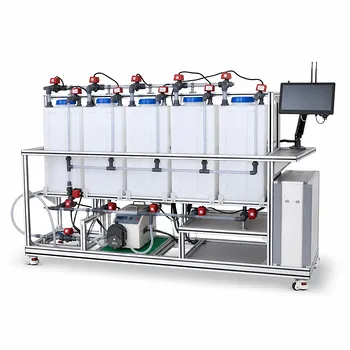
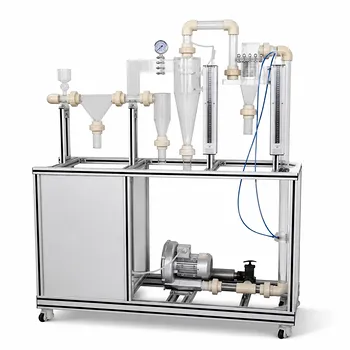
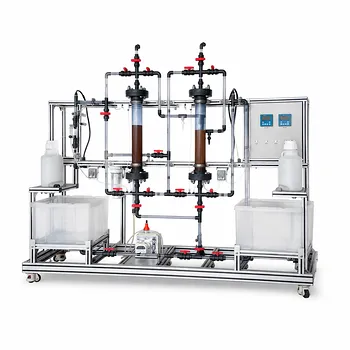
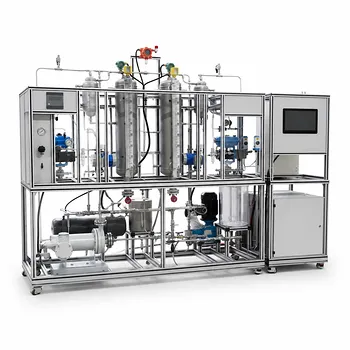
The configuration is a masterclass in integration, not just connection. A continuous esterification pilot plant doesn't treat waste and recover solvents as an afterthought. It weaves these functions directly into the heart of the process to drive the reaction forward. The system is configured around a three-pronged strategy: an azeotropic distillation loop to continuously remove reaction water, a dedicated extraction column to scrub wastewater of valuable organics, and a cascading wash-purification chain to refine the final product while recycling every usable molecule.
The core insight is that in a continuous esterification pilot plant, the "environmental" and "production" systems are one and the same. You’re not just cleaning up a mess; you’re engineering a closed-loop system where the recovery of solvents and the purification of the product are the critical control levers for shifting the reaction equilibrium to completion, maximizing yield, and minimizing waste at the source.
The Chemical Imperative: Why Recovery is Not Optional
The entire configuration of a continuous esterification pilot plant is dictated by a fundamental chemical constraint: the reaction is reversible and limited by equilibrium. You are constantly battling Le Chatelier's principle.
The Central Role of Azeotropic Distillation
To push an esterification reaction past its natural stopping point, you must continuously remove one of the products—almost always water. In a pilot plant, this is achieved practically with an integrated azeotropic distillation system.
An organic entrainer, like cyclohexane, is introduced. It forms a low-boiling ternary azeotrope with the reaction water and the alcohol. This vapor is routed to the top of a distillation column, condensed, and sent to a decanter—a phase separator. Here, the lighter, water-saturated organic phase is continuously refluxed back to the reactor column, while the separated water phase is continuously discharged. This elegant loop is the engine that drives the reaction to completion.
From Batch Thinking to a Continuous Cascade
The shift from a single reactor to a continuous sequence is what makes the configuration complex and powerful. The reacting mixture doesn't stay in one vessel; it flows through a cascade of stages, each with a specific temperature and pressure profile. For a process like Dioctyl Phthalate (DOP) production, the primary reference dictates a structured series: a high-temperature monoesterification reactor, a precisely zoned esterification column, a neutralization stage, and finally a thermal decomposition and distillation step. Each stage's output directly sets the conditions for the next.
Configuring the Three Core Recovery & Treatment Units
Based on the process requirements, the pilot plant's environmental and recovery systems are configured as three distinct but interconnected unit operations.
1. The Organic Recovery Extraction Unit
After the reaction mixture is neutralized with a sodium carbonate solution, the resulting process wastewater is not simply discarded. It’s a stream laden with valuable, but now water-soluble, contaminants like the sodium salts of unreacted phthalic acid.
This stream is fed directly to a wastewater extraction tower. Here, an organic solvent is contacted counter-currently with the aqueous waste to recover the dissolved organics. This is a core principle of waste minimization at the source, as it recovers reactants that would otherwise be lost and reduces the organic load on any downstream biological treatment, as detailed in best practices for pilot-plant waste minimization.
2. The Integrated Solvent Recycle Loop
The primary reference identifies cyclohexane as the entrainer, and its recovery is not a side process—it is the central control loop. The water phase from the azeotropic decanter is the effluent from the reaction's driving force.
But the solvent recovery challenge goes further. Unreacted alcohol, such as octanol, is recovered in two places: first, in the azeotropic distillation, and second, in a dedicated downstream purification step. The neutralized ester liquid is heated to thermally decompose any catalyst-diester complexes and then routed to a distillation column operating with an overhead temperature designed to boil off and recover the unreacted octanol for direct recycling, while the bottoms proceed to final purification.
3. The Product Purification & Wash Configuration
The crude ester leaving the reaction and neutralization stages still carries impurities. The final recovery unit is a purification chain. This is configured as a water-washing unit using hot deionized water (at 90°C), followed by a stripping column and a dual-stage vacuum drying system.
This sequence is critical because each step is designed to remove a specific type of impurity. The hot water wash removes water-soluble salts, the stripping column separates any remaining volatile organics under vacuum, and the dual-stage drying ensures the final product meets purity specifications without thermal degradation.
Understanding the Operational Trade-offs
An expert advisor must be clear-eyed about the limitations and challenges of this integrated configuration, which you would study directly on a pilot plant.
The Recycle Loop Accumulation Nightmare
The most common pitfall in a closed-loop configuration is the accumulation of trace impurities. When you continuously recycle entrainer and unreacted alcohol, heavy-boiling byproducts or impurities from the raw materials can build up to levels that poison the catalyst or create new azeotropes. A pilot plant must include a small purge stream from the solvent recycle loop to prevent this, a critical design detail often overlooked in purely theoretical setups.
The Energy-to-Purity Balancing Act
Recovering every last molecule is energy-intensive. The decision to distill octanol with an overhead of 100°C or to strip the final product under deep vacuum involves fundamental trade-offs that a pilot plant is designed to quantify. You must experimentally determine the relationship between the purity of a recycled solvent, the energy required, and the impact of minor contamination on reaction kinetics. The most thermally efficient configuration is rarely the one that yields the highest product purity, and finding this sweet spot is the pilot plant’s primary purpose.
How to Apply This to Your Pilot Plant Project
Your specific configuration should directly mirror the primary goal you've set for your pilot plant research or education program.
- If your primary focus is kinetic modeling and yield optimization: Prioritize the precise temperature zoning and residence time control in the esterification column and the efficiency of the azeotropic decanter. The extraction and drying stages can be simplified.
- If your primary focus is waste minimization and environmental engineering: Invest in the sophistication of your wastewater extraction tower and the analytical capacity to track mass flow of contaminants through every recycle and purge stream.
- If your primary focus is full-scale process integration and control: Ensure every stage from the primary reference—esterification, neutralization, thermal decomposition, distillation, washing, and vacuum drying—is a distinct, instrumented module where students can manipulate variables like the sodium carbonate dosing rate or the decanter interface level.
The endpoint is a system where the "wastewater" and "solvent recovery" labels become almost meaningless, replaced by a single, integrated picture of a continuous, equilibrium-driven process whose very success depends on the seamless interplay of reaction and separation.
Summary Table:
| Unit Operation | Primary Process Function | Recovered Material |
|---|---|---|
| Azeotropic Distillation | Removes reaction water to drive equilibrium forward | Water and recycled cyclohexane entrainer |
| Wastewater Extraction | Scrubs wastewater to recover valuable organics | Dissolved unreacted reactants and organic salts |
| Purification & Drying | Washes and strips product under deep vacuum | High-purity ester and recovered alcohol |
Elevate Your Engineering Education and Research with LABPARK
Looking to configure advanced, closed-loop systems for your training programs? LABPARK provides premium Educational and Vocational Unit Operations Pilot Plants in chemical engineering, bioprocess & biotech, and environmental & water treatment.
Tailored for universities, research institutes, and enterprises, our modular systems enable students and researchers to master real-world challenges like solvent recovery, azeotropic distillation, and wastewater treatment.
Ready to optimize your lab's capabilities? Contact us today to request a quote or custom design configuration.
Related Products
- Solid Waste Pyrolysis and Refining Educational Pilot Plant for Unit Operations
- Electrochemical Water Treatment Educational Unit Operations Pilot Plant
- Multimodal Absorption and Desorption Pilot Plant for Unit Operations Training
- Dual-Mode Rectification Pilot Plant for Practical Training Unit Operations
- Multi-Functional Membrane Separation Educational Pilot Plant for Unit Operations Lab
People Also Ask
- How do educational unit operations pilot plants bridge theory and design? Bridge the Engineering Gap
- How do educational unit operations pilot plants address safety and waste management when scaling up?
- When to transition from PID to adaptive control in pilot plants? Key process indicators.
- Why is the chemical plant startup schedule crucial? De-risk scale-up with pilot plants.
- Why Compare Predicted and Experimental Excess Enthalpy? Key to Accurate Pilot Plant Scale-up