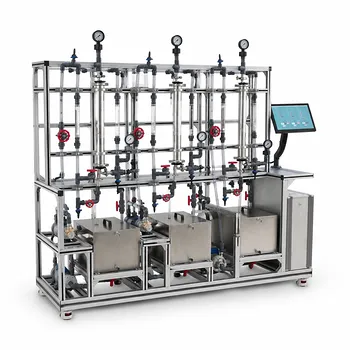
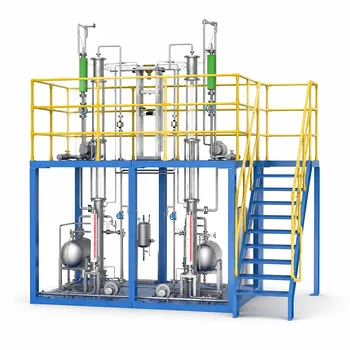
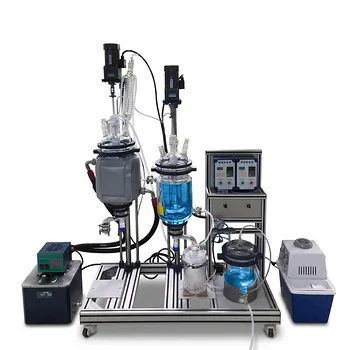
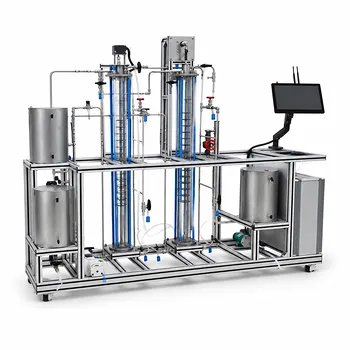
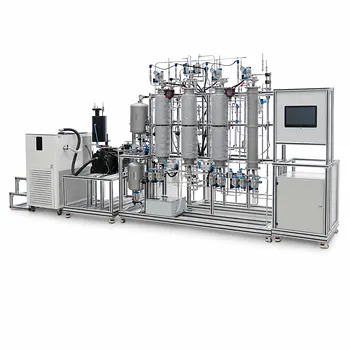
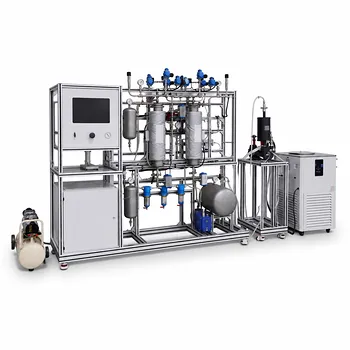
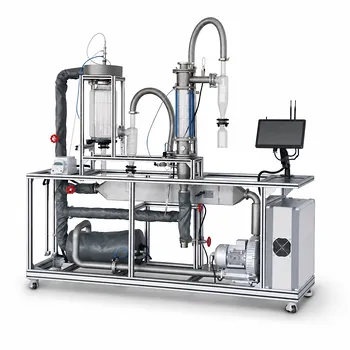
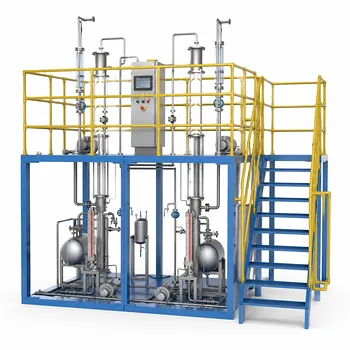
The most reliable differentiator for teaching filtration in a unit operations pilot plant is the feed’s solid concentration. Cake filtration should be introduced for slurries with a high solid volume fraction—typically above 1%—where particles build a surface layer that dominates the separation. Deep bed filtration, by contrast, is the lesson for low-concentration feeds (below 0.1%), where fine particles are trapped inside a thick porous medium without a visible cake. Using pilot-scale equipment that can demonstrate both modes helps students immediately connect theory to industrial practice, from chemical product recovery to water purification.
The single most dependable teaching rule is: use cake filtration when you have a concentrated slurry that will visibly form a cake, and deep bed filtration when you have a dilute suspension that must be clarified through a deep, granular bed. This concentration-based threshold—visible to the naked eye on the pilot floor—anchors every deeper discussion about equipment selection, performance, and scale-up.
The Fundamental Dividing Line: Solid Concentration
To make the distinction stick, have students first measure the solid fraction of their feed. This one variable consistently predicts which filtration mechanism will dominate.
When Solids Exceed 1%: The Domain of Cake Filtration
If the slurry contains more than about 1% solids by volume, particles quickly accumulate on the filter medium. That accumulation—the filter cake—becomes the primary filtration layer, determining both flow resistance and product quality.
Deep bed systems clog rapidly under these conditions. The concentrated solids would blind the internal pores of a sand bed almost immediately, making the lesson impossible to observe.
Below 0.1% Solids: Deep Bed Filtration Takes Over
For highly dilute suspensions, a surface cake never forms in a meaningful way. Instead, particles are captured as the fluid winds through the tortuous internal channels of a thick medium like sand, gravel, or a packed bed.
This is the classic scenario in environmental water treatment demonstrations. Students see clear water emerge from a column that has trapped invisible solids within its depth—no cake, no abrupt blinding, just a gradual rise in pressure drop.
Where the Particles End Up: Surface vs. Internal Capture
Once the concentration boundary is clear, the next teaching point is the physical location of the separated solids. Visualizing this difference solidifies the mental model.
Cake Filtration: Building a Secondary Filter
In cake filtration, the solids stack up on the upstream face of the medium. The initial filtrate might be slightly turbid until a thin bridging layer forms, but after that, the cake itself—not the cloth or screen—performs nearly all the separation.
Pilot plants let students scrape off that cake, measure its thickness, and see how its growth changes flux and pressure drop over time.
Deep Bed Filtration: Trapping Particles Inside the Medium
Deep bed filtration conducts the separation within the medium. Solid particles adhere to the walls of internal pore channels, gradually reducing the bed’s permeability without forming a distinct surface layer.
This is why backwashing and regeneration are such important operational topics for deep beds. Because the contaminants are held internally, they can often be flushed out and the medium reused—a concept that becomes tangible when students run a pilot column and then observe turbid backwash water.
Designing Pilot Plant Experiments to Illustrate the Differences
A well-equipped pilot facility makes these mechanisms impossible to confuse. By deliberately choosing equipment and operating conditions, you can turn abstract definitions into memorable observed behavior.
Selecting Pilot Equipment for Each Mode
For cake filtration, the teaching arsenal typically includes plate-and-frame filter presses, rotary vacuum filters, or centrifugal separators. These units encourage students to examine cake thickness, moisture content, and washing efficiency.
For deep bed filtration, a tall column packed with sand or graded granular media is the natural choice. The column’s transparent walls—if available—show a clear liquid zone advancing, while particle capture happens invisibly along the bed height.
Pilot plants that offer both types of hardware in a single teaching loop give the strongest comparative lesson.
Observing Key Performance Indicators
In cake filtration experiments, focus students on measuring filtration rate as a function of cake height, the pressure drop across the cake, and the residual moisture of the isolated solids. These directly connect to industrial design calculations.
In deep bed experiments, the critical teachable parameters are effluent turbidity over time, the pressure drop through the bed as solids load increases, and the effectiveness of backwashing for regeneration. These metrics show why deep beds are used for clarification rather than bulk solid recovery.
Understanding the Trade-offs and Pitfalls
No filtration method is universally superior. The real learning comes from exploring what can go wrong when the concentration threshold is ignored or operating parameters are pushed too far.
The Compressibility Trap in Cake Filtration
On a pilot scale, students often discover that doubling the pressure drop does not double the filtration rate—it might actually slow things down.
Highly compressible cakes compact under high differential pressure, drastically reducing permeability. This is a scale-up lesson that a vacuum flask in a laboratory class rarely reveals, because the thin, low-pressure cake formed in a Buchner funnel is up to 10 times faster and shows almost no compression.
When teaching with a pilot filter, deliberately vary the pressure and have students plot flux against applied pressure for a compressible material. The flattening—or even declining—curve is a lesson they will never forget.
The Misapplication of Deep Bed Filtration to Concentrated Slurries
Trying to clarify a 1% slurry with a deep sand bed is a classic teaching moment in failure. The bed surface blinds almost instantly, flow rates plummet, and backwashing becomes ineffective.
A dedicated demonstration of this mismatch teaches students that deep bed filtration is a polishing step, not a primary separation for anything but the most dilute suspensions.
Making the Right Choice for Your Educational Goal
How you design the pilot plant curriculum depends on what you most want your students to internalize. Use the concentration boundary as the anchor, but tailor the emphasis to your program’s objectives.
- If your primary focus is ingraining fundamental separation mechanisms: Always start with a simple suspension that straddles the concentration threshold. Have students measure solids content, then run the same slurry through a cake-forming device and a deep bed. The stark difference in performance and visible behavior cements the concept permanently.
- If your primary focus is industrial equipment selection and scale-up: Use pilot-scale rotary vacuum filters or plate-and-frame presses for cake work, and a tall sand column for deep bed. Run experiments that generate data sets of flux versus cake height or pressure versus time, and teach students to use these to size full-scale units.
- If your primary focus is troubleshooting and process limits: Build in a compressibility module where students deliberately over-pressurize a cake and measure the resulting flux decline, and a deep bed blinding module where they exceed the concentration limit. These “negative data” lessons build diagnostic instincts they will carry into their careers.
When a pilot plant lets students see the cake form or watch a deep bed slowly load up, the knowledge moves from textbook abstraction to enduring professional intuition.
Summary Table:
| Parameter | Cake Filtration | Deep Bed Filtration |
|---|---|---|
| Feed Solid Concentration | High (typically > 1% by volume) | Low (typically < 0.1% by volume) |
| Capture Mechanism | Surface capture (filter cake acts as the primary medium) | Internal capture (particles trap inside porous bed) |
| Typical Equipment | Plate-and-frame presses, rotary vacuum filters | Sand, gravel, or graded granular media columns |
| Primary KPIs | Cake thickness, moisture content, filtration rate | Effluent turbidity, bed pressure drop, backwash efficiency |
| Common Operation Pitfall | Cake compressibility under excessive pressure | Surface blinding when feed concentration is too high |
Elevate Your Engineering Curriculum with LABPARK
Looking to bring industrial-scale solid-liquid separation processes to life in your lab? LABPARK designs and manufactures premium Educational and Vocational Unit Operations Pilot Plants across chemical engineering, bioprocess & biotech, and environmental & water treatment.
We help universities, research institutes, and enterprises bridge the gap between theory and practice with robust, transparent, and highly adjustable filtration systems.
Ready to enhance your students' hands-on learning? Contact our expert team today to customize a pilot plant solution tailored to your curriculum requirements!
Related Products
- Hot Filtration Educational Unit Operations Pilot Plant Laboratory System
- Gas-Solid Heterogeneous Separation Demonstration Educational Unit Operations Pilot Plant
- Two-Dimensional Fluidization Hydrodynamics Educational Pilot Plant for Unit Operations Training
- Pressure Swing Adsorption Educational Unit Operations Pilot Plant
- Solid Waste Pyrolysis and Refining Educational Pilot Plant for Unit Operations
People Also Ask
- How to Determine Specific Cake (r) & Filter Medium (Rm) Resistance Using Filtration Pilot Plant Data
- How can researchers identify and resolve filter medium blinding? Optimize Your Pilot Plant Runs
- How to select solid-liquid separation equipment for pilot plants? A Step-by-Step Guide
- Why Demo Constant-Rate to Constant-Pressure Filtration on a Pilot Plant? Key Practical Insights
- How do Buchner funnels & leaf filters differ in filtration scale-up? Key Differences Explained