Selecting distillation trays for an educational pilot plant is not a one-size-fits-all decision—it’s a strategic curriculum choice.
The answer lies in matching the tray’s hydraulic behavior to your specific teaching objectives. Sieve trays excel at demonstrating fundamental limits like weeping and flooding, valve trays reflect modern industrial flexibility, and bubble-cap trays uniquely reveal stable operation at near-zero vapor loads. The most versatile investment is a modular column that lets students compare all three types hands-on.
Core Insight: Choose a tray not for its standalone performance, but for the distinct mass transfer and hydraulic phenomena it reveals. A pilot plant with interchangeable bubble-cap, sieve, and valve trays transforms a single piece of equipment into a multipurpose teaching tool—covering everything from basic weeping to advanced turndown flexibility and industrial relevance.
Aligning Tray Type With Learning Objectives
Your tray choice should mirror the concepts you want students to see in action. Each type amplifies a different aspect of distillation’s operational envelope.
Sieve Trays: Teaching Weeping and Flooding Fundamentals
Sieve trays are the simplest and most cost-effective option. Vapor passes directly through perforated holes, giving students a clear view of weeping at low gas flow rates and flooding at high rates.
This narrow turndown ratio (about 50%–120% of design flow) makes them perfect for introducing hydrodynamic limits. They also generate the lowest pressure drop, which is ideal for basic mass transfer demonstrations.
Valve Trays: Bridging to Industrial Practice
Valve trays (such as F1 or V-4 types) use liftable caps that adjust opening size based on vapor flow. This gives them a wide operating flexibility comparable to modern industrial columns.
Students learn how an auto-regulating mechanism maintains high efficiency across variable loads. They represent the industry standard, so hands-on experience with valve trays directly prepares students for real-world plant operation and troubleshooting.
Bubble-Cap Trays: Exploring the Limits of Low Vapor Rates
Bubble-cap trays feature risers topped with caps that maintain a constant liquid seal regardless of vapor velocity. They virtually eliminate weeping, even at extremely low gas flow rates.
This makes them the ideal tool for demonstrating batch distillation or absorption processes that require high liquid holdup. Students directly observe how a stable liquid layer is maintained when other trays would fail—an effect not visible on sieve decks.
Understanding the Key Trade-offs
No single tray type is best for every educational goal. A well-equipped lab uses the inherent constraints of each design as teachable moments.
Cost and Maintenance Realities
Sieve trays are the most economical to manufacture and clean. Their simple architecture minimizes clogging risk.
Bubble-cap trays are the most expensive and complex. The caps and risers trap solids, making them highly susceptible to fouling and corrosion—a maintenance lesson in itself.
Valve trays strike a middle ground in both acquisition cost and upkeep, reflecting their balanced engineering.
Operating Flexibility and Turndown
Turndown ratio directly dictates how much you can vary throughput before separation collapses.
Bubble-cap trays offer the widest window, operating stably even at near-zero vapor loads.
Valve trays provide a large practical range—wider than sieve—while sieve trays force students to operate close to design conditions. This spectrum lets you demonstrate why industrial columns prize flexibility.
Pressure Drop Implications
Sieve trays exhibit the lowest pressure drop, followed by valve trays, then bubble-cap trays.
Higher pressure drop increases reboiler duty and affects vacuum operations. By measuring pressure differentials across each tray type, students learn to balance hydraulic efficiency against separation power.
Why a Modular Pilot Plant Is the Ideal Investment
A single column with interchangeable internals delivers more educational value than three separate dedicated columns. Students can swap trays between experiment sessions, witnessing firsthand how tray design alters weeping points, flooding curves, and overall separation efficiency.
This modularity also allows comparative efficiency calculations using methods like the O’Connell correlation or the more detailed Erwin two-film method. Such hands-on analysis bridges theoretical design equations and real pilot-plant data.
How to Select the Right Configuration for Your Curriculum
Your final choice should be driven by the primary skill you want students to develop. Use these goal-oriented guidelines to configure your lab.
- If your primary focus is demonstrating fundamental mass transfer and hydrodynamic limits: Start with a sieve tray column. Its tendency to weep and flood provides unmistakable, visual proof of turndown constraints.
- If your primary focus is aligning with modern industrial standards and variable operation: Prioritize a valve tray setup. It teaches students how liftable internals handle fluctuating feed conditions—a skill directly transferable to plant roles.
- If your primary focus is maximizing research flexibility or studying batch processes: Incorporate bubble-cap trays. Their ability to hold liquid at zero vapor flow makes them essential for advanced distillation experiments and high-holdup applications.
- If your goal is to offer comprehensive, side-by-side education: Invest in a modular pilot plant with interchangeable sieve, valve, and bubble-cap internals. This single asset enables the full spectrum of curriculum, from weeping basics to industrial turndown mastery.
By prioritizing interchangeable tray internals, you empower students to move from theoretical principles to hands-on comparison, building the practical judgment that defines expert chemical engineers.
Summary Table:
| Tray Type | Primary Teaching Focus | Turndown Ratio | Cost & Maintenance | Pressure Drop |
|---|---|---|---|---|
| Sieve | Hydrodynamic limits (weeping & flooding) | Narrow (50%–120%) | Low (Easy to clean) | Lowest |
| Valve | Industrial standards & flexible loads | Wide (Variable) | Medium | Moderate |
| Bubble-Cap | Low-vapor rates & batch operations | Widest (Zero weeping) | High (Complex) | Highest |
Bring Hands-On Distillation Mastery to Your Lab
Looking to upgrade your chemical engineering curriculum? LABPARK provides state-of-the-art Educational and Vocational Unit Operations Pilot Plants in chemical engineering, bioprocess & biotech, and environmental & water treatment for universities, research institutes, and enterprises.
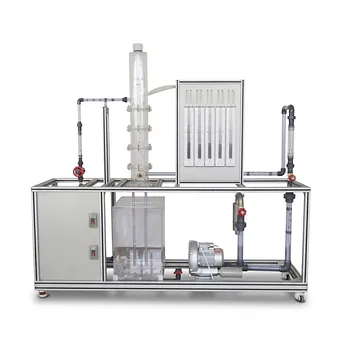
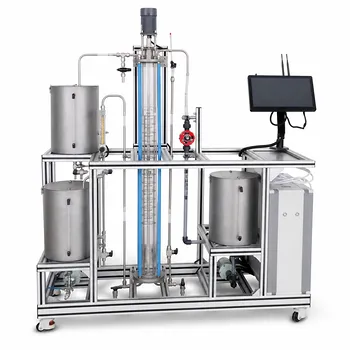
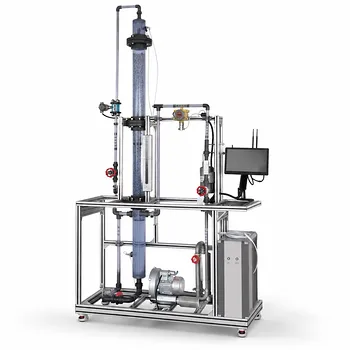
Our modular distillation pilot plants allow students to easily swap and compare sieve, valve, and bubble-cap trays on a single system—maximizing educational versatility and training ROI.
Contact LABPARK today to customize a pilot plant configuration that meets your curriculum goals!
Related Products
- Continuous Sieve-Plate Distillation Pilot Plant for Unit Operations Laboratory Education
- Multi-Functional Special Distillation Educational Pilot Plant
- Multi-Modal Distillation Unit Operations Training Pilot Plant
- Continuous Batch Extractive Distillation Educational Pilot Plant
- Dual-Mode Rectification Pilot Plant for Practical Training Unit Operations
People Also Ask
- How do distillation pilot plants validate VLE data? Achieve reliable solvent separation scale-up.
- Why is condensate subcooling critical in pilot plants? Expert Design & Control Guide
- How does catalyst water concentration affect distillation pilot plant design? Key separation train choices.
- Why is the column performance diagram critical? Optimize distillation pilot plant safety & efficiency.
- Why is vacuum operation capability an essential feature for a distillation unit operations pilot plant? Unlock Efficiency