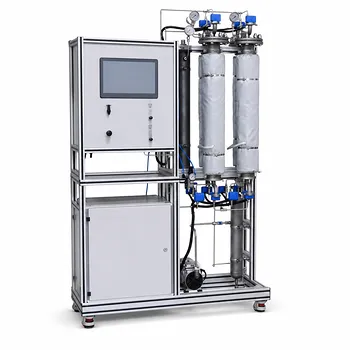
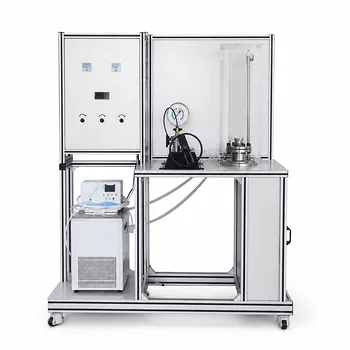
Answering the surface-level need first, the selection of a carbon dioxide removal technology for a gas purification pilot plant hinges on a simple matrix: match the feed gas condition to the pedagogical objective. If your feed gas has a high CO2 partial pressure (>0.5 MPa) and low temperature, physical absorption with Propylene Carbonate is a strong candidate. For demonstrating simultaneous acid gas removal with industrial relevance, a physico-chemical MDEA/sulfolane system is ideal. If your focus is on solid adsorbents and ambient-temperature hydrogen or nitrogen purification, choose Pressure Swing Adsorption (PSA) . And for integrated chemical synthesis curricula, a chemical by-product method that converts CO2 into fertilizers or soda ash is the most relevant.
The core challenge is not just removing CO2; it's selecting the technology that best illuminates the specific thermodynamic, kinetic, or process integration principles your students and researchers need to master. A modular, well-instrumented system that clearly demonstrates the underlying separation mechanism is always superior to a "black box" that simply works.
Aligning Technology with Educational Goals
The deep need in an academic setting is to translate abstract chemical engineering principles into tangible, observable phenomena. The pilot plant is a physical textbook, and the chosen technology dictates which chapter you can teach.
Demonstrating Physical Solubility with Inert Solvents
Physical absorption using Propylene Carbonate (PC) is a perfect vehicle for teaching Henry's Law in action. This method relies purely on the physical solubility of CO2 in a solvent, with no chemical reaction involved. It makes the pressure-dependency of absorption vividly clear, as CO2 is absorbed at high pressure and released simply by depressurization. This allows students to decouple absorption from chemical kinetics and focus entirely on mass transfer and phase equilibria. The low regeneration energy requirement, achieved via simple flashing, is another key engineering lesson.
Exploring Hybrid Mechanisms with Amine-Based Solvents
The MDEA/sulfolane system provides a rich platform for exploring complex reaction engineering. Unlike physical solvents, this mixture engages in both physical dissolution and an acid-base reaction with CO2. This dual mechanism allows students to study the effects of temperature and solvent composition on selectivity. It’s the ideal choice for curricula focused on natural gas sweetening, as it can simultaneously demonstrate the removal of H2S and CO2, just like an industrial process. The higher solvent cost becomes a teachable moment in operational economics.
Visualizing Solid-Phase Interactions with PSA
Pressure Swing Adsorption (PSA) transforms an invisible process into a data-rich, time-dependent experiment. This technology operates on the principle of selective adsorption onto a solid surface at high pressure and desorption at low pressure. Students can trace adsorption breakthrough curves in real-time, calculating mass transfer coefficients and analyzing the dynamic behavior of a fixed bed. Its ambient-temperature operation and low energy consumption make it an excellent case study for process intensification and the purification of high-value streams like hydrogen.
Connecting Theory to Product in Integrated Systems
For institutions emphasizing process design and green chemistry, chemical by-product methods offer a uniquely holistic view. Here, CO2 is not a waste product; it is a reactant. Stripping CO2 and then reacting it with ammonia to form ammonium bicarbonate or with brine for soda ash directly links the purification unit to a downstream synthesis reactor. This is the most powerful option for teaching industrial ecology and techno-economic analysis, as students must evaluate the value of the final product against the cost of the entire integrated train, not just the removal step.
Understanding the Trade-offs
A critical part of an engineer’s education is learning that no perfect solution exists. Selecting a technology for a pilot plant requires an objective look at the downsides.
- Physical Absorption (PC Method): Its primary limitation is low efficiency at low CO2 partial pressures. It also cannot achieve ultra-high purity with a simple flash, as co-absorbed light hydrocarbons will remain in the product stream, and there's a risk of valuable hydrocarbons being lost into the acid gas.
- Physico-chemical Absorption (MDEA): The complexity lies in the chemical handling and higher upfront solvent costs. The regeneration process is more energy-intensive than physical methods, requiring steam, which adds operational complexity and safety considerations.
- Pressure Swing Adsorption (PSA): The process is inherently cyclic and generates a tail-gas stream at low pressure, which can complicate downstream integration. Adsorbent degradation over time and the mechanical stress on switching valves are key reliability issues students will confront.
- Chemical By-product Methods: This approach introduces complete process lock-in. The purification unit is now subservient to the downstream reaction, offering zero flexibility for studying other gas streams or purification targets. The operational safety profile also escalates dramatically with the introduction of reactive chemicals like ammonia.
Making the Right Choice for Your Institution
Your final selection should be dictated by the core competency you wish to build in your students. Define your primary learning outcome, then choose the tool that makes that outcome impossible to miss.
- If your primary focus is mass transfer and phase equilibria: Select the Propylene Carbonate system. Its pure physical absorption mechanism isolates pressure and temperature effects with the fewest confounding variables.
- If your primary focus is industrial gas treating and reaction kinetics: Choose the MDEA/sulfolane system. It brings the complexity of simultaneous acid gas removal and reactive absorption into the teaching lab.
- If your primary focus is solid-gas interfaces and product purity: Choose a PSA system. It provides the most hands-on experience with adsorption dynamics, breakthrough curves, and cyclic process control.
- If your primary focus is process integration and business viability: Implement a chemical by-product method. It forces students to evaluate a process from raw feed to marketable product, including economic and safety constraints.
The right technology does not simply purify a gas stream; it clarifies a fundamental chemical engineering principle, making the invisible forces of separation visible and measurable.
Summary Table:
| Technology | Primary Mechanism | Best For (Educational Goal) | Key Limitation |
|---|---|---|---|
| Physical Absorption (PC) | Physical solubility (Henry's Law) | Mass transfer & phase equilibria | Low efficiency at low partial pressures |
| Physico-chemical (MDEA) | Physical dissolution + chemical reaction | Industrial treating & reaction kinetics | High regeneration energy & chemical costs |
| Pressure Swing Adsorption | Solid-gas selective adsorption | Breakthrough curves & cyclic dynamics | Cyclic operation & adsorbent degradation |
| Chemical By-product | Reaction of CO2 into products | Process integration & industrial ecology | Complete process lock-in; safety hazards |
Ready to configure your next gas purification system? LABPARK provides state-of-the-art Educational and Vocational Unit Operations Pilot Plants in chemical engineering, bioprocess & biotech, and environmental & water treatment. Designed specifically for universities, research institutes, and enterprises, our modular systems translate complex thermodynamic and separation principles into hands-on learning. Contact our specialists today to design the ideal pilot plant for your lab!
Related Products
- Carbon Dioxide Absorption and Desorption Educational Pilot Plant for Carbon Capture Studies
- Carbon Dioxide Adsorption and Capture Educational Unit Operations Pilot Plant
- Carbon Dioxide Hydrogenation Methanol Synthesis Educational Unit Operations Pilot Plant
- Carbon Dioxide Capture and Utilization Educational Pilot Plant for Unit Operations
- Bench Scale Carbon Dioxide Capture Educational Unit Operations Pilot Plant
People Also Ask
- How does operating pressure influence the transition between absorption and desorption in a CO2 pilot plant?
- How do temperature variations affect CO2 transport models in pilot plants? Model vs Reality
- What unit operations are critical for CCUS training pilot plants? Build hands-on engineering expertise.
- How do electrolytes affect phase equilibrium in absorption pilot plants, and how to calculate it?
- Why is critical surface tension key in column internals? Optimize gas absorption pilot plant efficiency