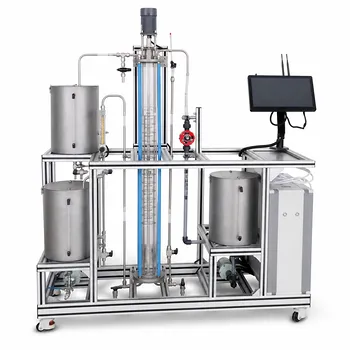
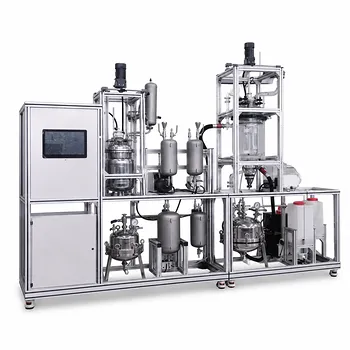
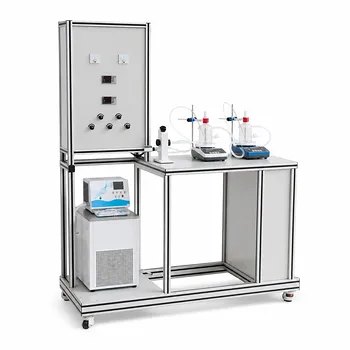
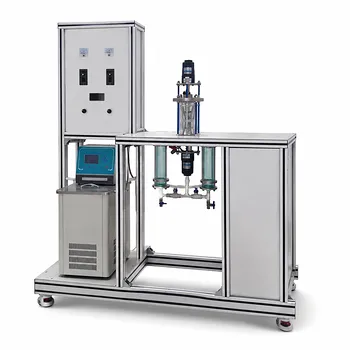
The right liquid-liquid extraction pilot plant is the one that aligns with your system’s physical properties, your required number of theoretical stages, and the practical constraints of your laboratory.
Mixer-settlers, agitated columns, and centrifugal extractors each excel under different conditions. The key is to start with the density difference and interfacial tension of your liquid pair—because those properties dictate how easily the phases separate. From there, you match the equipment’s stage efficiency, throughput, and footprint to your experimental or educational objectives.
The single most important selection factor is the system’s phase-separation tendency: small density differences or emulsifying feeds demand a centrifugal extractor, while stable systems with moderate differences can be handled by agitated columns, and mixer-settlers remain the go‑to for low-density-difference systems where high stage efficiency and reliable scale-up matter most.
Start with Your System’s Physical Properties
The speed and completeness of phase separation are not luxuries—they are the foundation of a successful extraction. Before you choose an equipment type, measure your liquid pair’s density difference, interfacial tension, and viscosity.
Small Density Differences Demand Energy Input
When the two liquid densities are very close (e.g., less than 50–100 kg/m³), gravity alone works too slowly. You must introduce mechanical energy to accelerate the process. Mixer-settlers and agitated columns (like rotating disc or pulsed columns) provide this energy and are well‑suited to systems with low density differences. For extremely small density differences or when fast separation is critical, centrifugal extractors use high g‑forces to achieve separation in seconds.
High Interfacial Tension or High Viscosity Favor Active Dispersion
Systems that resist droplet breakup or flow sluggishly also need mechanical assistance. Mixer-settlers create intense contacting through impeller agitation, while rotating disc columns and pulsed columns generate fine dispersions that enhance mass transfer. If the system is both viscous and emulsifying, a centrifugal extractor is the safest path to a clean, rapid split.
Emulsion‑Prone or Unstable Feeds Require Short Residence Times
If your feed tends to form stable emulsions, contains shear‑sensitive biomolecules, or decomposes quickly, minimizing contact time is non‑negotiable. Centrifugal extractors are the clear choice: they hold the liquid volume for only a few seconds, sharply reducing the risk of rag layer formation and product degradation.
Match Equipment to Required Stages and Throughput
After you understand the physical behavior, map your separation to the equipment’s capacity and stage-wise performance.
Counter‑Current Stages: How Many Do You Really Need?
Simple separations (3 or fewer theoretical stages) are often handled by a packed or spray column. If you need 4 to 10 stages, sieve‑plate columns, pulsed columns, or a small bank of mixer-settlers become appropriate. For deep separations requiring 10 to 20 stages, rotating disc columns, reciprocating plate columns, or a multi‑stage mixer‑settler battery are the robust options.
Throughput and Scale Shape Your Layout
Agitated columns are inherently compact and handle high throughputs in a single vertical line, making them ideal when floor space is tight. Mixer‑settlers offer easy stage addition but consume more horizontal area and need multiple pumps. Centrifugal extractors are high‑throughput units that occupy a small footprint but typically have higher capital and maintenance costs.
Consider Footprint, Operational Complexity, and Lab Objectives
Your laboratory’s physical space and the end‑user’s skill level often override the “ideal” technical choice.
Footprint: Vertical Height vs. Horizontal Spread
If you have generous vertical clearance but limited floor space, packed or plate columns and agitated columns are space‑efficient. When headroom is low (low ceiling), horizontal mixer‑settlers are a better fit. Centrifugal extractors, while tall, can fit into a surprisingly small floor area, though service access must be planned carefully.
Operator Skill and Maintenance Tolerance
Mixer‑settlers are the most forgiving to operate and maintain; their visible phase boundaries and simple mechanical design make them excellent for teaching basic stage‑wise extraction. Agitated columns need more careful tuning of agitation speed and throughput but reward you with a continuous process and reduced solvent inventory. Centrifugal extractors, while extremely effective, demand precise bearing maintenance and rotor cleaning, making them better suited to experienced researchers or dedicated technical staff.
Educational and Method‑Development Goals
When the pilot plant is a training tool, offering both a mixer‑settler and a column (or a centrifugal unit) lets students directly compare how residence time, dispersion intensity, and footprint influence efficiency. Even if your core research uses only one type, a second technology builds deeper insight into process‑equipment matching.
Understanding the Trade‑offs
No single type dominates every metric. Being explicit about the downsides prevents costly mistakes.
Mixer‑Settlers: High Efficiency at the Cost of Space and Solvent Inventory
Their per‑stage efficiency often exceeds 80%, and they can tolerate suspended solids that would clog columns. However, they require a large total solvent volume, a correspondingly larger inventory of potentially hazardous chemicals, and a sprawling site layout. Multiple stages mean multiple pumps, which increases energy consumption and failure points.
Agitated Columns: Compact but Sensitive to Operational Drift
Columns use gravity or mechanical agitation to achieve continuous counter‑current flow. They reduce solvent inventory and footprint dramatically. On the downside, they are more sensitive to changes in feed flow rate or interfacial tension; flooding or weeping can happen if the operating window is missed. Scale‑up from a column pilot plant requires careful hydrodynamic modeling.
Centrifugal Extractors: Speed at a Premium
Centrifugal units separate phases in seconds, consume minimal solvent, and handle the toughest emulsions. The price is higher equipment cost, more intensive maintenance, and—critically—limited internal volume, which can restrict the number of theoretical stages a single unit provides. They are often best used in series for multi‑stage duties, which amplifies both cost and complexity.
Making the Right Choice for Your Goal
Once you have weighed the system demands and your lab’s reality, select the equipment that best serves your primary objective.
- If your primary focus is demonstrating fundamental stage‑wise extraction with high efficiency and forgiving operation: Choose a multi‑stage mixer‑settler pilot plant. Its visual clarity and stability make it ideal for training and robust process development.
- If your primary focus is processing high‑throughput streams in a limited footprint, with moderate density differences: Select an agitated column such as a rotating disc or pulsed column. The continuous operation and low solvent hold‑up are decisive advantages.
- If your primary focus is handling feeds that emulsify, have extremely small density differences, or require sub‑minute residence times: Invest in a centrifugal extractor. Its unmatched separation speed eliminates the risk of slow settling failures.
- If your primary focus is pedagogical and you want to cover the full extraction technology spectrum: Combine a mixer‑settler with a column or a centrifugal unit. This side‑by‑side approach builds deep, transferable engineering judgment.
The ideal pilot plant is never a default choice—it’s the one that turns your specific chemical system and laboratory constraints into a reliable, data‑rich extraction tool.
Summary Table:
| Equipment Type | Key Advantages | Best Suited For |
|---|---|---|
| Mixer-Settlers | High stage efficiency (>80%), easy operation, handles suspended solids | Basic stage-wise extraction training and stable process development |
| Agitated Columns | Compact vertical footprint, continuous operation, low solvent inventory | High-throughput systems with moderate phase density differences |
| Centrifugal Extractors | Rapid separation (seconds), handles emulsifying feeds, minimal footprint | Emulsion-prone systems and unstable or shear-sensitive feeds |
Optimize Your Lab Operations with LABPARK
Choosing the right extraction technology is essential for accurate research and effective training. LABPARK design and supply premium Educational and Vocational Unit Operations Pilot Plants in chemical engineering, bioprocess & biotech, and environmental & water treatment. We help universities, research institutes, and enterprises bridge the gap between theory and industrial practice with robust, safe, and scale-up-ready pilot equipment.
Ready to equip your laboratory with the ideal extraction system? Contact LABPARK today to discuss your project requirements with our engineering experts!
Related Products
- Educational Rotary Disc Liquid-Liquid Extraction Pilot Plant
- Comprehensive Liquid-Liquid Extraction Pilot Plant for Engineering Education
- Gallium and Indium Selective Extraction Educational Pilot Plant
- Ternary Liquid-Liquid Equilibrium Educational Pilot Plant
- Liquid-Liquid Mass Transfer Coefficient Determination Educational Pilot Plant
People Also Ask
- How do density and IFT affect liquid-liquid extraction pilot plants? Optimize Column Performance
- How are ternary phase diagrams and LLE data applied in extraction experiments? Optimize Pilot Plant Scale-up
- In a liquid-liquid extraction pilot plant, how is a ternary-phase diagram utilized to determine solvent feed requirements?
- How Do Selectivity & Distribution Coefficients Influence LLE Pilot Plant Solvent Choice?
- How to Validate BIPs for LLE Pilot Plants? Steps to Align Simulations with Reality