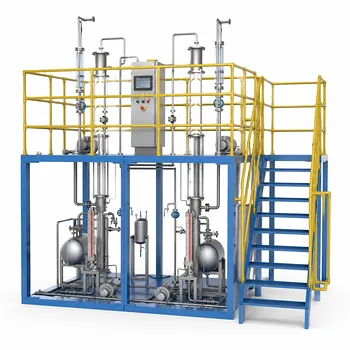
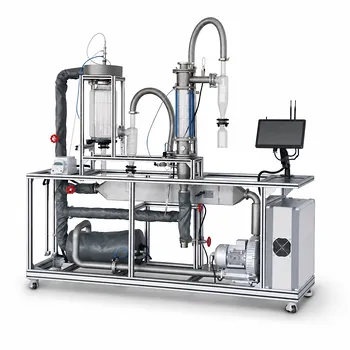
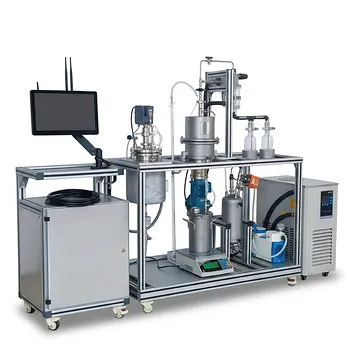
For a university laboratory, the immediate choice between a tower loop bioreactor and a traditional stirred-tank bioreactor pilot plant hinges on the specific biological systems and unit operations you need to teach. A stirred-tank pilot plant is the non-negotiable industry benchmark, providing hands-on study of mechanical agitation, power draw, and high-shear mixing. A tower loop (airlift) pilot plant is the definitive platform for teaching low-shear, pneumatically driven bioprocessing—essential for modern mammalian and shear-sensitive cell culture. The most complete educational preparation comes from having both, as it allows direct student comparison of fundamentally different mass transfer, heat dissipation, and scale-up strategies.
The deep need isn’t just choosing a piece of equipment; it’s investing in a pedagogical tool that shapes student intuition. If your curriculum prioritizes traditional fermentation and mechanical agitation design, the stirred tank is mandatory. If it focuses on gentle handling of fragile cells and energy-efficient mixing, the tower loop becomes critical. The optimal long-term approach is a staged investment that eventually integrates both to teach comparative bioreactor design.
The Educational Power of a Stirred-Tank Bioreactor
This is the universal language of industrial fermentation. It prepares students for the most common reactor configuration they will encounter in chemical engineering and large-scale microbial bioprocessing.
The Industry Workhorse and Its Core Lessons
A stirred-tank reactor enables students to physically trace the cause-and-effect relationship between impeller speed, power input, and mixing quality.
It directly demonstrates the principles of Rushton turbine, pitched-blade, or marine impeller fluid dynamics and the resulting shear rates.
For aerobic processes, students learn to optimize sparging patterns under high back pressure, a scenario that dominates microbial fermentation.
Key Engineering Parameters Students Will Measure
With a stirrer, you can run classic power number versus Reynolds number experiments, making abstract chemical engineering correlations tangible.
Students gain direct experience measuring volumetric mass transfer coefficients (kLa) under varying agitation speeds, a foundational skill for process scale-up.
The stirred tank’s versatility also allows seamless demonstration of batch, fed-batch, and continuous operation modes, teaching students the full spectrum of production strategies and their kinetic implications.
The Educational Value of a Tower Loop (Airlift) Bioreactor
When the teaching goal shifts to biopharmaceuticals, waste treatment, or any process involving shear-sensitive organisms, the tower loop becomes irreplaceable.
Gentle Mixing for Modern Biotechnology
A tower loop pilot plant provides a visual, intuitive model of pneumatic agitation—mixing driven entirely by gas injection.
It is the ideal system to teach handling of mammalian cells, filamentous fungi, or plant cells, which would be destroyed by the high tip speeds of a stirred tank’s impeller.
This addresses a core industry need: students must understand that high viability often trumps maximum oxygen transfer, a mindset shift the equipment itself enforces.
Demonstrating Pneumatic Agitation and Mass Transfer
Students can directly measure the gas hold-up and liquid circulation velocity as a function of superficial gas velocity, two parameters absent from a stirred-tank exercise.
It offers a clear physical demonstration of the trade-off between mixing intensity and energy input, as the gas compressor becomes the sole source of both.
This configuration is also exceptionally suited for teaching continuous processes with cell retention, a key concept in high-density perfusion cultures that avoids the shear of mechanical pumps.
Understanding the Trade-offs Between the Two Systems
Objective selection requires facing the inherent limitations. A device’s strength in one educational context is often its weakness in another.
Shear Sensitivity and Cell Viability
A stirred tank’s high local energy dissipation rates around the impeller can fracture cells or alter their metabolism, a lesson in itself but a major constraint for whole classes of experiments.
The tower loop eliminates this by distributing energy more evenly, but at the cost of precision: you cannot independently control mixing and aeration—they are tightly coupled.
If your syllabus needs to teach damage mechanisms like Eddy disruption length, having both is the only way to physically compare lethal and sub-lethal shear effects.
Mass Transfer and Mixing Efficiency
Stirred tanks typically achieve higher maximum kLa values thanks to rigorous bubble break-up from impellers, making them superior for teaching high-oxygen-demand microbial fermentations.
Tower loops often exhibit lower mass transfer coefficients, especially in viscous broths, which can limit their use for demonstrating extreme respiratory rates without pure oxygen supplementation.
The stark difference in mixing time—typically much longer in an airlift—offers a perfect teaching moment about reactor geometry dictating performance, but it means a tower loop cannot simulate a well-mixed stirred-tank assumption.
Operational Complexity and Versatility
A stirred-tank pilot plant is mechanically complex (shaft seals, motors, sterile barriers) and teaches maintenance realities but poses a higher contamination risk at the agitator penetration.
A tower loop is mechanically simpler and often requires less capital cost for the vessel itself, but it demands a deeper understanding of two-phase flow stability and gas distributor design to avoid flow reversal.
The stirred tank is inherently more flexible for retrofitting different impeller types or adding baffles, while the tower loop’s internal draft tube design locks in its hydrodynamic character from the start.
Making the Right Choice for Your Educational Goal
Your decision must flow from a clear-eyed audit of what your students must be able to do on day one in industry. Use these goal-oriented scenarios to guide the investment.
- If your primary focus is classic chemical engineering unit operations: Prioritize the stirred-tank pilot plant first. It teaches mechanical power draw, impeller hydrodynamics, and the standard correlations found in core textbooks, forming the non-negotiable baseline.
- If your primary focus is modern biotechnology and biopharmaceutical processing: Prioritize the tower loop bioreactor. It teaches the gentle, scalable environment essential for mammalian and stem-cell culture, the dominant skillset in today’s high-value bio-production.
- If your program aims to produce well-rounded process design engineers: Establish a long-term plan to acquire both systems. The irreplaceable educational value lies in side-by-side student comparisons of kLa, cell viability, energy costs, and mixing time for the same biological model.
- If your focus is energy efficiency and wastewater bioprocessing: The tower loop’s pneumatic simplicity and low energy input make it the more authentic model for teaching large-scale environmental biotech, mirroring the airlift design of most industrial treatment systems.
The most powerful answer is rarely an “either/or” but a deliberate sequence—starting with the instrument that anchors your core curriculum and building toward a comparative suite that turns abstract reactor design principles into something students can see, touch, and measure.
Summary Table:
| Feature / Parameter | Stirred-Tank Bioreactor | Tower Loop (Airlift) Bioreactor |
|---|---|---|
| Mixing Mechanism | Mechanical agitation (impellers) | Pneumatic agitation (gas injection) |
| Shear Stress | High (can damage fragile cells) | Low (ideal for shear-sensitive cells) |
| Mass Transfer ($k_La$) | High (ideal for high-oxygen demand) | Lower (limited by gas velocity) |
| Best For Teaching | Fluid dynamics, power draw, classic fermentation | Mammalian cell culture, perfusion, wastewater treatment |
Equip Your Lab with Industry-Standard Pilot Plants
Selecting the right educational equipment is crucial for shaping the next generation of engineers. LABPARK provides state-of-the-art Educational and Vocational Unit Operations Pilot Plants in chemical engineering, bioprocess & biotech, and environmental & water treatment. Designed specifically for universities, research institutes, and enterprises, our pilot plants deliver hands-on, industry-relevant learning experiences.
Ready to enhance your curriculum with high-quality stirred-tank or tower loop bioreactors? Contact LABPARK today to get expert guidance and a customized proposal for your laboratory.
Related Products
- Bio-fermentation Ethanol Production Practical Training Unit Operations Pilot Plant
- Multimodal Absorption and Desorption Pilot Plant for Unit Operations Training
- Multi-Reactor Educational Pilot Plant for Reaction Engineering Unit Operations
- Dual Mode Heat Transfer Pilot Plant for Unit Operations Training
- Educational Unit Operations Pilot Plant for Intraparticle Diffusion Effective Factor Measurement
People Also Ask
- Why Use PTFE & Hastelloy in Chemical Pilot Plants? Prevent Corrosion & Ensure Safety
- Why Compare Predicted and Experimental Excess Enthalpy? Key to Accurate Pilot Plant Scale-up
- Why is the chemical plant startup schedule crucial? De-risk scale-up with pilot plants.
- When to transition from PID to adaptive control in pilot plants? Key process indicators.
- Why must batch and fed-batch fermentation pilot plants be designed to accommodate changing rheological conditions?