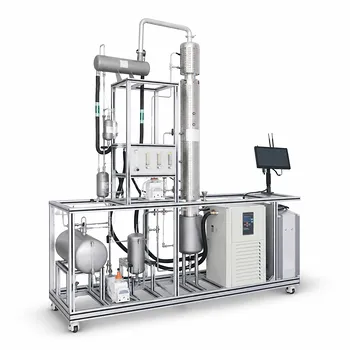
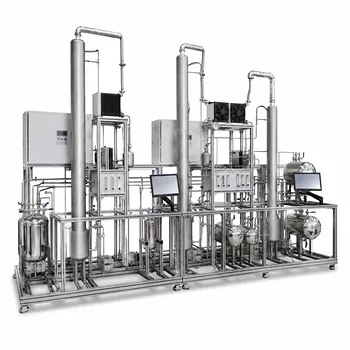
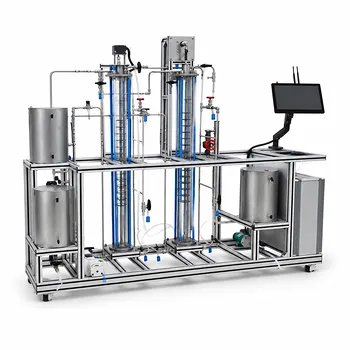
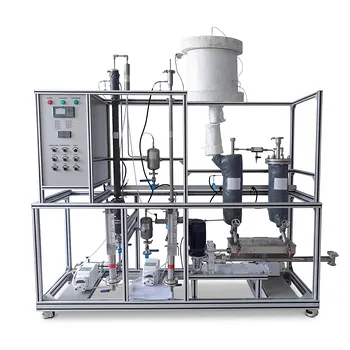
The separation of a multi-component mixture is taught using a single batch distillation pilot plant by turning time into a separation dimension. Instead of relying on a series of dedicated columns in a continuous process, the batch column is run under a carefully controlled transient operation. The mixture is charged, the column is stabilized under total reflux, and then high-purity product fractions are collected sequentially in the order of increasing boiling points. Intermediate transition cuts between pure fractions are collected and later recycled into subsequent batches, giving students a hands-on understanding of cut‑point determination, recycle logistics, and the practical management of batch‑distillation cycles.
A single batch distillation pilot plant teaches multi‑component separation by transforming the problem from “how many columns” into “when to cut.” The whole process hinges on stabilizing the column, using top‑column temperature to decide exactly where one pure component ends and the next begins, and recycling the mixed intermediate fractions to recover value without ever needing a second column.
The Batch Distillation Principle for Multi‑Component Mixtures
Batch distillation exploits the fact that the composition in the still changes continuously over time.
Because the column is operated transiently, a single column can resolve an n‑component mixture into n pure products – something that would require n‑1 columns in a continuous plant.
The process relies on the fundamental difference in vapor pressures of the components.
The most volatile component concentrates in the vapor phase first, so it can be drawn off at the top as a pure distillate while the pot residue becomes progressively richer in the heavier species.
Why a Single Column Works When Continuous Systems Need Many
In continuous distillation, each column provides only one separation “split” between a light key and a heavy key.
A ternary mixture therefore demands two columns arranged in a direct or indirect sequence.
A batch column decouples the separations in time.
You first remove the lightest component completely, then the next, and so on, all from the same piece of equipment.
Operating a Single Pilot Column: The Step‑by‑Step Management
Stabilization Under Total Reflux
The batch is charged into the reboiler, and the column is brought to boiling with the reflux valve fully open – no product is taken.
This total‑reflux condition allows liquid and vapor traffic to equilibrate, establishing a steady temperature and composition profile along the column.
Stabilization ensures that the lightest component reaches maximum concentration in the condenser.
Students learn to watch the top‑column temperature stabilize at the boiling point of the pure lightest component, signaling that the column is ready for product withdrawal.
Sequential Product Collection
Once stable, the reflux ratio is set and the first high‑purity fraction (the most volatile component, A) is collected.
When the top temperature begins to rise, it indicates that the concentration of A in the vapor is dropping – the cut is ending.
The operator then collects a transition cut, a mixed fraction containing both A and the next component B.
After that intermediate fraction is drained, the top temperature will stabilise again at the boiling point of B, and collection of pure B can begin.
This sequential pattern – pure cut, transition cut, pure cut – continues all the way to the heaviest residue remaining in the still.
Handling Transition Cuts
Transition cuts are not discarded.
They are stored in labelled vessels and later fed back into the next batch, either blended with the fresh charge or added during the corresponding boiling‑point window.
This recycle loop teaches mass‑balance closure and the economic reality that no material is wasted in chemical plant operations.
Students must track the composition and volume of each transitional fraction to plan the next batch’s feed and to avoid accumulating impurities over multiple cycles.
Managing Cut Points: Temperature as the Decision Signal
In a pilot plant, the primary tool for deciding when to switch fractions is the dynamic temperature reading at the top of the column.
A constant temperature at a steady reflux ratio tells you that a pure component is being distilled – temperature corresponds directly to the boiling point of that substance at the operating pressure.
Using Top‑Column Temperature to Identify Pure Fractions
The operator monitors a detailed temperature‑time curve.
A flat plateau region signals a pure‑component collection window; a rising temperature slope signals the arrival of the next, less‑volatile component.
Students learn to identify the exact moment to close the product receiver and open the transition‑cut receiver.
This decision‑point is critical: cutting too early loses pure product, cutting too late contaminates the product with the next component, forcing a re‑run of the impure cut.
Recycling Transition Cuts into the Next Batch
The volume and composition of each transition cut are recorded.
When planning the next batch, the stored transition fraction is added at the logical time – for example, a cut containing A and B is introduced once the column again reaches the boiling point range of A.
This hands‑on recycling teaches students to build a complete material balance around a cyclic process and understand how small inefficiencies in cut‑timing can amplify into larger losses if not managed.
Educational Value of the Single Batch Setup
Bridging Theory and Practice
The pilot plant turns textbook concepts like Rayleigh distillation and the Fenske‑Underwood‑Gilliland methods into observable events.
Students can compare the predicted temperature profiles from simulation software with the real‑time sensor data, learning to calibrate models and recognize deviations caused by non‑ideal mixing or measurement lag.
They also gain experience with the physical logistics of switching receivers, labelling cuts, and documenting a batch record – essential skills for process development and scale‑up.
Contrast with Continuous Sequences
The same ternary mixture that would require a direct or indirect two‑column sequence in a continuous plant is separated in one column.
This stark contrast reinforces a key engineering lesson: process selection depends on volume, flexibility, and capital cost, not just chemistry.
For small production volumes or complex separations where product specifications change frequently, a single batch column is often more flexible and cheaper to install than a cascade of continuous columns.
Understanding the Trade‑offs and Common Pitfalls
A single batch column is not without limitations, and teaching those limitations is part of pilot‑plant education.
Time and Throughput Limitations
Because separations occur sequentially, total cycle time can be long, especially for multicomponent mixtures.
Productivity is inherently lower than in continuous operations, making batch distillation unsuitable for high‑volume commodity chemicals.
Thermal Sensitivity and Degradation
The pot liquid experiences the full heating cycle for the entire batch duration.
Heat‑sensitive materials can degrade if held at elevated temperatures for too long, a situation made worse when heavy boilers are concentrated at the end of the batch.
Azeotropes and Non‑Ideal Behavior
Simple batch distillation cannot break azeotropes; it will simply collect a constant‑boiling mixture at that composition.
Pilot plants that handle systems like ethyl acetate‑ethanol‑water require an integrated decanter and a heterogeneous azeotropic distillation loop – a different, more complex teaching module that cannot be done with a simple single‑column batch still.
Cut‑Point Discipline
The largest source of error for students is the timing of the transition cuts.
Cutting too early leaves valuable pure product in the pot; cutting too late contaminates the collected fraction, reducing its purity and increasing the size of the recycle loop.
Mastery comes from repeated practice and careful observation of temperature trends rather than relying on a fixed clock.
How to Maximize Learning with a Single Batch Distillation Pilot Plant
The power of this teaching tool depends on how the activity is structured. Different educational goals demand a different emphasis.
-
If your primary focus is fundamental understanding of vapor‑liquid equilibrium: Run the column at total reflux for extended periods, sample the top and bottom, and compare the measured compositions with VLE predictions from simulation software.
-
If your primary focus is operational skill and cut‑point decision‑making: Emphasize real‑time temperature monitoring; have students manually switch receivers based solely on the temperature‑time trace, then analyse the purity of each cut with a refractometer or GC.
-
If your primary focus is process design and economics: Require students to plan a multi‑batch campaign with full recycle of transition cuts, calculate overall mass balances, and evaluate the energy consumption per kilogram of pure product produced.
-
If your primary focus is comparative analysis of process schemes: First separate the mixture in the batch column, then use simulation to design the equivalent direct and indirect continuous sequences, and discuss why one approach is preferred over the other for a given production scale.
A single batch distillation pilot plant is far more than a piece of hardware – it is a controlled environment where the abstract theory of multi‑component separation becomes a tangible, step‑by‑step operation. Every temperature plateau and every receiver change teaches a lesson about thermodynamics, control, and the art of making pure products from messy mixtures.
Summary Table:
| Batch Distillation Stage | Key Operational Action | Educational Learning Objective |
|---|---|---|
| Stabilization | Operate under total reflux until top-column temp stabilizes | Understand vapor-liquid equilibrium (VLE) |
| Sequential Collection | Collect pure components separated by transition cuts | Master cut-point determination using temperature |
| Recycling | Store transition cuts and recycle into the next batch | Learn mass-balance closure and process economics |
Ready to elevate your chemical engineering curriculum or process training? LABPARK provides state-of-the-art Educational and Vocational Unit Operations Pilot Plants in chemical engineering, bioprocess & biotech, and environmental & water treatment. Specifically designed for universities, research institutes, and enterprises, our pilot systems bridge the gap between theory and practical industrial operations. Contact us today to discover how LABPARK can help you design the perfect training solution for your facility!
Related Products
- Continuous Batch Extractive Distillation Educational Pilot Plant
- Continuous Sieve-Plate Distillation Pilot Plant for Unit Operations Laboratory Education
- Multi-Functional Special Distillation Educational Pilot Plant
- Multi-Modal Distillation Unit Operations Training Pilot Plant
- Green Anhydrous Ethanol Purification Extractive Distillation Unit Operations Training Pilot Plant
People Also Ask
- Wilson vs. UNIQUAC: How to Choose the Right Thermodynamic Model for Your Pilot Plant
- How does the feed thermal state influence distillation pilot plant design and utility consumption?
- Why use non-ideal VLE calculations in distillation pilot plants? Ensure accurate scale-up & purity
- How to Configure a Distillation Pilot Plant? Key Steps for Multi-Mode Setup
- How to Integrate Spectroscopy in Distillation Pilot Plants for Advanced Process Control